If You Always Enjoy It, You're Not Pushing It Hard Enough

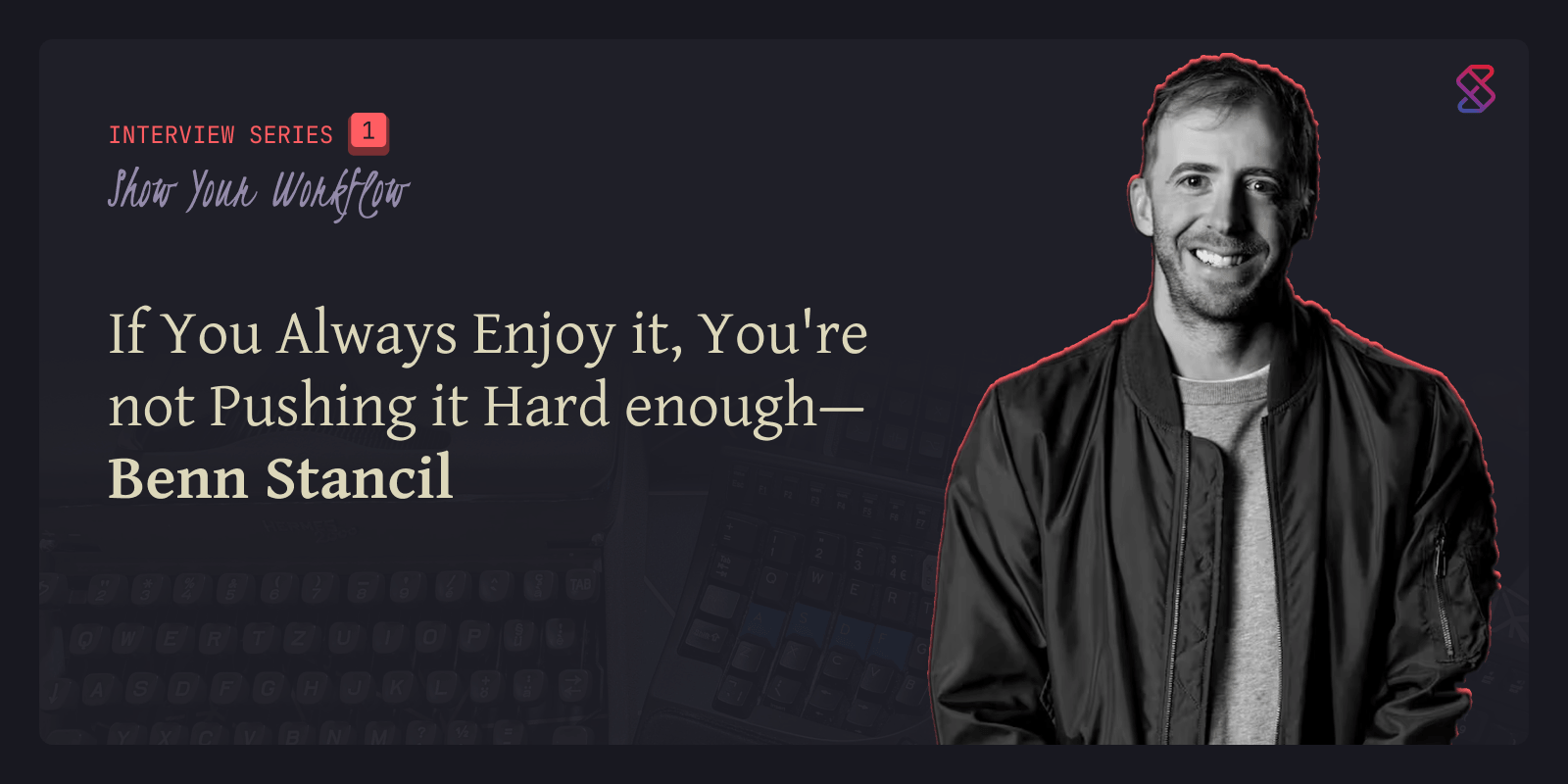
I had the pleasure to discuss and analyze the workflow of none other than Benn Stancil, legendary writer and storyteller in the data space and beyond, who started writing back in 2013 (with a seven-or-eight-year startup break in between). This is the first interview in the series «Show your Workflow», and I couldn’t be happier to start with Benn.
As this series is all about how writers write, how to come up with stories, how to take notes (or not), and each one’s workflow, I asked Benn about the origin of his writing and how it all started with his weekly Friday “let’s fight articles”, how he uses deadlines to push him beyond perfect, how he processes ideas, and how he mastered the art of storytelling with analogies he learned from his talks he gave, converting it into his writing style and voice. We talk about how he uses Sublime Text and Google Docs, and end with approaches on how to start today.
This episode is filled with insights to get better at writing. I hope you enjoy it as much as I did when talking to Benn.
[!abstract] Who is Benn Stancil: An Introduction
Benn Stancil is mostly known as the founder of Mode (a modern BI tool), where he started the company blog and became known as one of the most prolific writers in data. He co-founded Mode in 2013 and worked there until 2024, after it got acquired by ThoughtSpot in 2023. Since then he has been writing weekly on his own Substack.
How Benn Got into Writing
Starting at the beginning of how Benn started writing, he told me that it started by accident, as it so often does. When he started a company called Mode in 2013, there were three of them, and he didn’t build or lead the company as a CEO, so he started writing the company blog posts. That was “pre content marketing”, he mentions, before there was “the obvious playbook of go be an influencer on linkedin”, and he started writing about topics that interested him. It wasn’t about Mode, but about the data space—also because there was no product to write about in the early beginning, he said 😉.
He noticed that people started to like it. After a while though, he was more involved in daily work and building a startup, which meant he didn’t have time to write too much anymore. He “always kind of had this notion that I would get back to doing writing more at some point”.
Much later, around 2021, when he did get back to it, his blog that he started had evolved into something different, “very much just classic company blog”. Much later, around 2021, when he did get back to it, the original Mode blog had evolved into something different, “very much just classic company blog”, so they made a decision to start a new one Substack. Not really deliberately, but because that was the thing you used, and with no fixed plan—the very first posts were still data-team-ish, and it evolved from there:
The first posts that were kind of data posts were a little bit more like things you learn at work, it was a little more like data teamy stuff. But at some point it just sort of evolved into whatever it became.
Now he writes about general topics, what he wants to write about or what he experienced during the week.
If You Don’t Hate It Sometimes, You Don’t Push Enough
He mentioned that, back in college and earlier, he didn’t particularly enjoy writing, and was more drawn to math and other things. So I asked whether more than a decade of writing had changed that:
I mean, I don’t know. You like it sometimes and you hate it sometimes and there are days you’re like it’s fun.
Writing is not like a regular job:
It’s not something you’re like: great, I’m going to sit down at nine and work until five, and I have my nine to five that I just do it. It’s like you’re not doing that, because it doesn’t come out that way.
He also doesn’t want to call it a job, as currently, it isn’t his job to write. He does it because he wants to, but he said something interesting that I believe is so true:
If you always enjoy it, you’re not pushing it hard enough. Like, if you love playing basketball and you’re good at it, and all you do is you’re like: I will play to the point where I no longer just love playing it, then you’re not actually pushing yourself very hard. You have to get to a point where you kind of hate it. That doesn’t mean you’re gonna hate it always, doesn’t mean you’re gonna resent it, it doesn’t mean you’re gonna walk away from this thing being like: oh my god, I can’t do this anymore. But I think to make something good, you have to hate it sometimes.
As an example of basketball:
I’m sure LeBron loves playing basketball, I’m sure various great writers that we all like love writing things I’m sure there are days they hate it, and I think they have to. I think that’s why they’re the best ones.
Having a Schedule, a Deadline, Is the Most Important Tool
On that note of “whatever it became”, I asked him how he got his schedule fixed (he posts every Friday), and how he found his writing voice.
Benn said clearly that deadlines are something useful to have. It’s the thing that gets the thing done. Later he added, it’s even more important when you start out. You might think that you don’t have something interesting to say, and you never feel ready to publish. That’s why you need to just ship it a handful of times: you need to have some standard of quality and expectations, but otherwise, just ship.
Many people have this:
They have an idea and it’s not sort of fully baked, and because they have no real deadline or timeline to hit, it always feels like it’s not quite ready it’s not ready to be released yet.
In the end, he thinks, you can’t just wait until it’s perfect.
[!tip] His deadline arrived from a joke, “It’s Friday, let’s fight”
After he started his own Substack, he once posted The case against SQL formatting. The whole post was a little bit of a joke, he said. Because of that, he tweeted it on Twitter as a joke: “it’s friday let’s fight”, not really a serious thing, but that we can fight about SQL formatting (a thing data people do 😉). ![[tweet-started-it-all.png]] Someone at the company kind of liked that Friday fun fight angle, and it also fit Benn a little bit as a character, a less serious thing, talking about a specific topic. And then it just became kind of an accidental thing, and he started posting stuff on Fridays, and at some point, that was kind of his deadline for the Friday fights.
Benn’s Process of Idea Creation
When I asked Benn how he comes up with these refreshing and interesting new ideas he has every Friday, he said the ideas roll around with him during the week. What’s sometimes the hardest part is turning them into a story (more on that below).
Usually he takes them with him and they are very messy:
you have some working things in your head that are usually a mess. You have to sort of run around in the world with those things in your head and they run into things. It’s like you will find all these connections, because you have something sort of in the back of your mind, it will suddenly connect to a bunch of things that are not obvious connections.
And so ideas get formed really that way:
It’s a thing that exists that you sort of roll around in the world, and it picks up little pieces as it goes, and eventually something kind of interesting comes out of that.
Random Strings Pulled Together
Another speciality of Benn is to have lots of links to random things as part of his blogs. Some hate it, others love it (I love them!). He said something interesting, as many ask him if he adds them at the end. He says no. It’s all part of the writing process.
He might think of a song, search for it on YouTube, and watch it. While watching, he gets a completely new emotion, or idea, that will fit back to the topic. And sometimes, these short distractions or links that come to mind are influencing the story. So besides being added while the idea evolved, they even influence the storyline itself.
The Art of Storytelling of Benn
If you haven’t read Benn’s articles, you are missing some of the best storytelling in the whole data space, and beyond. Once he has come up with an idea, added links, and talked with people about it, he finds analogies in real life.
The storytelling is the hardest part, he says. The worst is when he has a lot of ideas with “here’s a lot of notes”, but no story, no connected thread. Then it takes him much longer, and he might not find a story to tell.
Some other times though, the story emerges naturally, and it’s a point of relief. It’s always different though. Sometimes he has the beginning he really likes, which carries the point. Or other times he has a paragraph that is fixed and great, and then he finds the story around it.
Benn’s Trick to Tell a Good Story: Finding or Setting Up an Analogy
A great story for Benn is having a great analogy. Finding a good intro is really, really hard, he says.
Then he kind of “cheats”: he finds an analogy from Batman, basketball, or whatever comes to mind, and the analogy starts to drive the whole point he wanted to make.
This way of storytelling emerged for him from the many presentations he did, and swapped over to writing. In his decks there is a talk track, the thing he is saying, and the slides are a kind of background commentary: a point that is analogous to Batman simply gets a slide of Batman next to it. And once one piece of the analogy fits, “you tacked the points onto the analogy rather than the analogy onto the points”—which is what makes it look so tight and clever.
[!note] This reminds me of Derek Sivers
This reminded me of Derek Sivers too: when you have writer’s block, just add [[constraints]]. In music, say you want to play with only two chords, or only two instruments, and suddenly your creativity is flourishing. You have clear boundaries you can play with, instead of having an open end, where everything is possible, and it is very hard for the mind to start or finish anything. I think that’s a little bit what’s happening here too: if you start with Batman, the figure, you start with a constraint.
Some say, when they read, “get to the point”, because he writes so indirectly through an analogy, but for him, “there’s no fun in that”, and he’s “not trying to make an argument in court”.
Also because he has a deadline on Friday, he needs to get it done every Friday, and that’s where the mood influences the piece as well. I agree, and I call it [[Writing from The heart|Write from the Heart]]: if you feel angry or emotional, that is felt in the writing, and it can give the piece the needed elevation or realness.
Workflow: The Process, The Note-taking
This series is also about behind the scenes, about tooling, text editors and workflow each uses. We discuss Benn’s process and what he uses below.
The Writing Tools: Google Docs and Sublime
He typically starts by just writing ideas in Sublime Text. He likes it: it’s distraction-free, undecorated, so he can just focus on the text at hand, and write without formatting, grammar, or errors in mind. Once there’s a bit more material, he moves it into Google Docs and works through it there, adding ideas, paragraphs, and links, with some docs staying open (and growing to 10 pages) for a very long time.
He just starts writing, whatever comes to mind or happens: bullet points, conversations, and paragraphs.
The Publishing Workflow
Ideally he has it completely done in Google Docs and just copies it over to Substack, but usually he still proofreads it a couple of times there and fixes small last-minute things. He doesn’t use the Substack editor for anything material.
Why Not Obsidian?
I asked Benn why he didn’t use Obsidian as it seems that he is big on connections, and that they are a big part of his writing style. He said that Google Docs is good enough. He tried Obsidian-typish notes with connections, but it never stuck.
He even tried to vibe-code such a thing himself, something that “reads your writings and can kind of present you related ideas as you do it” (sounds similar to Karpathy LLM Wiki), but usually it turned out to be “more of a distraction” than he wanted it to be, and on top of that, he’s “not convinced that there isn’t a good way to do that somehow”.
He also has “a very unproven theory” for why this kind of connection-finding is exactly where AI struggles:
The things that are often most interesting are disparate connections between things that don’t obviously have a connection (more on that below).
He instead has this kind of “serendipity type way”, “where you run into various things around the world”. In a way, it’s applying the Obsidian-type notes more to real life.
Also organization-wise, his ideas are all over the place, rather than in one note-app:
Currently on my desktop I have two lists of blog post notes and a Sublime thing, there is a list in an Excel sheet somewhere, a Google Sheet somewhere, there is obviously a bunch of half-written drafts and Google Docs.
Why Benn Does Not Use AI Tools for Writing
When asked how he uses AI as a tool, he said he does not use Grammarly, and he doesn’t give posts to Claude or ChatGPT for edits. The one exception: Google Docs’ built-in AI-generated grammar suggestions (the blue squigglies), those he does use. But what he uses a lot is ChatGPT for research, as an enhanced Google to explain a thing in history, or why it happens.
The other big use case is for Thesaurus kind of questions: “I am trying to figure out a word to describe X”, where you “can give it two words and be like: something like this”.
He is very intentional about not using Grammarly, because of the way AI wants to compress the writing. He said GenAI generally tries to make the writing tight. It hates meandering, but Benn likes meandering.
He already hated compressing before AI. E.g., when they collected ten important statements about the company that they came up with during a brainstorming session with the team, the sticky notes sessions, and then tried to compress them into 1-2 sentences of a mission statement. In the end, the outcome was always to his dissatisfaction.
Where Does Benn Get His Inspiration From?
I asked him where his inspiration came from, and if he believes that to write “interesting things”, you have an interesting life. Would you agree?
He thinks you need to be exposed to “stuff”. His initial ideas come from conversations, being out there. He says you can’t start with the objective of writing to generate “lead flow for potential investments”. He told me about a VC he knows who writes infrequently, but when he does, people care. That VC gets a bunch of people reaching out asking how to write a blog like that for lead flow. And his (and Benn’s) take is:
If you’re starting from the objective of: the point of this is to create leads, or the point of this is to generate people clicking on my company website then you sort of already lost the plot , just write interesting things on its own.
Interestingly, Benn thinks people:
Slightly overrate the point of having a point.
You don’t have to say something that’s never been said before, you just have to tell it in an interesting way. And, Benn also said, it must be fun (sometimes, as we heard above).
Benn’s Very Unproven Theory for Why AI Struggles with Writing
He makes the example of the board game Codenames: you give your team a one-word clue and a number, and they have to find the cards it links. “Hogwarts, four” obviously covers magic and school, but it might also cover train, because of the Hogwarts Express. The point is that the words are
associated in a weird way you wouldn’t necessarily associate magic and train.
That, he thinks, is roughly how creativity works in general:
You have exposure to some particular thing and then you have some idea, like whatever business thing you care about, and you make those connections. You want to talk about data stuff, but you also know a lot about, I don’t know, camping. You find this connection between these two things, where these things are not at all related, but it tells an interesting story.
Every human has a “relatively sparse knowledge of the world”, and Benn says this is a lot of what creativity is:
People smashing together very strange things, because their experiences are like this eclectic collection of things that aren’t obviously all tied together.
[!note] The Opposite way, of “saying something that sounds smart”
“Making a smart point” or “saying something smart” didn’t work for him, because you can’t see these interesting connections between things that don’t obviously exist. So having an interesting life is helpful for that.
Finding Your Writing Voice
In that regard, as finding your writing voice is inevitable and important for you as a writer, I asked how he found his “Writing Voice”.
Benn said it just emerges: “you probably don’t go in being like, this is the voice I want to have, and now you do it”. His voice emerged in Slack channels, where he wrote paragraphs upon paragraphs. He didn’t say it exactly like that 😉, but these were essentially reps of just him writing to inform his peers at work. Doing that often, you might find ways that work better, and things that don’t.
Don’t Strip Out Too Much of the Story
He also made an interesting point, one that a lot of writers face: if you strip out too much of the story and your voice, all you’re left with is having to say something that is, by itself and in plain language, original, and “it’s really hard to say original stuff”.
Reduce a novel to a bullet list of plot points and those points are pretty unoriginal, because “there aren’t that many stories you can tell”. The interest comes from how you tell it.
Same with databases: the bare bullets are hard and dry, and that’s where his writing style with analogies and making a story really works.
What Approach Would You Suggest to Someone Starting Out Today?
Before we wrapped up, I asked him one last question, about what he would suggest for someone starting to write today.
He gave three clear pointers:
- Have deadlines, which is critical especially early on
- Your motivation has to be pure. You kind of need to want to do it (like a musician who likes to play the instrument). Otherwise, do something else. And keep your ego out of it. Readers come for the ideas, not for you: “you’re not always the main character”.
- And the writing is not the bullet points, it’s filling things in between, filling in the text between the bullet points. Like the stand-up Slack messages he had to write to the team, he enjoyed them.
I hope you enjoyed this typed-out interview with Benn Stancil as much as I did learning from him in our conversations. Benn is an exceptional writer, and seeing his process and workflow of how he writes is pure joy to me. I hope I could bring some of this joy over, and that, if you are a writer, you could learn something.
Please follow him on all his socials, and subscribe to his Friday Fights at Benn’s Substack. Also check out his latest article and learn more about How to have ideas, or How to find insights.
- Andrew Sean Greer says on Write Better Stories in 72 Minutes: “highly recommend[s] life experiences,” ideally through an interesting day job.

 点赞
点赞 收藏
收藏 点踩
点踩 分享
分享