
Fourteen Days to Object: How AI Data Centres Outrun Their Neighbours
'%20fill-opacity='.8'%20d='M3.256%203.913a3.083%203.083%200%200%200-.003%204.397L8%2012.998l4.743-4.684a3.085%203.085%200%200%200%20.001-4.4c-.6-.593-1.4-.914-2.233-.914a3.17%203.17%200%200%200-1.91.635L8%204.087l-.601-.452A3.17%203.17%200%200%200%205.489%203c-.834%200-1.634.321-2.233.913m10.19%205.111-4.748%204.69a.996.996%200%200%201-1.397%200L2.549%209.02a4.083%204.083%200%200%201%20.004-5.82A4.17%204.17%200%200%201%205.488%202c.907%200%201.787.29%202.512.835A4.17%204.17%200%200%201%2010.51%202c1.093%200%202.146.422%202.936%201.202a4.085%204.085%200%200%201%200%205.822'%20/%3e%3c/svg%3e)
'%20stroke-opacity='.75'%20stroke-width='1.5'%20stroke-linejoin='round'/%3e%3c/svg%3e)

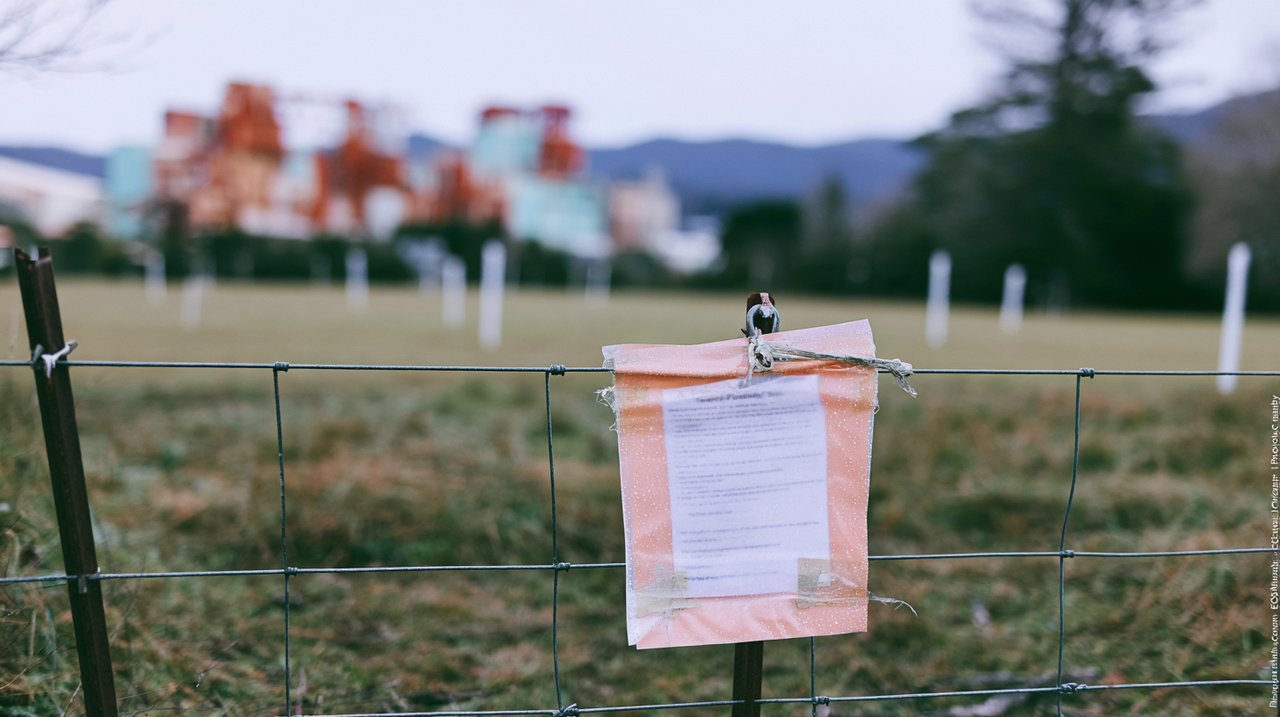
On 27 August 2026, Latrobe Council in north-west Tasmania released a development application it had been sitting on while it waited for the applicant to answer questions. The document described a 52-megawatt artificial intelligence data centre on the site of the old paper mill at Wesley Vale, in an industrial estate called Mill Park. A data hall of 2,689 square metres. Twenty adiabatic cooling units and twenty chillers. Forty diesel backup generators. Seventy jobs during construction, twenty once the thing was running.
Residents were given fourteen days to respond. Submissions close on 9 September.
Four days after that application became public, on 31 August, a parliamentary e-petition closed on the Tasmanian House of Assembly website. It had been open since 22 June, sponsored by Cecily Rosol, the Greens member for Bass. It asked Parliament to direct the government to impose an immediate moratorium on all non-complete AI and data facilities in the state. When it closed, it carried 10,035 signatures. It was tabled in the House on 2 September, one of the largest e-petitions in the history of Tasmanian parliamentary democracy.
Set those two numbers next to each other and you have the entire problem in miniature. Ten thousand and thirty-five people spent ten weeks assembling a demand to be consulted. The people who live within earshot of the actual proposal got a fortnight to write a letter about it. The petition is not a planning instrument. It has no legal force. It cannot stop a single generator being installed. It is, in the most literal sense, a request for permission to have an opinion that counts.
What Ten Thousand Names Actually Asked For
The petition text is worth reading closely, because it is not the blunt refusal that the word moratorium implies. It asks for five specific things, and every one of them is a piece of ordinary regulatory plumbing that most industrialised jurisdictions already possess for facilities of comparable scale.
It asks for planning legislation that addresses the environmental and social impacts of AI facilities. It asks for a public register tracking the energy and water these operations consume. It asks for parliamentary oversight of any facility drawing more than 50 megawatts. It asks for guarantees of lasting local employment. And it asks that ordinary electricity customers be shielded from price rises caused by connecting AI facilities to the grid.
The moratorium is the lever, not the goal. The petition proposes a pause that ends when those five instruments exist. That is a substantively different proposition from a permanent veto, and the distinction matters enormously for how you judge what the signatories were doing.
Tabatha Badger, the Greens member for Lyons and the party's spokesperson for science and information technology, framed the demand in terms of parliamentary process rather than opposition to computing. Speaking after the petition was tabled, she called for a moratorium on new AI and data facilities until there is proper regulation and until Parliament has oversight of the energy and water that will be committed to them. Rosol, tabling it, made the point that the community had been clear about its concerns and that the government had proceeded without consulting them or putting guardrails in place.
Behind the language is an observation about sequence. The facilities are arriving first. The rules, if they arrive at all, will arrive second, and will apply to whatever has not yet been built.
The Arithmetic of a Small State
Australian Bureau of Statistics figures put Tasmania's estimated resident population at 579,110 at the end of December 2025. Against that denominator, 10,035 signatures is roughly 1.7 per cent of every man, woman and child in the state.
Proportion is the only honest way to read a petition from a small jurisdiction, and it is the reading that almost never happens when these numbers travel. Scaled to the United Kingdom, 1.7 per cent would be something over a million signatures. Scaled to the United States, close to six million. Scaled to New South Wales, around 145,000. Petitions of that magnitude do not get filed away. They generate select committees.
The comparison inside Tasmania is equally instructive. The largest e-petition the House of Assembly had previously seen came in 2020, supporting the End of Life Choices Bill, and gathered 11,699 electronic signatures alongside 1,383 on paper. That was a petition about assisted dying, an issue with decades of organised advocacy behind it, deep personal stakes for thousands of families and sustained media attention across the entire state.
The AI data centre petition got to 10,035 in ten weeks, on a subject that barely existed in Tasmanian public conversation eighteen months earlier, driven by a minor party. It drew more than 4,200 signatures in its first week. Whatever else that tells you, it tells you the concern is not confined to the handful of postcodes that would host the buildings.
Four Hundred and Forty Megawatts in a Hydro State
The proposals that triggered all this belong to Firmus Technologies, a Singapore-headquartered company run by co-chief executives Tim Rosenfield and Oliver Curtis. It has three Tasmanian sites in play, representing a stated investment of around 2.1 billion dollars.
The first, at St Leonards outside Launceston, is 104 megawatts and already under construction, with power contracted from Aurora Energy and an expected start in early 2027. The second, at Bell Bay on the site of the former pulp mill, is 288 megawatts and was approved with conditions by George Town Council on 25 August 2026. The third is Wesley Vale, at 52 megawatts, the one Latrobe residents were given a fortnight to comment on.
Together that is around 440 megawatts of continuous industrial load in a state whose electricity system was built for aluminium smelting, zinc refining and a few hundred thousand households. An energy consultant told the ABC in June that the three sites combined would represent roughly 20 per cent of Tasmania's total energy consumption, more than the combined demand of every household in the state. Firmus would become, comfortably, Tasmania's largest single power user.
Those are the numbers attached to the buildings. The number attached to the grid arrived on 4 September, when the ABC reported that Hydro Tasmania is assessing a request from Firmus for a long-term contract to supply 450 megawatts across the three sites. The company currently runs on a three-year contract for the 104 megawatts that powers St Leonards. What it has asked for now is different in kind: a standing commitment rather than a short one, at a volume Hydro puts at up to 30 per cent of Tasmania's current electricity consumption, comfortably ahead of Bell Bay Aluminium, the state's present largest user, at 355 megawatts. The two percentages describe different things and are not in conflict. The June estimate of roughly 20 per cent was a consultant's read of what the three sites would be likely to consume. The 30 per cent figure is Hydro's read of the contract now sitting on its desk.
Hydro says it expects an outcome by the end of 2026, and it has set out the four questions it is weighing: whether Firmus is financially stable, what new renewable generation would have to be built to serve the load, whether the arrangement is profitable for Tasmania, and whether it is consistent with Hydro's responsibilities to Tasmanians. Alongside those it said something more consequential than any of them. Tasmania's energy system is currently in balance, generating about what the state consumes, and a request of this size can only be met by building new wind and solar. Hydro would not build or fund it. Firmus would contract directly with third-party developers, or contract with Hydro and have Hydro firm the intermittent output.
That is a decision the planning system neither makes nor reviews. Two councils assess two buildings against two planning schemes, while a state-owned company decides, on commercial terms and to its own timetable, whether there is 450 megawatts to sell.
Tasmania is not a bad place to put a data centre, and it is important to say so plainly. The grid is dominated by hydroelectricity, the climate is cool enough that mechanical cooling runs less often, industrial land at decommissioned mill sites is available and serviced, and the state government has actively marketed itself into exactly this business. The Office of the Coordinator-General, the arm of the Department of State Growth responsible for attracting major investment, lists data centres as an emerging sector opportunity and offers case management to any project involving at least five million dollars of private investment or twenty-five full-time jobs. Australia's National AI Plan, published on 2 December 2025, identifies sovereign digital infrastructure as a strategic priority and sets an explicit objective of attracting hyperscale capacity onshore.
None of that is secret. What is not public is which other proponents the Office of the Coordinator-General is currently talking to, at what scale, on what sites, or how far those conversations have progressed. That is the specific complaint the Greens raised alongside the petition: that while Wesley Vale goes through a council assessment with a fourteen-day comment period, other proposals are being developed in a process with no comment period at all, because there is nothing yet to comment on.
Two Degrees on the Ground
The environmental case the petitioners are making rests partly on a body of research that is very new, and it deserves to be represented accurately rather than inflated.
A preprint posted to arXiv in March 2026 by a group of researchers including Andrea Marinoni, Erik Cambria, Weisi Lin, Mauro Dalla Mura, Jocelyn Chanussot and Benjamin Horton examined satellite-derived land surface temperature data across multiple decades for regions surrounding AI data centres worldwide. Their finding, stated in those terms, is that land surface temperature increases by 2 degrees Celsius on average after the start of operations of an AI data centre, producing what they call the data heat island effect. They estimate that more than 340 million people could be exposed to these localised increases.
Two qualifications matter. Land surface temperature is not air temperature, and the two diverge substantially, particularly over hard surfaces on sunny days. And a satellite study of this design establishes an association between the commencement of operations and a measured warming signal; it cannot fully isolate the data centre from the industrial estate, road network and land clearing that typically arrive with it. This is a preprint, not yet through peer review.
What it does establish is that the warming signal is measurable, consistent across sites and large enough to matter. For a facility at Wesley Vale sitting in an agricultural district, and for a facility at Bell Bay less than two kilometres from the small community of Rowella, that is a question worth an answer before approval rather than after. Tasmania's planning scheme does not currently require anyone to ask it.
The Water Nobody Had Agreed to Supply
The water question in Tasmania produced the single most revealing document in this entire episode, and it was published by accident.
In July 2026, the ABC reported that Firmus had inadvertently published internal notes on the frequently asked questions page for its Wesley Vale facility. Among them was a line explaining why the company had not yet disclosed where its cooling water would come from. It planned to draw on Tasmanian Irrigation, the state-owned agricultural water scheme, and the note read: “We do not want to highlight this yet, as they are yet to agree to supply us.” The content was deleted after the ABC made enquiries. Firmus described it as internal information that was inadvertently published.
Tasmanian Irrigation responded that its legislative framework is set up to enable the supply of water for agriculture and hydrogen production. Neil Grose, chief operating officer of TasFarmers, put it more directly: irrigation water is for irrigating farmland. By the time the development application was released in August, the irrigation plan had gone. The company now proposes rainwater capture supplemented by trucked water in extreme dry periods, with evaporative cooling engaged only when ambient temperature exceeds 26 degrees. Firmus has said the Wesley Vale facility at full capacity would use about as much water annually as a restaurant.
That may well be true of the site. It is not the only relevant question, and a preprint posted to arXiv in June 2026 by Basit Akinade, Amobichukwu Amanambu, Jonathan Frame and Shaolei Ren explains why. The paper formalises what the authors call the Water and AI Feedback Loop and introduces a Water Consumption Impact index designed to measure burden at the level of the community utility rather than the facility. Applied across ten United States locations, the index produced results ranging from 0.2 per cent to 134 per cent of host capacity.
That range is the finding. A data centre's water demand is not meaningfully described by its absolute volume. It is described by the volume relative to the system that has to supply it, and in the worst case in the sample, a single facility's requirement exceeded the entire capacity of its host utility. A restaurant's worth of water is a trivial number in Hobart and a considerably less trivial one in a rural scheme during a dry February.
The aggregate picture comes from a third preprint, posted to arXiv in January 2026 by Aadi Patel, Nikhil Mahalingam and Rusheen Patel. Drawing on International Energy Agency projections that global data centre electricity demand may rise from roughly 415 terawatt hours in 2024 to nearly 945 by 2030, the authors project that United States AI servers alone will consume an additional 200 to 300 billion gallons of water annually and generate 24 to 44 million tonnes of carbon dioxide equivalent by 2030. These are projections built on demand forecasts, with all the fragility that implies, and the authors are explicit that cooling design and siting are the dominant variables. Advanced cooling can cut cooling energy by up to half, they find, and locating in low-carbon, water-secure regions can nearly halve the combined footprint.
Which is, read fairly, an argument for putting these facilities in Tasmania. It is also an argument for deciding deliberately how many, where, and on what terms.
A Planning Act Written in 1993
The instrument George Town Council used to assess a 288-megawatt AI facility was the Land Use Planning and Approvals Act 1993. It was drafted before the commercial web existed.
Mayor Greg Keiser, announcing the approval, said the council could not see any other grounds to do anything more than approve it. That is not evasion. It is a precise description of how a discretionary planning decision works. A council assesses an application against the criteria in the scheme. If the application satisfies them, refusal is not lawfully available, regardless of how many residents object or how novel the use is. Cumulative regional impact, statewide water allocation, grid economics and social licence are simply not criteria in the scheme.
Peter Freshney, mayor of neighbouring Latrobe, said the same thing about the legislation from the other side of the argument: the current scheme is not fit for purpose for evaluating projects of this scale. Two mayors from two councils assessing two facilities for the same company reached the same conclusion about the tool they were given.
Tasmania does have larger instruments. A Major Project declaration by the Minister for Planning triggers assessment by a panel of the independent Tasmanian Planning Commission alongside subject-matter experts, taking in matters a single council cannot reach. A Project of State Significance declaration under the State Policies and Projects Act 1993 goes further still, requiring an order approved by both Houses of Parliament. Latrobe Council has discussed asking for the Wesley Vale proposal to be declared a major project. Neither pathway has been triggered for any of the three Firmus sites.
There is now a layer above all of it, and the timing of that layer is the point. On 15 July 2026 the Prime Minister, Anthony Albanese, announced that the federal government would legislate mandatory Australian Standards for artificial intelligence, and established an Office of AI within the Department of the Prime Minister and Cabinet. New large AI data centres would be required to underwrite or supply their own power and to minimise their water use, with the stated expectation that facilities of that scale be net generators in energy terms rather than net consumers. On 26 August 2026 National Cabinet endorsed the Commonwealth's plan to legislate national AI laws and mandatory standards for large data centres. It was the first time all nine Australian governments, the Commonwealth and the eight states and territories, had committed to a common set of mandatory standards. Tasmania is one of the nine. The endorsement came one day after George Town Council approved a 288-megawatt facility under an act written in 1993.
The standards, as outlined, run to three domains. On energy, large operators would act as net generators, adding at least as much to the grid as they draw, pay the full cost of transmission and distribution connection, adopt efficiency measures, and offer demand flexibility to support grid stability. On water, they would minimise consumption, maximise efficiency and fund the additional infrastructure their facilities require. On land use, they would be steered towards appropriate locations, made to protect competing uses such as housing, and required to engage the communities that host them. They are aimed at large-scale facilities, co-location sites, hyperscale operations and large-scale AI compute centres, not at small edge or on-site enterprise data centres. They would sit on top of state planning regimes rather than replace them, so a developer would have to satisfy both the national standards and the usual state and local approvals. And they are not law. The Commonwealth has said it intends to legislate in early 2027, and the detailed specifications are still being written.
Then there is the appeal window. Objectors to the Bell Bay approval have fourteen days from formal notification to lodge a challenge with the Tasmanian Civil and Administrative Tribunal, a window that, counted from the approval on 25 August, closes in the first week of September. No appeal has been confirmed as lodged. Anne-Marie Bastian, president of the Environmental Awareness Association, called it a ludicrous time frame, with estimated legal costs of 20,000 to 50,000 dollars. Fourteen days to raise the price of a small car and instruct counsel, against a company with 2.1 billion dollars of announced investment.
The asymmetry is not a conspiracy. It is what happens when a process designed for a service station is applied to a facility that will draw a fifth of a state's electricity.
The Room Where the Conversation Happens First
Every planning system has a stage before the planning system. In Tasmania it is called strategic project facilitation, and it is run out of the Office of the Coordinator-General.
There is nothing sinister in the concept. Investment attraction agencies exist everywhere, and companies do have legitimate commercial reasons to keep site selection confidential while they negotiate land and power. A proponent who announces a shortlist watches land prices triple. That is a real cost and a real justification.
But the confidentiality has a second effect that is rarely acknowledged. By the time a project surfaces as a development application, the proponent has typically secured land options, negotiated grid connection, engaged consultants, commissioned technical studies and, frequently, obtained government statements of support. The community's fourteen days begin at the point where the commitment is already substantially sunk. Consultation is technically available and practically vestigial.
International experience shows how far this can be pushed. In Pennsylvania, Spotlight PA obtained at least eight non-disclosure agreements signed by township supervisors, county commissioners and state cabinet officials with data centre developers including Amazon Web Services, Vantage, Quality Technology Services and Talen Energy. Most did not define what counted as confidential. Melissa Melewsky, media law counsel for the Pennsylvania NewsMedia Association, observed that any time a private company tries to limit what a public official can say about public business, that is a red flag. The reporting produced a legislative response, with a bill conditioning tax exemptions on a pledge not to use non-disclosure agreements passing the state House 171 to 31, and an executive order prohibiting such agreements for data centre projects.
There is no reporting that Tasmanian officials have signed non-disclosure agreements over these projects, and it would be wrong to imply otherwise. The point is structural. Where a state agency's function is to attract investment, and its method is confidential case management, the default setting is that the community learns last. Tasmania does not need American-style secrecy agreements to arrive at the American-style outcome, because the outcome falls out of the sequence rather than the paperwork.
What Happened in Zeewolde, Cerrillos and Prince William
Communities elsewhere have won these fights, and how they won is more instructive than that they won.
In the Netherlands, Meta proposed what would have been Europe's largest data centre at Zeewolde, having acquired roughly half of a 166-hectare site. Local opposition alone did not stop it. What stopped it was that part of the land belonged to the Dutch state, which meant the sale required parliamentary approval, and the Senate voted to block that sale pending a national spatial planning vision for data centres. Meta abandoned the project in 2022. The lever was a national land ownership question that happened to sit in the path of the project.
In Chile, Google's 200 million dollar data centre at Cerrillos in Santiago would have used 7.6 million litres of potable water a day drawn from the Central Santiago aquifer in a country fifteen years into drought. In February 2024 an environmental court partially reversed the permit, requiring the assessment to incorporate the effects of climate change on the water component and contemplating a possible modification of the server cooling system. Google switched its design to air cooling and restarted the process. The lever was a specialist environmental court with jurisdiction to review the adequacy of an assessment.
In Virginia, the Prince William Digital Gateway involved rezoning around 1,700 acres. In August 2025 Circuit Court Judge Kimberly Irving voided the rezoning, not on environmental grounds but because the county had failed to comply with statutory advertising requirements before the December 2023 hearings; the first of two required newspaper notices was never actually published. The Virginia Court of Appeals affirmed in March 2026, and the QTS affiliate behind the project subsequently withdrew, ending it. The lever was a procedural notice rule.
In Memphis, the Southern Environmental Law Center appealed the Shelby County Health Department's air permit for fifteen methane gas turbines at xAI's data centre on behalf of the NAACP's Memphis branch and Young, Gifted and Green, arguing that the department had wrongly treated the turbines as exempt non-road engines under the Clean Air Act and had thereby allowed installation without written approval, public notice or pollution controls. The lever was federal air quality law.
In Ireland, the constraint is grid physics translated into regulation. Central Statistics Office figures show data centres consumed 7,663 gigawatt hours in 2025, 23 per cent of all metered electricity in the state, up from 5 per cent in 2015. EirGrid has not been offering new data centre connections in the Dublin region, a position understood to run to at least 2028, while the Commission for Regulation of Utilities has reworked large energy user connection policy around location, on-site generation and demand flexibility. The lever was the transmission system operator's technical judgement.
Land title. Environmental courts. Newspaper advertisements. Air permits. Grid capacity. Not one of these communities won by objecting. Every one of them won because some pre-existing instrument, usually designed for something else entirely, happened to have teeth. Tasmania's petitioners are asking for an instrument that is actually designed for the purpose, in advance, rather than hoping one turns up.
The Case for Saying Yes
The strongest version of the argument against the petitioners is considerably better than its opponents usually allow, and it has four parts.
The fiscal part is the most concrete, and Loudoun County in Virginia is the demonstration. The county states that data centres generate almost half of its property tax revenues, that for every dollar in services the county provides to data centres it receives twenty-six dollars in tax revenue, and that without the industry its real property tax rate would likely exceed one dollar per hundred dollars of assessed value against a current rate of 80.5 cents. Data centres contributed 16 billion dollars to a 41 billion dollar real property portfolio in 2024, at assessed values per square foot roughly triple other commercial uses. That revenue funds schools. It is not a rounding error, and it is not hypothetical.
The strategic part is that compute is becoming infrastructure. If Australia processes its health records, its defence modelling and its financial system on servers in Virginia and Singapore, it has outsourced a category of national capability that it cannot readily repatriate. The National AI Plan's emphasis on sovereign digital infrastructure follows from that, and hosting in a jurisdiction with a hydro-dominated grid is a better climate outcome than hosting the same workload on a coal-heavy one.
The systems part is the least intuitive and the most serious. A data centre concentrates load that would otherwise be distributed across thousands of premises. A concentrated load is visible, meterable, and negotiable. It can be required to report consumption, to shift timing, to fund transmission, to sign firm renewable contracts. The same computation spread across a million individual devices is regulable by nobody. Concentration is what makes accountability technically possible. Firmus has pledged to build two megawatts of new renewable generation for every megawatt it consumes, which is a commitment no diffuse load could ever be asked to make.
The engineering part is that cooling design is genuinely improving. Closed-loop liquid cooling recirculates a fixed charge of coolant rather than evaporating water continuously. The Firmus design at Wesley Vale engages evaporative cooling only above 26 degrees ambient, which in north-west Tasmania is a small number of hours a year. Yesterday's water figures do not describe today's plant.
And the political part, which the petitioners should take most seriously, is that moratoria have a way of not ending. The Rockefeller Institute of Government has tracked a spreading pattern of local pauses across the United States, from Groton in Connecticut to Peculiar in Missouri to Bangor in Maine, and municipalities in New York including Lysander, which adopted a six-month moratorium in May 2026, and the Town of Perth, which passed a one-year pause in June. Around fourteen states have considered moratorium legislation, with thresholds ranging from one megawatt to a hundred. A pause pending regulation is only meaningful if the regulation actually gets written. Otherwise it is a veto wearing a deadline.
Where the Case for Yes Runs Out
Take them in order.
The Loudoun figures are real, and they are also a warning rather than a model. A county deriving half its property tax base from a single industry has not diversified its economy, it has concentrated its risk, and the concentration is in an industry whose capital cycle is measured in a few years and whose demand depends on a technology thesis that may not hold. More to the point, the Loudoun bargain is not on offer at Wesley Vale. Twenty ongoing jobs is the number in the application. Tasmania does not levy a personal property tax on computer equipment the way Virginia does. The revenue mechanism that produces the Loudoun outcome does not exist here, so citing Loudoun as a reason to approve a Tasmanian facility is citing a fiscal system the state has not got.
The sovereignty argument is sound and does not resolve anything. Sovereign compute capability is a national interest; where a specific building goes, how much water it draws in a dry summer and who pays for the transmission upgrade are local questions. Answering a local question with a national one is a category error, and it happens constantly. Firmus is a private company selling AI tokens on a commercial market. Its facilities may serve sovereign capability. That is a reason to have a national siting framework, not a reason for Latrobe Council to approve an application in fourteen days.
The concentration argument is the best one, and it is self-refuting in the current arrangement. Yes, concentrated load is regulable. That is exactly why the absence of regulation is the problem rather than an argument against pausing. The petition asks for a public register of energy and water consumption and parliamentary oversight above 50 megawatts. Those are precisely the instruments that make concentration an advantage. Without them, concentration delivers all the exposure and none of the leverage. A pledge to build two megawatts of generation for every one consumed is worth a great deal in a supply contract and considerably less in a press release, and the distance between those two documents is most of what the petition is about.
The cooling argument is true and incomplete. Closed-loop and adiabatic designs do reduce water use, and the 26 degree threshold is real. But water is only one vector. The data heat island preprint measured land surface temperature, which responds to waste heat rejection regardless of whether the heat is carried away by air or water. Forty diesel generators produce emissions and noise, with the acoustic assessment already recommending additional mitigation. And a facility's cooling design is a commitment made at approval, in a document, about equipment that will be replaced several times over the life of the building.
The permanent-veto risk is the one legitimate hit. It should be answered by writing a sunset into the moratorium, not by declining to have one. A pause that lapses automatically when the register, the threshold and the oversight mechanism are in force is a schedule, not a ban.
What Consent Would Have to Look Like
The Tasmanian government has rejected the moratorium. Felix Ellis, the minister responsible, has said a statement of expectations for AI data centres will be released within the government's current hundred-day period, with energy and water among its key features, and that it is intended to build on the Australian Government's expectations for data centres and AI infrastructure developers, published in March 2026. As of the first week of September it has not appeared. A parliamentary inquiry established at the Greens' instigation is taking submissions until 21 September, and its recommendations will be non-binding.
A statement of expectations is not a law. It is a document describing what a government would like companies to do. Ehsan Noroozinejad, a researcher at Western Sydney University, gave the ABC the framing that matters: the key issue is ensuring private investment does not transfer costs or environmental risks to communities. Nothing in a statement of expectations prevents that transfer, because nothing in it binds anyone.
The strongest answer to that is federal, and it should be stated at full strength. Three of the petition's five asks, the treatment of energy, the treatment of water and the transfer of costs to other customers, are addressed in substance by the mandatory standards National Cabinet endorsed on 26 August. A requirement to act as a net generator and to pay the full cost of connection is a more demanding instrument than anything the petition asked for, and it would apply nationally rather than resting on the goodwill of one state government. If those standards are legislated in the form described, a good part of the Tasmanian argument will have been settled somewhere else. The qualification is the calendar, and it is the Commonwealth's own: early 2027, specifications unwritten, applying to what has not yet been approved.
What would look different is not complicated, and it is mostly what the petition asks for. Publish consumption. A register of actual metered energy and water use per facility, reported quarterly, converts every subsequent argument from a contest of adjectives into a contest of numbers. Ireland's data centre debate is more grounded than Australia's for exactly one reason: the Central Statistics Office publishes the figure, so nobody can claim it is 5 per cent when it is 23.
Set a threshold that changes the pathway. Above 50 megawatts, a facility should not be assessed by a single council under an act from 1993 against criteria that do not include the thing everybody is worried about. The Major Project and Project of State Significance pathways already exist. Using them is a decision, not a reform.
Fix the clock. Fourteen days to comment on a document running to hundreds of pages, and fourteen days to fund an appeal, are not consultation periods. They are compliance artefacts. Thirty days minimum, sixty above a threshold, and some mechanism for funding community technical review, would change what a submission can contain.
And publish the pipeline. Not commercially sensitive terms, but the fact of a proposal: location, indicative scale, stage. A community that learns of a 288-megawatt facility when the application lands has been handed a fait accompli dressed as a consultation.
The Thing the Petition Measures
Here is what the gap actually consists of, in units of time.
Firmus went from public announcement of its Tasmanian expansion to a facility under construction at St Leonards inside the same reporting cycle that first brought the plans to statewide attention. A development application at Wesley Vale went from publication to close of submissions in fourteen days. An appeal against the Bell Bay approval must be lodged within fourteen days at a cost of up to 50,000 dollars. The petition took ten weeks to gather 10,035 signatures and will produce, at most, a debate. The inquiry it prompted is still taking submissions, and will report with non-binding recommendations.
The dates can now be laid end to end, which they could not be in June. Latrobe Council is expected to vote on Wesley Vale in October 2026. Hydro Tasmania expects to know by the end of 2026 whether it will sell Firmus 450 megawatts. The mandatory national standards that all nine Australian governments endorsed on 26 August are not expected to become law until early 2027, and their detailed specifications have not been written. The Tasmanian statement of expectations, promised inside a hundred days, has not been published. The council vote comes first. The power contract comes after it, and the binding standards after that.
Construction runs faster than consultation, which runs faster than legislation. Each stage of the response is slower than the thing it is responding to, and the compounding is the whole story. The rules are no longer hypothetical, and that strengthens the point rather than weakening it. They are agreed, they are national, and they arrive in the year after the concrete. By the time Australia has mandatory standards for AI data centres, Tasmania will have AI data centres, and the standards will apply to the next ones.
That is what 10,035 people were actually registering. Not a view about artificial intelligence, on which they will hold every possible opinion. Not even, for most of them, opposition to a specific building most will never see. What they registered is that the mechanisms available to them operate on a timescale that guarantees they arrive after the decision.
A petition is the oldest and weakest instrument in parliamentary democracy. It is what you use when you have nothing else. Ten thousand people in a state of 579,000 reaching for it, in ten weeks, about a class of infrastructure that did not exist in the public conversation two years ago, is not a measure of how much Tasmanians dislike data centres. It is a measure of how little else was on offer.
Sources and References
- Parliament of Tasmania, House of Assembly E-Petitions, “AI Data Facilities in Tasmania”, petition 147, sponsored by Cecily Rosol MP, open 22 June 2026 to 31 August 2026, 10,035 signatures. https://haepetitions.parliament.tas.gov.au/haepet/Home/PetitionDetails/147
- Tasmanian Greens MPs, “Parliamentary Petition Calls for AI Data Centre Moratorium”, media release, 29 June 2026 (https://tasgreensmps.org/media-releases/parliamentary-petition-calls-for-ai-data-centre-moratorium/), and Tasmanian Times, “Greens Table Massive AI Data Centre Moratorium Petition”, September 2026 (https://tasmaniantimes.com/2026/09/greens-table-massive-ai-data-centre-moratorium-petition/).
- ABC News, “Northern Tasmanians prepare to fight George Town Council AI data centre approval”, 30 August 2026. https://www.abc.net.au/news/2026-08-30/ai-data-centre-tasmania-firmus-technology-george-town/107089468
- ABC News, “Firmus plans to truck water in and use rainwater to cool proposed Wesley Vale AI data centre”, 27 August 2026. https://www.abc.net.au/news/2026-08-27/firmus-truck-water-rainwater-cool-wesley-vale-ai-data-centre/107083230
- ABC News, “'We do not want to highlight this yet': AI data centre's FAQ slip-up”, 22 July 2026. https://www.abc.net.au/news/2026-07-22/tasmania-firmus-ai-data-centre-plan-to-use-irrigation-water/106935718
- ABC News, “AI company Firmus to become Tasmania's biggest power user if three planned sites come to fruition”, 15 June 2026. https://www.abc.net.au/news/2026-06-15/firmus-ai-company-tasmania-biggest-power-user-three-sites/106783142
- ABC News, “Hydro Tasmania to decide by end of year on AI data centre company Firmus's request for 450MW”, 4 September 2026. https://www.abc.net.au/news/2026-09-04/hydro-tasmania-assess-firmus-450-mw-energy-request/107116852
- ABC News, “Data centre inquiry by Greens to examine 'what, if any,' benefits will come to Tasmania from rollout”, 19 August 2026. https://www.abc.net.au/news/2026-08-19/ai-data-centre-inquiry-tasmanian-greens/107050792
- Australian Bureau of Statistics, “National, state and territory population, December 2025”, estimated resident population of Tasmania. https://www.abs.gov.au/statistics/people/population/national-state-and-territory-population/latest-release
- Tasmanian Times, “Record-Breaking Voluntary Assisted Dying Petition Tabled”, August 2020, reporting 11,699 e-petition and 1,383 paper signatures. https://tasmaniantimes.com/2020/08/record-breaking-voluntary-assisted-dying-petition-tabled/
- Planning in Tasmania, Department of Premier and Cabinet, “Major projects”, assessment pathway under the Land Use Planning and Approvals Act 1993. https://www.stateplanning.tas.gov.au/planning-system/development/major-projects
- Office of the Coordinator-General, Tasmanian Government, “Strategic project facilitation”, investment thresholds and case management. https://www.cg.tas.gov.au/project_facilitation/strategic_project_facilitation
- Andrea Marinoni, Erik Cambria, Weisi Lin, Mauro Dalla Mura, Jocelyn Chanussot, Edoardo Ragusa, Chi Yan Tso, Yihao Zhu and Benjamin Horton, “The data heat island effect: quantifying the impact of AI data centers in a warming world”, arXiv:2603.20897, 21 March 2026, revised 21 April 2026. https://arxiv.org/abs/2603.20897
- Basit A. Akinade, Amobichukwu C. Amanambu, Jonathan M. Frame and Shaolei Ren, “AI Data Centers and the Water Use Feedback Loop”, arXiv:2606.21760, 19 June 2026. https://arxiv.org/abs/2606.21760
- Aadi Patel, Nikhil Mahalingam and Rusheen Patel, “The Environmental Impact of AI Servers and Sustainable Solutions”, arXiv:2601.06063, submitted 24 December 2025. https://arxiv.org/abs/2601.06063
- Central Statistics Office, Ireland, “Data Centres Metered Electricity Consumption 2025”, published 2026 (https://www.cso.ie/en/releasesandpublications/ep/p-dcmec/datacentresmeteredelectricityconsumption2025/keyfindings/), and Data Center Dynamics, “EirGrid says no new applications for data centers in Dublin until 2028” (https://www.datacenterdynamics.com/en/news/eirgrid-says-no-new-applications-for-data-centers-in-dublin-till-2028/).
- Data Center Dynamics, “Dutch Senate stymies huge Meta data center in Zeewolde by blocking Government land sale to Facebook”. https://www.datacenterdynamics.com/en/news/dutch-senate-stymies-huge-meta-data-center-in-zeewolde-by-blocking-government-land-sale-to-facebook/
- Data Center Dynamics, “Chile partially reverses Google data center permit over water use concerns”, February 2024. https://www.datacenterdynamics.com/en/news/chile-partially-reverses-google-data-center-permit-over-water-use-concerns/
- Virginia Business, “Prince William Digital Gateway data center project officially dies”, 2026. https://virginiabusiness.com/prince-william-digital-gateway-data-center-project-officially-dies/
- Southern Environmental Law Center, “Groups appeal permit for xAI's South Memphis data center, decisions around unpermitted methane gas turbines”. https://www.selc.org/press-release/groups-appeal-permit-for-xais-south-memphis-data-center-decisions-around-unpermitted-methane-gas-turbines/
- Spotlight PA, “Why PA data centers want public officials to sign NDAs”, August 2026. https://www.spotlightpa.org/news/2026/08/pennsylvania-data-center-nda-public-record-capitol/
- Loudoun County, Virginia, “Data Centers, Tax Revenues and the County Budget”, official page on data centre tax contribution and real property tax rates. https://www.loudoun.gov/6409/Data-Centers-Tax-Revenues-County-Budget
- Rockefeller Institute of Government, “Updates on the Cloud: More Moratoriums on Data Centers”, June 2026. https://www.rockinst.org/blog/updates-on-the-cloud-more-moratoriums-on-data-centers/
- Clayton Utz, “Nine governments, one rulebook: National Cabinet backs mandatory AI and data centre standards”, August 2026. https://www.claytonutz.com/insights/2026/august/nine-governments-one-rulebook-national-cabinet-backs-mandatory-ai-and-data-centre-standards
- Clifford Chance, “Australia's National AI Plan 2025: key takeaways”, January 2026. https://www.cliffordchance.com/briefings/2026/01/australia-national-ai-plan-2025-key-takeaways.html

Tim Green UK-based Systems Theorist & Independent Technology Writer
Tim explores the intersections of artificial intelligence, decentralised cognition, and posthuman ethics. His work, published at smarterarticles.co.uk, challenges dominant narratives of technological progress while proposing interdisciplinary frameworks for collective intelligence and digital stewardship.
His writing has been featured on Ground News and shared by independent researchers across both academic and technological communities.
ORCID: 0009-0002-0156-9795 Email: tim@smarterarticles.co.uk
Listen to the free weekly SmarterArticles Podcast