Aurora Linux thoughts & moving back to Gentoo

A little less than half a year ago, I helped my girlfriend move her PC from Windows 11 to Linux Mint. Her PC, which among other things has a Celeron and 4GB RAM, was struggling very hard with running Windows 11 to the point where it took several minutes or tens of minutes to boot and to open apps. After helping her install Linux Mint and introducing her to the basics, this however got me thinking: What is the current state of "beginner friendly linux distributions?"
Some questions back and forth to friends of mine made me want to try out Aurora Linux from Universal Blue. It's essentially Fedora Silverblue but with many things, some more opinionated than others, laid over it to make it be plug-and-play and then just work™ with the help, flatpak, brew, and different auto-update scripts. I installed it and after dailying for quite some time ended up with the experience that it works, but is very difficult to learn due to lackluster documentation and varying help through the official support forum - a discord channel. It also somehow lands in the awkward spot of being both easy and hard to use at the same time. Since their tooling isn't properly documented (by them that is, brew documentation ie. still exists) it's harder to learn than other systems and also harder to fix without prior experience and knowledge of the systems internals.
Take gaming on Aurora as an example. The official docs do not tell you a lot of information if you're new around here. It lists of some programs, then some "Essential Vulkan runtimes and tools", before going into advantages of Steam as a Flatpak and links to the Steam Flatpak Wiki for workarounds that might be needed. Here there is no pointer towards what neither Vulkan nor a runtime is, and the Flatpak advantages are include "Consistent runtime environment" and "Cross-distribution compatilibty". Even for me who has been running Linux for what's nearing a decade, these are words that require a quick pause before taking in what it means - and knowing what it means, I can safely say that there are few end users who should be worried about whether or not the package has cross-distribution compatibility. This is only interesting for a developer.
The next paragraph I also find interesting. It's called "Switch to Bazzite from Aurora", and says "Bazzite is the better choice if your gaming needs rank higher over productivity, development, or general computing usage" followed by the Recommendations section basically saying "to game casually, use flatpak steam, for 'gaming focus', switch to bazzite for the best gaming experience". Why? What's done different? Why isn't Aurora able to do similar stuff?
Anyways. The reason I first opened this page on Aurora, was because I had an issue with TF2, as can happen on Linux. I went down to the troubleshooting section, and... Well.
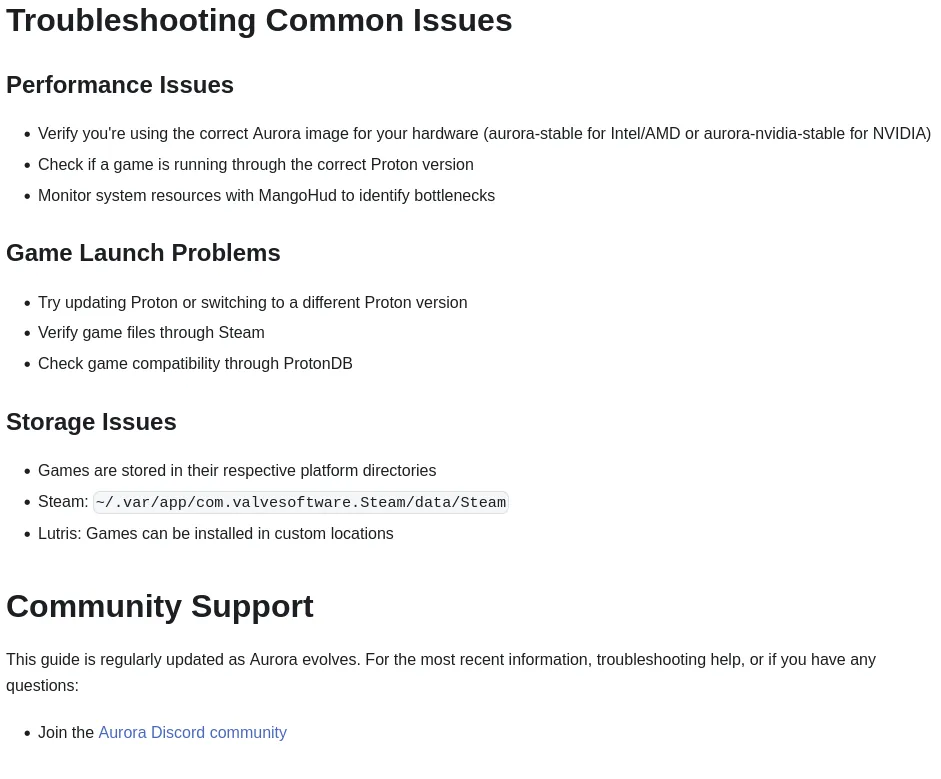
In short - it did not help me fix my issue, and sadly, neither was the Aurora Discord community. The funny thing however is that two weeks later things worked again, probably due to an automated update.
While it's nice that it worked again, I still am not really impressed by this. I had no way of knowing that something had changed nor what had changed, leaving me with a sensation of similar to "okay so you'll kind of be gambling on whether or not your app runs or not this week". I didn't run into many similar issues in the future, certainly not simiarly disruptive ones where the program just doesn't launch, but it was still not a very good feeling. Anyways...
I originally intended for this to just be a month. It ended up going all the way from May until end of August. Part of it, I will admit, was due to Aurora being a pretty pleasant experience in the sense of me not having to think about my system. The biggest part however was me constantly post-poning the time of me reinstalling Gentoo again.
This time ended up being last night, and I'm very happy to be here again.
Gentoo is very much the "my beloved" of the Linux distributions. Gentoo simply just does things right, and, at least for how I use my computers, it just works. Sure, the install might be a little bit tedious and time consuming, but afterwards everything just comes together so damn smoothly. You can not only replace any system component (including systemd) as you want, but you can also specify what you want from them and how you want them to be built.
On my daily system, I use a very 'un-tuned' system. I set my commonflags to build for my CPU-architecture instead and then I allow all licenses (I sadly have NVIDIA) and enable a binary host. Later I add just some very basic USE-flags to make sure my system has ie. networkmanager and pipewire, and the rest I leave up to my desktop profile. I later set up and enable Flathub to keep my proprietary programs in their sandbox. That's about it really. Obviously there's the sections hidden in the middle here of choosing what packages and toolings to install blablabla, but in the big picture, I just set it to be exactly what I need for the machine that I need it on. And I love it. The option of doing something advanced without being forced to do it - I'm looking at you, suckless people.
Gentoo also has the best documentation I have ever faced. Back when I had Arch as my base, I used to love the Arch wiki. It is still a really great wiki, I will admit, and especially for many tiny niche toolings. Compared to the Gentoo wiki however, the Arch wiki gives me a 'little brother' kind of feeling. While there are articles written better on Arch wiki (and vice versa), the Gentoo wiki just gives me so nice and complete understanding of what the tools I look up do, how they do it, and how they interact with a Gentoo system. If it wasn't for portage being so freaking awesome, I'd be willing to say that the wiki could be seen as the biggest upside of using the distribution. The Gentoo Handbook too is simply marvelous for getting a quick and solid introduction to how everything works here. I'm really impressed by the quality of documentation.
Finally, one of the things that has made me truly embrace Gentoo as the 'my beloved' and what is increasingly feeling sort of like a 'last stand' after seeing what happened with Debian, is it's AI-policy. It says: "No, you don't."
God I love this system.
Reply via email

 点赞
点赞 收藏
收藏 点踩
点踩 分享
分享