
Bidirectional Charging During Grid Outages
'%20fill-opacity='.8'%20d='M3.256%203.913a3.083%203.083%200%200%200-.003%204.397L8%2012.998l4.743-4.684a3.085%203.085%200%200%200%20.001-4.4c-.6-.593-1.4-.914-2.233-.914a3.17%203.17%200%200%200-1.91.635L8%204.087l-.601-.452A3.17%203.17%200%200%200%205.489%203c-.834%200-1.634.321-2.233.913m10.19%205.111-4.748%204.69a.996.996%200%200%201-1.397%200L2.549%209.02a4.083%204.083%200%200%201%20.004-5.82A4.17%204.17%200%200%201%205.488%202c.907%200%201.787.29%202.512.835A4.17%204.17%200%200%201%2010.51%202c1.093%200%202.146.422%202.936%201.202a4.085%204.085%200%200%201%200%205.822'%20/%3e%3c/svg%3e)
'%20stroke-opacity='.75'%20stroke-width='1.5'%20stroke-linejoin='round'/%3e%3c/svg%3e)

David asked a great question on my solar battery system post: why buy a small battery just for emergencies when electric cars have a large battery you can also use for other things? [1] This would be great, and seems like the obvious way for it to work: when the grid goes down the panels can charge the car when it's sunny, and the car can power the house when it's not. Unfortunately as far as I can tell the only way I could do this today is with a Cybertruck, and other systems are a long way off.
The basic problem is that while several manufacturers support having the car power your house when the grid is down ("V2H"), they generally treat it as a separate discharging-only mode. For example, the GM V2H Bundle documentation says "During a power outage, the GM Energy Home Hub safely disconnects your home from the local power grid and enables backup power to flow from the GM Energy Inverter throughout your home" and "Once power is restored, your GM EV will automatically end the discharge session and begin charging" without any mention of recharging the car when the grid is down.
For Fords, automatically powering your house during a grid outage was a big selling point in the F150 Lightning marketing campaign, but they now say "The Ford Charge Station Pro, required for Automatic Home Backup Power, is no longer for sale", probably because the F150 Lightning has been discontinued. And it looks to me like even then they didn't support bidirectional charging during a grid outage. The only option today is V2H via a transfer switch, which doesn't let you charge an F150.
For Kia, there's Wallbox's Quasar 2. Unfortunately this is a mess where Wallbox is very enthusiastic and says V2H works, but then customers run into trouble actually trying to use it. And it doesn't work with current models, plus "Solar Charging cannot be used simultaneously with ... V2H".
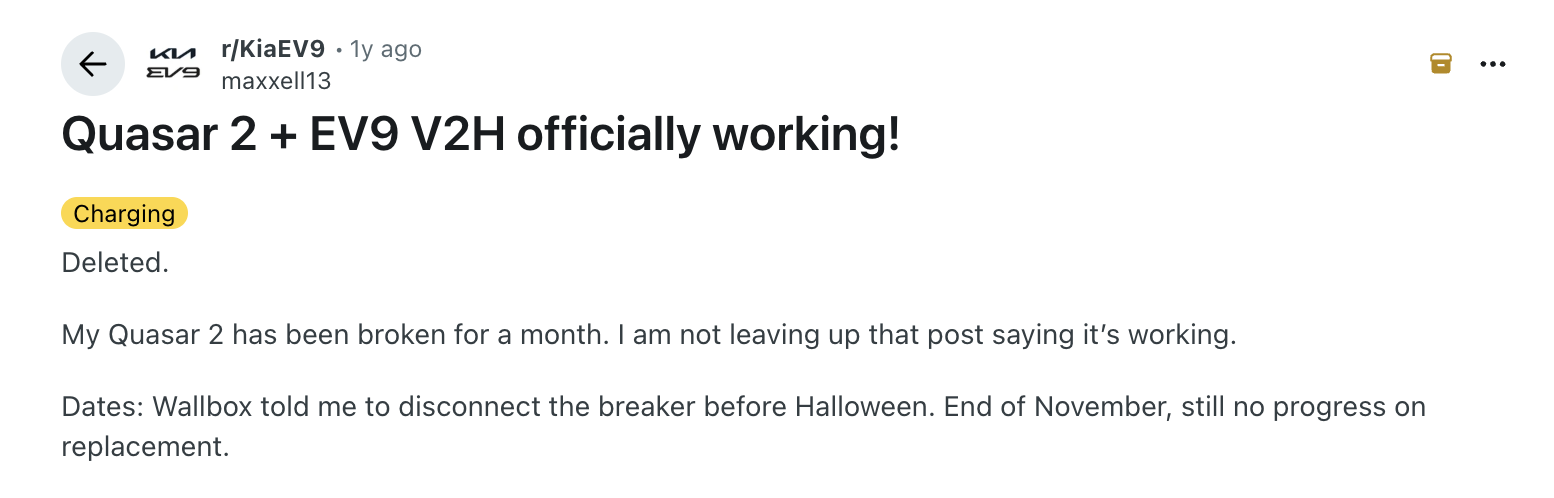
The only way I can see to do this today is with Tesla Powershare + Cybertruck, which says "If the system includes a UL 1741-listed solar system and there is capacity in the backup panel, ensure the solar system is included in the backup circuit to allow Cybertruck to recharge during an outage." But I don't want a Cybertruck, and (counting the cost of a Cybertruck over a vehicle we'd normally buy) this would be way more expensive than the Enphase 10C I'm considering installing.
Another possibility is that Enphase is planning on shipping a bidirectional EV charger, but I don't see anything more recent than a 2026-02-02 announcement that they're "targeting volume production beginning in Q4 2026" and they say "projected vehicle compatibility and bidirectional functionality will depend on automaker enablement, vehicle software, applicable standards, and final product specifications." I suspect it will slip into 2027, MA availability will be even later, and when it does come out I'd need to buy a specific new EV (expensive).
I don't want to wait that long to get good backup power in place, since I want to be prepared for a world that might change quickly in the next few years. So I'll probably go ahead with the smaller emergencies-only battery.
[1] All of this assumes we have an electric car. Which we don't, but our shared Honda Fit is a 2013 and while it's been a fantastic car I don't expect it to last that much longer. A plug-in hybrid or full EV are possibilities for a next car. I think our families are unusually poorly suited for full EVs since we don't use the car much (minimal gas savings and pollution reduction) and a larger than typical proportion of our trips are long (ex: driving to play a dance).