
Election signs
'%20fill-opacity='.8'%20d='M3.256%203.913a3.083%203.083%200%200%200-.003%204.397L8%2012.998l4.743-4.684a3.085%203.085%200%200%200%20.001-4.4c-.6-.593-1.4-.914-2.233-.914a3.17%203.17%200%200%200-1.91.635L8%204.087l-.601-.452A3.17%203.17%200%200%200%205.489%203c-.834%200-1.634.321-2.233.913m10.19%205.111-4.748%204.69a.996.996%200%200%201-1.397%200L2.549%209.02a4.083%204.083%200%200%201%20.004-5.82A4.17%204.17%200%200%201%205.488%202c.907%200%201.787.29%202.512.835A4.17%204.17%200%200%201%2010.51%202c1.093%200%202.146.422%202.936%201.202a4.085%204.085%200%200%201%200%205.822'%20/%3e%3c/svg%3e)
'%20stroke-opacity='.75'%20stroke-width='1.5'%20stroke-linejoin='round'/%3e%3c/svg%3e)

A municipal election is coming up here in Kelowna, which means that election signs are now showing up everywhere. Let me be blunt, I hate these signs. Not just because they’re ugly, although they are, but because they’re manipulative.
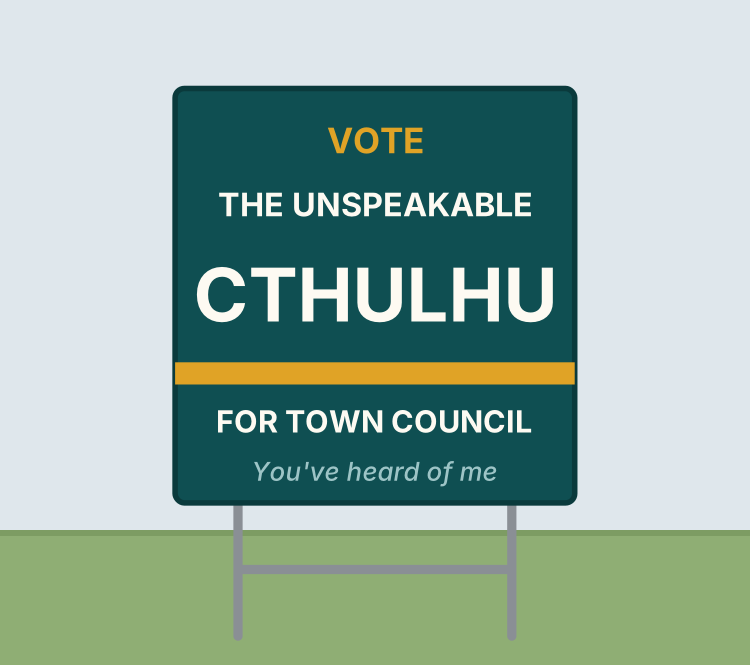
Why is this relevant here? Not because it’s politics, but rather because understanding how we are manipulated by the environment around us is a skill we should all have.
The signs went up recently, and now every corner lot has three or four of them. Of all the signs I could see, I recognised exactly one name, and only because he already has the job.
So what is a sign actually doing to us? The obvious answer is that it makes a name familiar, and that familiar things feel safer. Although that’s not the whole story. When Cindy Kam and Elizabeth Zechmeister studied this directly, they found something more specific going on.
“we provide conclusive evidence that name recognition can affect candidate support, and we offer strong evidence that a key mechanism underlying this relationship is inferences about candidate viability”
Cindy Kam and Elizabeth Zechmeister, “Name Recognition and Candidate Support”
Viability, not affection. We don’t warm to the familiar name so much as conclude that it belongs to whoever is going to win, and then we move toward the winner. Donald Green and his colleagues found the same thing across four randomised experiments in New York, Virginia and Pennsylvania, planting signs in randomly selected American voting precincts. The signs they put in supporters’ front gardens were expected to work mainly through what they called the support among neighbours signal.
So a lawn sign isn’t telling us that we like this person. It’s telling us that the people on this street are already with him.
You might be thinking that a street full of signs really does show local support. What it shows instead is which campaign had the budget for signs and the volunteers to plant them. It’s the same reason campaigns quote how much money they’ve raised as though that predicted how well they’d govern. It predicts how many times they can put themselves in front of us, which is a very different thing.
Timing matters more than we’d guess, too. Hill and his colleagues measured how long the persuasive effect of political advertising actually survives, and found that it fades within days. Further down the ballot it barely survives at all: “in lower level races, advertising causes preference shifts that have half-lives of only 1 to 2 days and no discernible long-term survival”. The sign we drove past three weeks ago has already stopped working on us. The one still standing on the route to the polling station is doing nearly all of it.
None of this is unique to elections. The vendor with the biggest booth at the conference feels like the safe choice. The colleague who is visible in every meeting gets read as the one contributing most. The idea that wins planning is often just the one that got said most often, which is the same social proof that shapes so many of our meetings.
What’s happening in all of those is that we’ve quietly swapped the question, which is the essence of attribute substitution, a cognitive bias where we replace a complex problem with a simple one and solve for that instead. Working out who would actually govern well, or which vendor is actually better, is expensive and often impossible from where we’re standing. Working out whose name we’ve seen most is free. Our brains answer the cheap question and hand us the result as though it were the answer to the expensive one.
I’d still like to ban the signs, but that wouldn’t fix the biggest part of the problem. They’re the cheapest medium there is, so taking them away just hands the vote to whoever can afford television instead. What we’d need to ban is any political advertising at all, in any media format.
The next time a name feels like the safe choice, it’s worth asking what we actually know about it, and whether the real answer is that we’ve simply seen it before.
- Kam, C. D., & Zechmeister, E. J. (2013). Name Recognition and Candidate Support. American Journal of Political Science, 57(4).
- Green, D. P., Krasno, J. S., Coppock, A., Farrer, B. D., Lenoir, B., & Zingher, J. N. (2016). The effects of lawn signs on vote outcomes: Results from four randomized field experiments. Electoral Studies, 41, 143-150.
- Hill, S. J., Lo, J., Vavreck, L., & Zaller, J. (2013). How Quickly We Forget: The Duration of Persuasion Effects From Mass Communication. Political Communication, 30(4), 521-547. Their “lower level races” were gubernatorial, Senate and House contests in the 2006 midterms, so a municipal election sits lower still. The half-life they estimate for the 2000 presidential race was about 4 days.