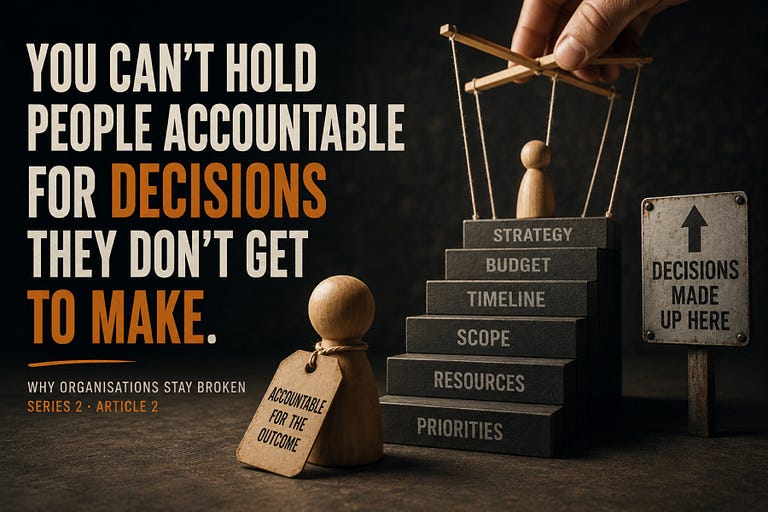
You can’t hold people accountable for decisions they don’t get to make

Organisations love the language of ownership. We ask people to own outcomes, take accountability, behave like founders, move with autonomy and act with urgency. The words appear in company values, job descriptions, performance reviews and leadership principles.
Then someone makes a decision.
Suddenly there are approvals, reviews, escalations and stakeholders who were not previously involved. Decisions get reopened. Scope gets added back. Priorities change. Resources move somewhere else. The person who supposedly owns the outcome discovers that ownership has boundaries they were never told about, while the accountability remains exactly where it was.
This creates one of the stranger contradictions in modern organisations. We increasingly hold people accountable for outcomes while withholding authority over the decisions required to achieve them.
That is not empowerment. It is accountability without authority. And eventually, it changes how people behave.
Ownership has become organisational theatre
Putting someone’s name next to an outcome does not mean you have given them ownership of it. Real ownership requires agency.
If I am accountable for an outcome, I need some meaningful ability to influence the variables that determine whether that outcome is achieved. That does not mean unlimited authority. Organisations need constraints, shared standards and decisions that sit at different levels. But there needs to be a credible relationship between what someone is being asked to own and what they are actually allowed to control.
Too often, there is not.
A leader may be accountable for the customer experience while having little influence over what gets prioritised. A product team may own an outcome while receiving a roadmap of predetermined solutions. A manager may own the performance of a team while having limited control over hiring or resourcing. A designer may be accountable for quality while being unable to meaningfully influence scope or what gets released. A product manager may own commercial results while having no authority over pricing, packaging or investment.
In each case, the organisation has distributed responsibility without distributing equivalent authority.
That distinction matters because accountability without authority is not ownership. It is responsibility theatre.
Accountability and authority have drifted apart
This problem rarely appears overnight. It tends to develop gradually as organisations grow.
More governance is often necessary. More people are affected by decisions. Risks increase. Dependencies become more complex. Leaders need visibility and teams need to coordinate. None of that is inherently bad.
The problem begins when governance accumulates without anyone reconsidering where decisions should actually live.
One approval becomes two. A review becomes a recurring forum. A senior stakeholder becomes someone whose agreement is now required. An escalation path slowly becomes the normal decision path. Eventually, the organisation can still describe teams as autonomous while consequential decisions continue travelling upward.
The language of empowerment remains, but the operating model tells a different story.
This is where accountability and authority begin drifting apart. People retain responsibility for the result while progressively losing control over the decisions that shape it.
The gap becomes dangerous because organisations tend to measure accountability much more explicitly than authority. We know who owns the metric. We know who owns the initiative. We know whose name appears next to the objective.
We are often much less precise about which decisions that person actually gets to make.
The variables people do not control
Consider how many variables can determine whether someone achieves an outcome. Prioritisation, scope, budget, hiring, resourcing, sequencing, quality, timing, dependencies, technology choices, commercial constraints and strategic direction can all materially affect the result.
Very few individuals should control all of these things. But the more of them that sit outside someone’s authority, the more careful we should be about describing that person as the owner of the outcome.
Take something as simple as customer experience. An organisation may tell a design leader that they are accountable for experience quality. That sounds entirely reasonable.
But what happens when the quality of the experience is affected by a deadline they cannot move, a scope decision they did not make, technical debt they do not control, a roadmap they cannot reprioritise and a release decision owned somewhere else?
They can influence. They can advocate. They can escalate. They can make the problem visible.
But they do not fully own the outcome.
The language matters because accountability carries an implicit promise. When an organisation tells someone they are accountable, it is effectively saying, we expect you to exercise judgement here.
If the organisation repeatedly prevents them from exercising that judgement, the accountability becomes increasingly hollow.
People adapt to the system
The most important consequence of accountability without authority is not frustration. It is behavioural adaptation.
If you make a decision and it is repeatedly reopened, you eventually learn to seek approval before making the next one. If you take a reasonable risk and later discover that leadership expected to be consulted, you begin involving leadership earlier. If you challenge a commitment and are described as difficult or as blocking progress, you become less likely to challenge the next one.
If you are repeatedly told to own an outcome while discovering that the decisions that matter happen elsewhere, you gradually stop behaving like an owner.
This is rational behaviour.
People learn the real boundaries of the organisation. They create additional meetings, circulate documents earlier, seek consensus, copy more people into conversations, ask for permission and wait for senior stakeholders to weigh in.
Then something fascinating happens. Leadership looks at the organisation and asks why nobody is taking enough ownership.
The company has systematically trained people not to.
Organisations can remove people’s agency and then diagnose the resulting behaviour as a lack of initiative.
What looks like weak ownership may actually be learned behaviour.
Escalation becomes rational
Escalation is often described as organisational dysfunction. Sometimes it is. But escalation can also be a perfectly sensible response to unclear or constrained decision rights.
If a team does not know whether it can make a decision, escalation reduces risk. If previous decisions have been overturned, escalation creates protection. If stakeholders can reopen work after the fact, early escalation becomes defensive alignment. If leaders regularly intervene, teams learn that involving them earlier is safer.
Over time, the organisation develops what looks like a consensus culture. Every decision needs more voices, more stakeholders, more reassurance and more alignment.
But consensus may not be the cultural preference at all. It may simply be the safest response to an environment where decision authority is unclear.
The problem is not necessarily that people escalate. The deeper problem is that the organisation has designed decisions so that escalation becomes necessary.
Seniority without authority is particularly expensive
This becomes especially costly when organisations hire experienced people.
Senior people are expensive partly because organisations are paying for more than execution. They are paying for judgement, pattern recognition and accumulated experience. They are paying for people who have seen versions of a problem before, who can identify risk earlier and who can make higher-quality decisions with less supervision.
That leverage is a large part of the value of experience.
Yet organisations sometimes hire senior leaders and place them inside systems that allow very little of that judgement to be exercised. They remain accountable, but relatively routine decisions require approval. Budgets are controlled elsewhere. Hiring decisions are reopened. Priorities are set several levels away. Quality calls are made by people who do not own the discipline.
The senior leader becomes an intermediary between the team and the people who actually decide.
You end up paying for judgement and using the person for coordination.
There is little point hiring experienced people if the organisation will not let them exercise experience.
This is not an argument for unchecked executive freedom. Strong leaders should be challenged. Decisions need transparency. Cross-functional work requires genuine collaboration.
But collaboration and permission are not the same thing. Neither are input and approval.
When organisations fail to distinguish between them, seniority becomes increasingly performative. The title changes, but the decision rights do not.
The accountability trap eventually damages leadership
The longer this gap persists, the more corrosive it becomes.
People compensate for the lack of authority in different ways. Some become political and learn which relationships matter more than the formal operating model. Some become highly approval-oriented and optimise for keeping stakeholders comfortable rather than making the best decision. Some disengage and continue doing the work while investing less energy in changing the system. Others stop challenging decisions they believe are wrong, while some eventually leave altogether.
The danger is that organisations can interpret every one of these behaviours as an individual issue.
That person was not strategic enough. They were not collaborative. They struggled with ambiguity. They could not influence. They were not the right cultural fit.
Sometimes those diagnoses are correct.
But if the same patterns repeatedly appear in different people operating inside the same environment, it is worth looking upstream.
Perhaps the organisation is creating the behaviour it subsequently criticises.
This is one reason persistent organisational problems are so difficult to solve. We keep replacing the people experiencing the system instead of changing the system itself.
Real empowerment requires explicit decision rights
The answer is not simply to tell people they have more autonomy. Autonomy is one of those words that sounds useful until a difficult decision arrives.
What matters is clarity.
Healthy organisations are explicit about who decides, who contributes and who needs to be informed. They make clear which decisions belong to teams, which genuinely require executive involvement, which constraints are fixed and where teams are free to exercise judgement.
They also make clear what should happen when reasonable people disagree.
These questions are far less inspiring than talking about empowerment. They are also far more useful.
Frameworks such as DRI, DACI and RAPID exist because decision-making itself needs to be designed. The specific framework matters less than the principle beneath it.
Accountability and authority should be deliberately matched.
If someone is accountable for an outcome, they need enough authority to materially influence it. If the organisation wants to retain a decision elsewhere, that can be entirely appropriate, but then it should be honest about where accountability ultimately sits.
You cannot centralise the important decisions and decentralise the blame.
Empowerment does not mean leaders disappear
There is an understandable fear behind some of this. Leaders can worry that distributed authority means losing control.
It does not.
The strongest leaders still set direction, create constraints, allocate capital, define quality expectations and intervene when the level of risk justifies it.
What changes is where their value sits.
Instead of making every decision themselves, they design an environment in which good decisions can happen without them. They provide context instead of instructions. They clarify intent instead of prescribing every solution. They create decision systems rather than becoming the decision system.
That distinction matters.
A leader who must personally approve everything may feel highly influential, but they have also built an organisation whose capacity cannot exceed their own attention.
The more senior someone becomes, the less scalable it is for their value to depend on personally making every important decision.
If you want ownership, give people something to own
Organisations should absolutely expect accountability. People should stand behind their decisions. Teams should own outcomes. Leaders should be responsible for the environments they create.
But accountability only works when it is credible.
You cannot ask people to act like owners while treating them like executors. You cannot tell someone to use their judgement and then repeatedly override it. You cannot ask someone to carry an outcome while controlling the important variables somewhere else. And you cannot systematically remove agency and then be surprised when people start asking for permission.
If you want ownership, give people something meaningful to own.
That means being explicit about authority, not merely enthusiastic about accountability.
Because when accountability and authority separate, the organisation does not create more ownership. It creates escalation, caution, politics and dependency.
Eventually, every important decision starts moving upward.
Which raises the next question.
What happens when an organisation keeps hiring more people, creating more teams and adding more layers, but the authority to make consequential decisions remains concentrated in the same place?
It hits a ceiling.
Next: When every decision still needs permission, you’ve stopped scaling.
Like this? Find more about Darren, his views, and selected work. https://darrensmith.lovable.app/
You can’t hold people accountable for decisions they don’t get to make was originally published in Bootcamp on Medium, where people are continuing the conversation by highlighting and responding to this story.

 点赞
点赞 收藏
收藏 点踩
点踩 分享
分享