Flock Taught Cops How to Surveil No Kings Protesters

Flock taught cops how they could surveil the No Kings protests and “small parades” using a mix of Flock’s technology and law enforcement’s own databases in a webinar last year. As Flock publicly downplays the power of its automated license plate camera network and highlights its use to solve violent crime, the company’s seemingly endless trove of webinars, training sessions, and blog posts show it offers far more invasive capabilities.
In the webinar, Flock’s director of market management Caity Peak explains how real time crime centers — which are police surveillance centers that utilize Flock cameras and other surveillance cameras — can be used for emergency response, but can also be used to surveil “established events” like 4th of July fireworks displays, parades, bike races, Mardi Gras, and protests. The webinar shows just how routine the idea of always-on surveillance has become, and how casually it is used during extremely innocuous events.
Peak explains that police can use FlockOS, a software platform that combines Flock’s automatic license plate readers (ALPR), drones, gunshot detectors, 911 data, and other surveillance cameras (including ones Flock does not own) into a “single pane of glass” or single piece of software to look at various types of surveillance in one place during both emergencies and relatively mundane events in a city or town.
“Imagine that you’re an incident commander, and you’re working this No Kings Protest,” Peak explains while a dashboard shows a series of surveillance tools overlaying the city of Denver. “If I’m somebody assigned a traffic post that’s working this No Kings Protest, I really don’t have time to go in and look at all these places [for different intelligence]. This is an example of viewing all of that in one place. I’m an officer, I can see the response plan that’s included, I can pull that up if I need it, but I can also see live video footage as that protest moves throughout the park.”
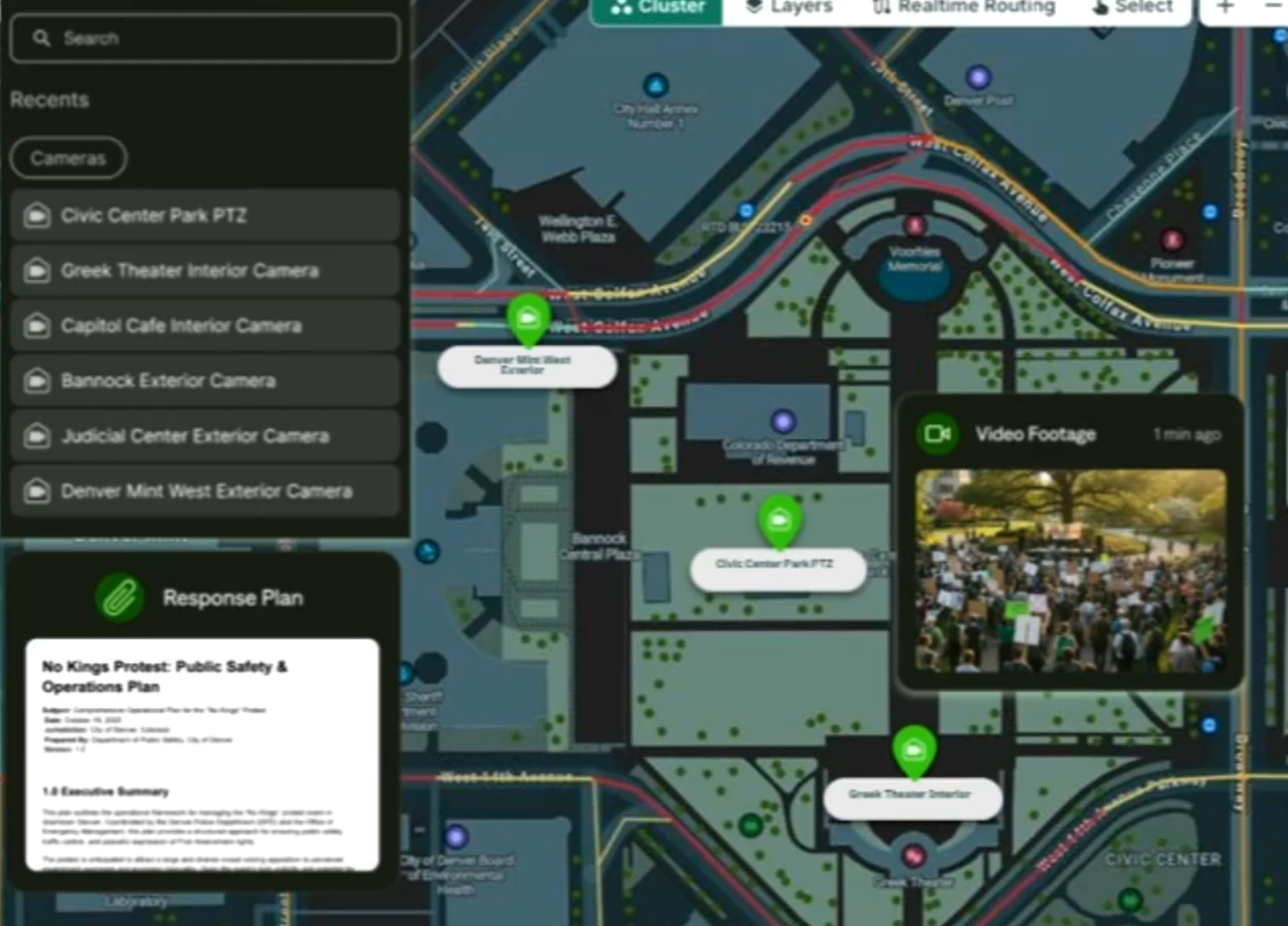
Peak says the surveillance footage can be used to monitor the protests without having cops physically on the ground “making it worse, getting attention.”
“I’ve got the video footage to monitor when things go sideways, I know when the environment is starting to shift. But I also know a lot of other things as well. I can see traffic flow, so as people are blocking the roadway, maybe that’s OK for a while, but if I see that traffic has been stopped a while, I may need to send officers to that area because I know that road rage is imminent,” she continues. The dashboard Peak shows includes traffic information, a “response plan” for the protest, the floor plans of nearby buildings, as well as a series of video feeds of both outdoor-mounted cameras and cameras inside businesses and government buildings.
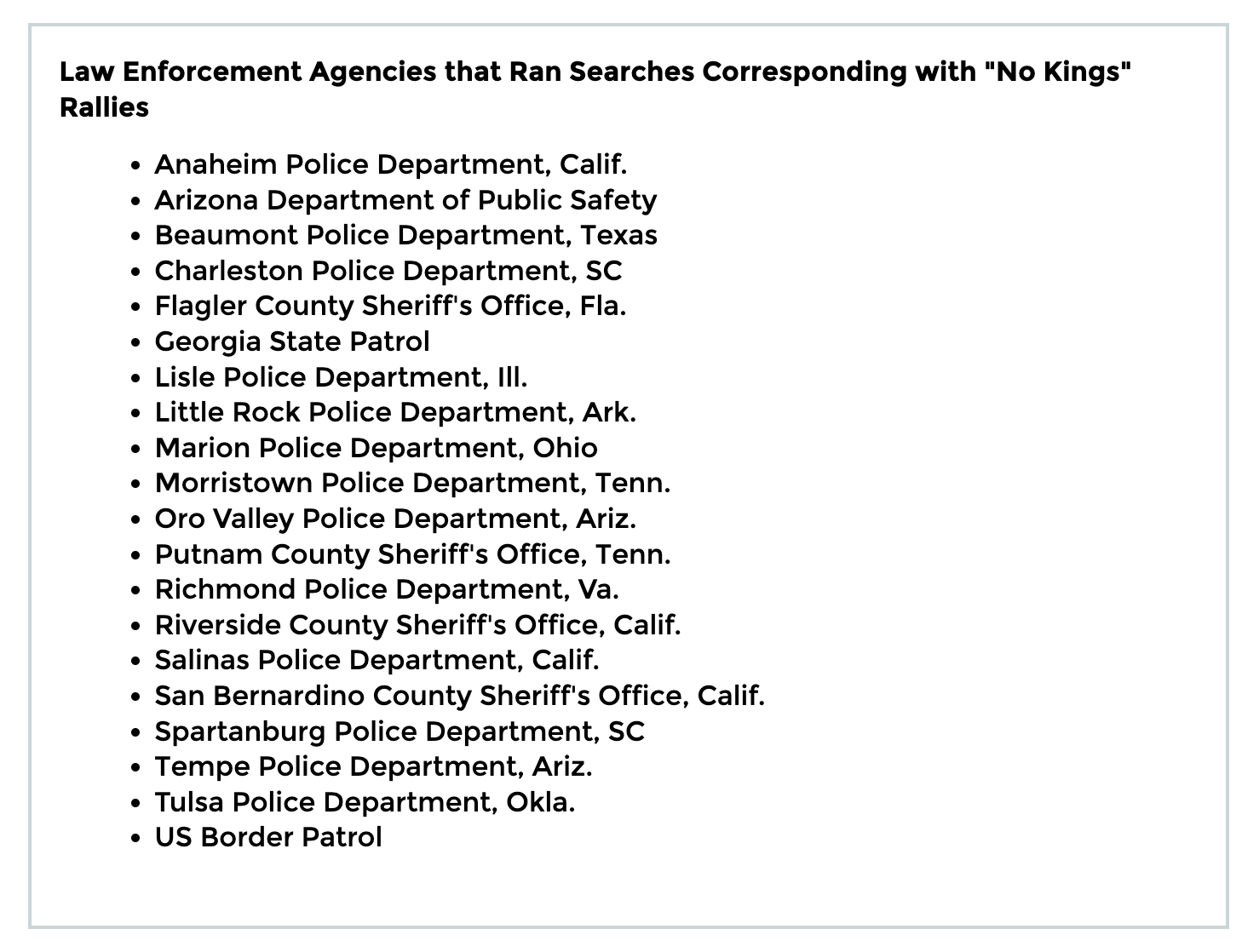
404 Media and the Electronic Frontier Foundation previously showed that police have specifically used Flock cameras to monitor the No Kings protests and other First Amendment-protected activity. 404 Media found California cops used Flock to monitor an “immigration protest.” The EFF found that the following law enforcement agencies ran Flock searches related to No Kings protests and rallies:
This webinar shows this type of surveillance is not anomalous, and is specifically taught by Flock. The webinar also shows that Flock’s latest public stance — that its ALPR cameras are noninvasive technology, that they take only static images at a single place and time, and that they are primarily used to solve the worst crimes — is wildly misleading. Flock has time and time again pitched itself to police as a sort of operating system to solve crime and do real-time surveillance and predictive policing. ALPRs are just one part of this broader surveillance apparatus that Flock has created, markets to police, and teaches them how to use. These real time crime centers are proving increasingly popular with police; Flock now says on its website that more than 4,800 cities around the country are running FlockOS software.
Matt Patin, a former New Orleans Police Department officer and current Flock employee, explains in the webinar that the dashboard can show ALPR data, body camera footage, and other data to “give me a full situational awareness of what’s going on.” Peak explains that, back when she was a cop, she used to hope that people would plan events near intersections that had ALPR cameras. “We’d have to pick which intersection is going to make sense [for an ALPR camera], where do we see the most traffic, where do we see the most events, and then I hoped that if an event happened in front of a camera, it’s one that’s in an intersection where I chose to put [the ALPR] and not one where I chose not to put an ALPR,” she says, adding that she would try to think which types of cameras and drones to use to police a specific event. “I want to make sure I have as many tools to make myself dangerous if and when I need it,” she adds.
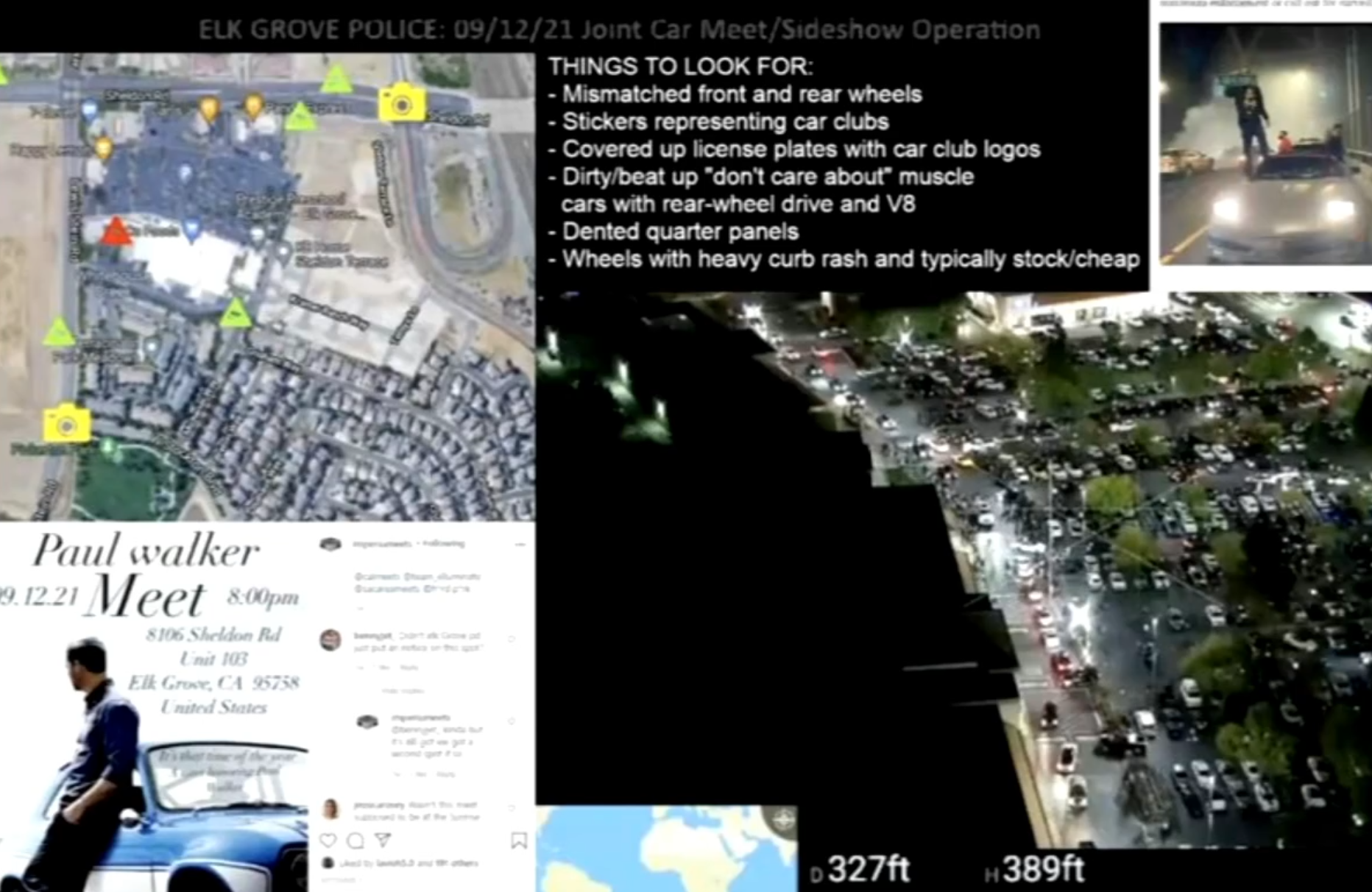
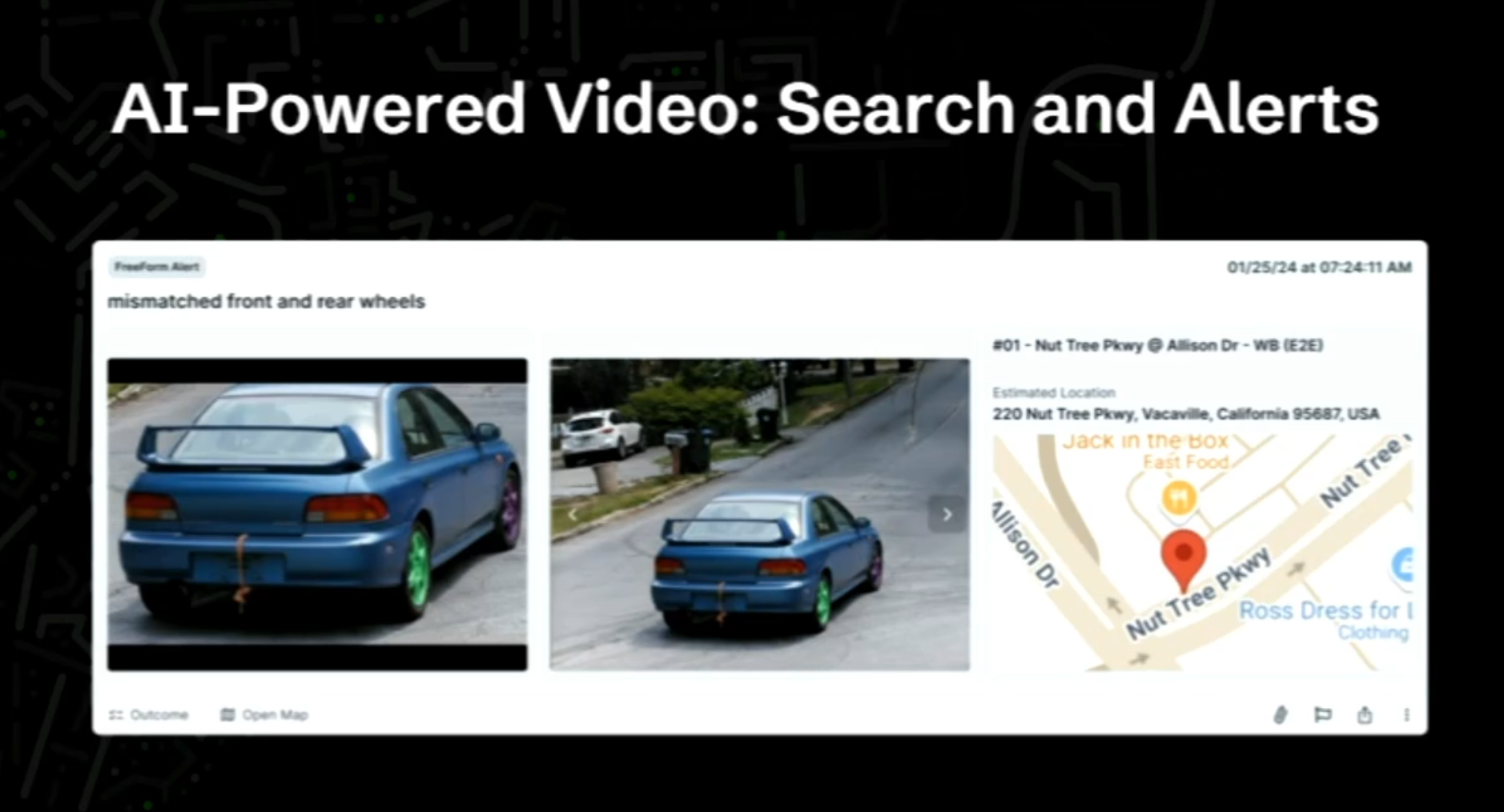
Peak goes on to give another example, in which police would surveil a car sideshow near Sacramento using a mix of drones, surveillance cameras, ALPRs, and monitoring of social media posts. “We knew it was likely to turn into nefarious activity based on who was promoting the car show,” she says. A list of “THINGS TO LOOK FOR” include “mismatched front and rear wheels, stickers representing car clubs, and covered up license plates with car club logos.” Peak then demos Flock’s free-form search, which is “AI-powered video search and alerts.”
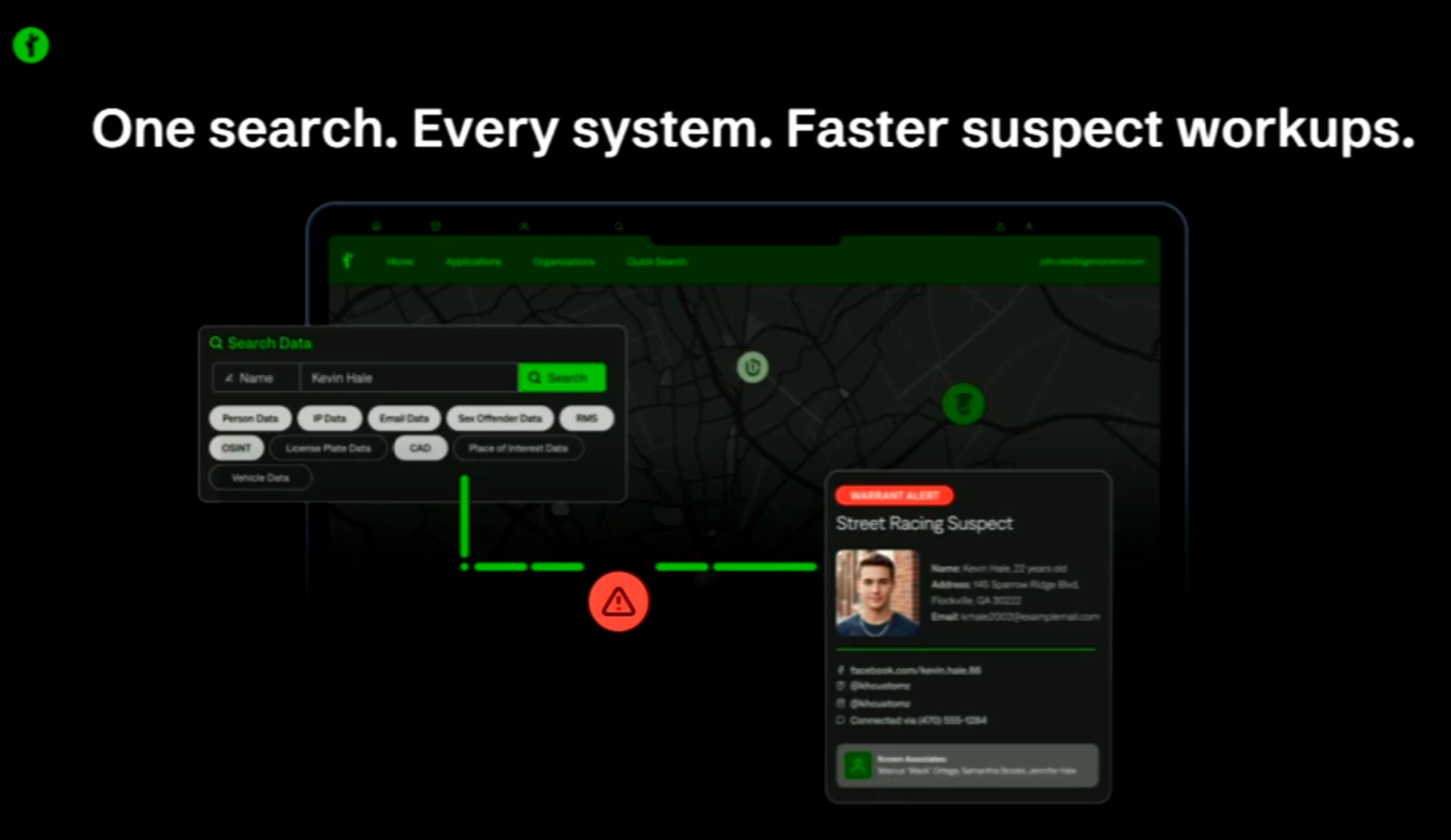
“Let’s take Flock’s free-form feature and say ‘hey, any time you see a car tonight with multi-colored wheels passing by any one of these five LPR cameras, I want you to send us an alert,’” she says. She then explains how Flock Nova, the company’s deeper investigative tool, can be used to marry LPR information with “all of your agency data,” which in this example includes “person data, IP data, email data, sex offender data, license plate data, vehicle data, and OSINT [open source intelligence].” A screenshot of the Flock system shows a “street racing suspect” complete with the man’s name, address, email, social media accounts, phone number, and various affiliations.
“It works like a Google Search,” she says, imagining a scenario in which cops pull someone over then use Nova. “I run him through Nova. I can query CAD [computer aided dispatch], RMS [records management system], OSINT, jail records. All these things we have integrated to see that we have contacted him before for sideshows, he has been contacted for spinning cars in an intersection in the last 90 days, he is related to this car club, and now with that information, I have the justification I need to actually tow the car for 90 days instead of just issuing a citation.”
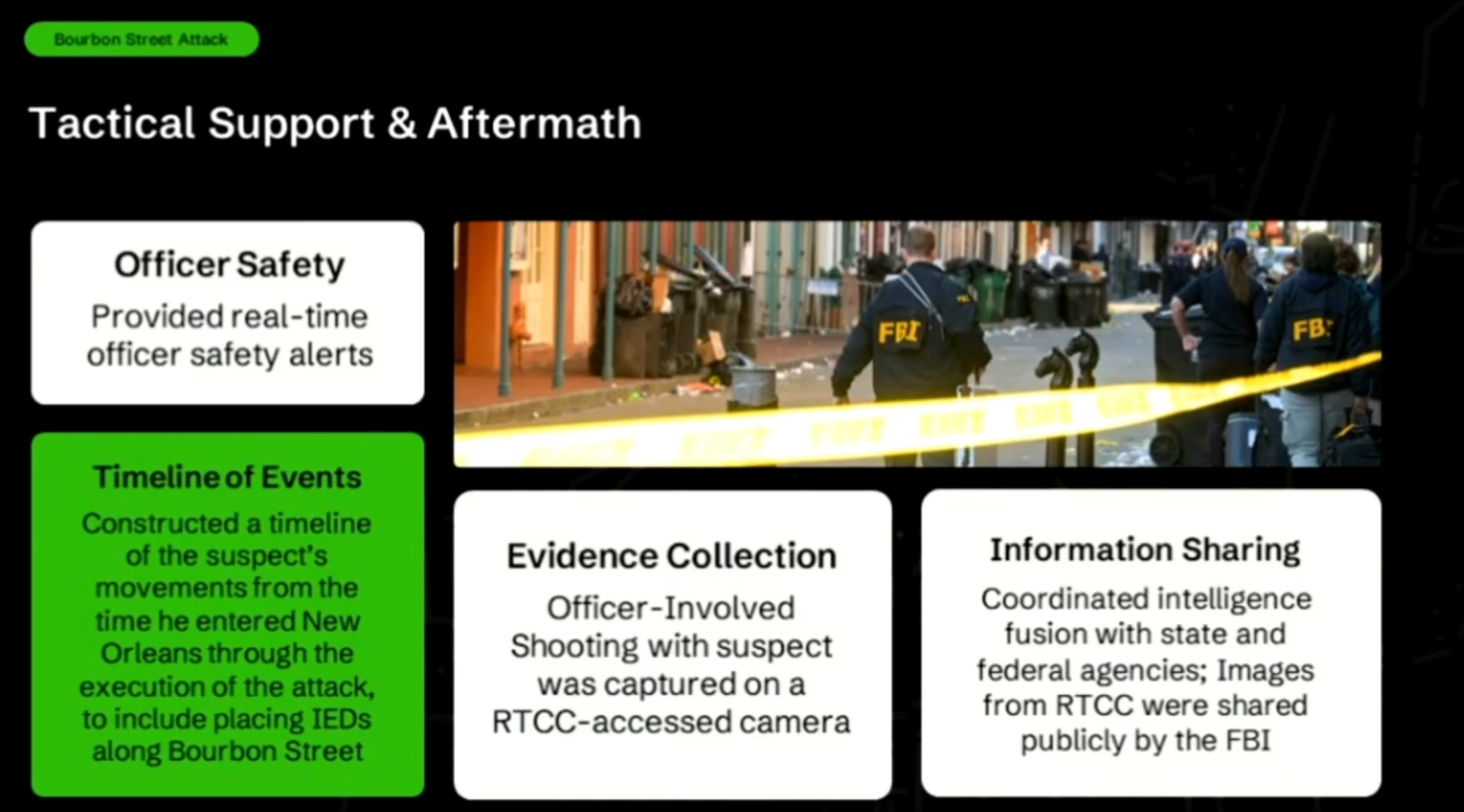
Later in the webinar, police from New Orleans and Flock representatives spoke about how its system was used by police in the aftermath of the Bourbon Street terror attack that killed 14 people on Jan. 1, 2025 and during the Super Bowl and Mardi Gras that year. The webinar highlights how this tech is used after a crime, and how the data often filters across agencies. Ross Bourgeois, who runs New Orleans' real time crime center, says that the city used a "tremendous amount of cameras in a very short time" to recreate the terrorist's movements.
“We were able to use our network of cameras and license plate readers to map out what he did when he entered the city a day or two before the event, up until he executed the event and engaged the police and our shooting situation at the conclusion of it,” Flock's Patin said, adding that footage running through FlockOS were eventually shared with the Department of Homeland Security, federal fusion centers, and the FBI. “7 terabytes of information, which was a lot of data, and we were able to share that with our fusion center and our federal partners. Homeland Security, HSI [Homeland Security Investigations, a division of Immigration and Customs Enforcement], and FBI.”

 点赞
点赞 收藏
收藏 点踩
点踩 分享
分享