Rogo, Hebbia Revenue Rises as Claude Finance Threat Looms


AI startups that aim to supplant the grunt work of junior bankers, private equity analysts and corporate finance associates have attracted billions of dollars of funding. They also face nagging doubts about whether Anthropic and OpenAI will annihilate them before long.
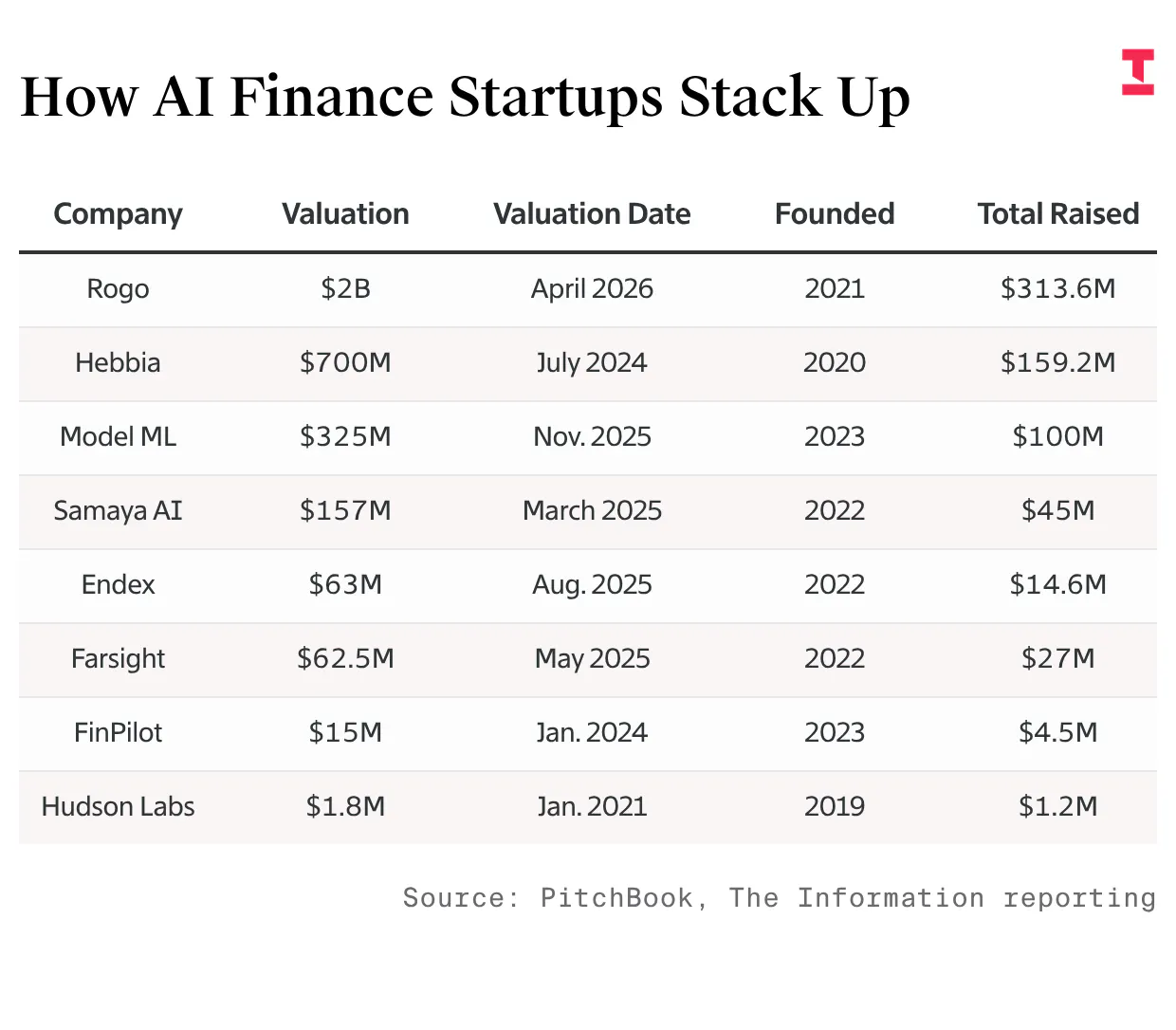
The two most highly valued finance AI startups—Rogo and Hebbia—have been trying to dislodge the naysayers with a blitz of new products, offices and newly announced customers. Both sell software and AI agents that can take written instructions and create a financial model, memo or a hundred-page pitch deck by plugging into the data providers banks pay for and into a firm's own files. Both use models from Anthropic, OpenAI and Google.
But their growth has diverged. Rogo recently passed $50 million in annual recurring revenue, according to a person with direct knowledge of its business, up more than three times from $15 million at the end of 2025. The five-year-old startup founded by former investment bankers at Lazard and J.P. Morgan is on track to generate around $100 million in ARR by the beginning of next year, the person said. It employs more than 200 employees and has been hiring in Singapore, Tokyo and Sydney. The New York-based startup has raised $313.57 million from investors including Thrive Capital, Kleiner Perkins and Khosla Ventures, most recently valuing it at $2 billion in April.
Meanwhile, Hebbia’s annual recurring revenue has risen to close to $50 million, a person with direct knowledge said. But it’s taken longer to reach that level than Rogo. Hebbia, founded in 2020 by a former Stanford University PhD student, was generating $13 million shortly after announcing its Series B round in July 2024, two people who have seen the pitch deck said. The person with direct knowledge confirmed the figure.
Competition between the two firms is likely to heat up. Rogo initially landed customers from the founders’ alma maters as well as banks including Bank of America, Wells Fargo and BNP Paribas. Its flagship product Felix, launched in April, plugs into data sources the company pays for and internal systems to screen deals, write documents used in M&A processes or produce client decks.
It’s now moving into selling to private equity, asset management, private credit and corporate development, the person with direct knowledge said.
Hebbia, in turn, initially targeted private equity, private credit and hedge funds. It’s now moving into banking, a person close to the company said.
A few months ago, Hebbia won a contract with Morgan Stanley that extends to about 5,000 of the investment bank’s workers, after a pilot of at least six months in which Hebbia competed with other vendors including Rogo, a person close to Hebbia said.
Morgan Stanley bankers now use Hebbia to to review complex documents, analyze financial data, automate the work of junior banker, and scale analysts’ productivity, according to a person close to the bank Morgan Stanley is also deploying Matrix, a product Hebbia revamped last week that lets customers build a custom agent and run many copies of it at once.
Hebbia hired 100 people since January, opening offices across London, San Francisco and New York, and now employs 180 employees. It raised $159 million from investors including Andreessen Horowitz and Index Ventures, most recently at a valuation of $700 million in October 2024, and has around $70 million of cash left in the bank, according to a person with direct knowledge.
The company had exploratory discussions with investors about a fundraising earlier this year but decided to not go through with it, a person close to the company said.
Such efforts haven’t dampened persistent rumors about whether Hebbia could be quietly for sale. Hebbia has shot down such claims. “A lot of noise on the market,” as Hebbia CEO George Sivulka noted in a post on X on Tuesday announcing that daily active users had tripled since the launch of Matrix and total usage of large language models had risen fivefold.
But neither rival can ignore the threat from the AI labs whose models support their applications. Anthropic launched Claude for Finance in July 2025 and “created the market for AI for finance startups because the models got better,” said Thomas Li, founder of Daloopa, which supplies financial data such as performance indicators or charts to hedge funds and investment professionals, AI labs and AI for finance startups like Rogo and Hebbia.
Claude for Finance is “probably bigger than the rest of the market combined,” he said.
OpenAI is further behind. But in March launched a set of tools for financial analysis and investment memos, along with a ChatGPT integration for Excel and connectors to FactSet and S&P Global. In June it added plugins for its coding agent Codex aimed at public equity investors and investment bankers.
Rogo and Hebbia argue the labs don‘t know enough about any individual firm to be useful. With agents fed a bank’s own history, Hebbia's agents behave “increasingly like your firm rather than like a generic Claude,” a person close to Hebbia said.
The other big headwind from the startups’ customers, who are developing their own AI agents using models from Anthropic, OpenAI and others.
That said, these AI startups may have room to grow for a while because in-house alternatives aren’t up to speed.
Samir Dutta, CEO of Farsight, which competes with Rogo and Hebbia by offering AI-powered agents to make pitch decks and deal documents for investment banks, said financial institutions’ employees are “really good at operating once the use case is very, very well scoped out. But a lot of these banks don't have that yet.”
Firms that decide they need no outside help “generally end up coming back full circle,” said Kris Bennatti, founder of Hudson Labs, which uses AI and agents pulls exact figures out of company filings and flags fraud risk to customers such as what kind.—Stephanie Palazzolo contributed reporting.
Here’s what else is going on…
Overheard
Anthropic co-founder Tom Brown called on countries to build more data centers at the G20 Innovation Ministerial in North Carolina on Wednesday, arguing that adding more computing power would be the best way for governments to benefit from AI gains. Elon Musk made similar comments in his virtual remarks at the event on Tuesday.
Nscale is telling prospective investors it has about $103 billion of total contracted revenue after clinching a $45 billion computing deal with Anthropic, ahead of an initial public offering for the neocloud that could take place as soon as this month, according to documents shared with investors and reviewed by The Information.
Meta is pulling back further from a push to make AI usage a measure of engineers’ performance, telling employees that the company “will not use AI adoption dashboards or token counts to evaluate impact.” In an internal memo Tuesday from executives Maher Saba and Santosh Janardhan, which was reviewed by The Information, Meta announced updated expectations for engineers across the company. The memo removes from Meta’s career expectations guidelines for engineers references to specific AI tools and replaces task-specific AI instructions with expectations focused on work quality and impact.
Micro1, a startup that sells data to improve AI models’ responses, has committed at least $1 million to train former Spirit Airlines employees with AI skills as part of its bid for the bankrupt airline’s corporate data, three people close to the company said. The pledge is part of an effort to convince the court that it will be a better custodian of the corporate data than Google, which in mid-August won an auction for the collapsed carrier’s internal business data and software code.
People on the Move
Anthony Armstrong, former chief financial officer at SpaceX’s xAI, is joining Coinbase’s board, Coinbase said. Armstrong, who has no relation to Coinbase CEO Brian Armstrong, left xAI as CFO earlier this year after joining last fall. Before joining xAI, Armstrong, a former Morgan Stanley banker, advised on Elon Musk’s Twitter takeover in 2022. In 2025, he worked for Musk’s Department of Government Efficiency.
Court Watch
The Trump administration backed OpenAI in its legal battle with the New York Times, arguing in a brief that barring AI companies from training their models on publishers’ output would be unfair and hurt U.S. technological competitiveness. The legal brief, filed by lawyers for the Department of Justice with the U.S. District Court for the Southern District of New York, argues that the Times is seeking an overly narrow definition of “fair use” that would improperly restrict how large language models are trained.
Earnings Report
Microsoft’s cloud unit Azure’s revenue was $101.9 billion in the twelve months ending in June, Microsoft disclosed Wednesday, up 40% from the year prior. Microsoft made the disclosure, and revealed it will start reporting Azure’s revenue quarterly, as part of a broader overhaul of how it reports the financial breakdown of its various businesses. And it comes as Azure’s progress has become a key metric that investors watch to track Microsoft’s AI progress.
Broadcom reported 86% higher revenue of $29.6 billion in the quarter ending Aug. 2, a sign that its business helping design AI chips for companies such as Google, Meta and OpenAI is continuing to explode. On an earnings call Broadcom CEO Hock Tan projected that Broadcom would double AI revenue to $115 billion in 2027, from an expected $57 billion this year. And Broadcom has a “line of sight” suggesting AI chip revenue could double again to $230 billion in 2028. Broadcom was on track to exceed $30 in earnings per share in 2028. Last year, Broadcom’s earnings per share was just below $5 a share.
Shares of Snowflake rose more than 20% late Wednesday after the database provider surpassed its earlier forecast for product revenue—its most closely watched sales metric—by more than $70 million for the second quarter ending July 31. Snowflake is benefiting as more of its customers use its AI products, which include an AI coding tool and a service for analyzing data to get answers to business questions. More than 9,100 customer accounts are using its AI coding tool, Cortex Code, up from 7,100 customer accounts last quarter.
Deals and Debuts
See The Information’s Generative AI Database for an exclusive list of private companies and their investors.
Nvidia said that it had agreed to acquire open-source model repository Hugging Face for $12.93 billion, confirming a report from The Information.
Nscale, an AI cloud company, announced that it had signed a multi-year strategic partnership with humanoid robotics company Figure to deploy up to 100,000 Nvidia Vera Rubin GPUs starting in the second half of 2027. The deal has an initial commitment of $3.5 billion of compute and the intent to scale to over $6 billion, the companies said. Nscale said it would become a FIgure shareholder and preferred compute provider.
Cornerstone Robotics, a company that develops robotic systems surgeons use to operate through small incisions, received an approximately $700 million strategic investment from Medtronic.
Wonderful, a company whose software acts as a shared control layer that lets a large company run AI agents, automated workflows and AI applications across its whole business rather than one department at a time, raised $550 million in a Series C funding round led by Insight Partners.
Palo Alto Networks paid $500 million in cash and stock for Console, whose software lets a company describe an operational goal in plain English and then carries out the work automatically, according to TechCrunch.
The US Army awarded Palantir and Anduril a combined $192 million in delivery orders to build eight more TITAN mobile ground stations—trucks carrying software that pulls in data from drones, satellites and ground sensors and turns it into target recommendations for long-range artillery, according to Defense Scoop.
Lyte, a company that designs the chips, sensors and software robots use to see where they are and what is moving around them, raised $165 million at a $1.6 billion post-money valuation in a Series C funding round led by Maverick Silicon.
iPronics, a company that offers optical switches letting an AI data center rewire the connections between its chips on the fly, raised $125 million in a Series B funding round led by Maverick Silicon and Light Street Capital.
HiddenLayer, an Austin-based company whose software watches a business's AI models and agents while they are running and blocks attempts to manipulate them, raised $100 million in a Series B funding round led by Delta-v Capital.
Elucid, a company whose software reads ordinary CT scans to measure the plaque in a patient's arteries and estimate the risk of a heart attack or stroke, raised $55 million in a Series D funding round from investors including IAG Capital Partners and Elevage Medical Technologies.
Capacity, a company whose software answers customer support questions automatically across chat, phone and messaging, raised more than $54 million in a Series E funding round, bringing total funding past $159 million.
Conveo, a company whose AI interviewer runs recorded video conversations with consumers and turns them into market research a company can search in plain language, raised $50 million in a Series A funding round from investors including DST Global, Balderton Capital, Visionaries, 6 Degrees Capital and Y Combinator.
SciFin, a company whose software pulls a sales organization's scattered information into one continuously updated picture and answers questions about it, emerged from stealth with $44 million in a seed funding round led by Altimeter and Madrona.
Locus Robotics, a company whose robots carry orders around warehouses so workers do not have to walk them, has raised $41.6 million so far in a Series G funding round that is still open, chief executive Rick Faulk told Axios.
Aitan, a company that develops ground combat robots that run their own AI on board and coordinate as a group, emerged from stealth with $41 million in a funding round led by Deep33 and Dell Technologies Capital.
Lasso Security, a company whose software inspects what a business's AI agents say and do and blocks unsafe requests, raised $30 million in a funding round led by ClearSky.
Huskeys, a company whose software gives security teams one place to see and set policy, and telling legitimate AI agents apart from AI-driven attacks, raised $27 million in a Series A funding round led by Blackstone Innovations Investments.
Moonshot AI, whose Kimi K3 open-source model has become a global hit, has filed confidentially an application for a Hong Kong initial public offering, Chinese media outlet LatePost reported Wednesday.
Meta Platforms announced Wednesday that it’s rolling out another AI model, Muse Spark 1.3. Meta’s chief AI officer, Alexandr Wang, said in an X post that Muse Spark 1.3, which is available through its coding product Muse Code and the Meta model API, is its “most capable model yet,” with improved agentic and coding capabilities.
Thank you for reading the AI Agenda Newsletter! I’d love your feedback, ideas and tips: [email protected].
If you think someone else might enjoy this newsletter, please pass it forward or they can sign up here.
Alix Coutures is a reporter covering startups and VC based in New York City. She graduated from the M.A Business concentration at Columbia Journalism School in May 2026. She previously covered tech and telecom in Paris, at the French business publication Challenges. She can be reached at [email protected] or on Signal at Alix_coutures.49

 点赞
点赞 收藏
收藏 点踩
点踩 分享
分享