A polymer membrane that grows its own arsenic-catching surface

Arsenic contamination in drinking water poses a critical global public health hazard. Prolonged exposure to inorganic arsenic—predominantly present in groundwater as arsenate, where arsenic exists in its +5 oxidation state—can lead to severe dermatological lesions, cardiovascular diseases, and cancers. To mitigate these health risks, the World Health Organization has established a strict provisional safety guideline of 10 micrograms of total arsenic per liter of drinking water. Because arsenic occurs naturally through the weathering of rocks and minerals in aquifers worldwide, engineering low-cost, scalable, and highly efficient materials for water purification remains a central goal in modern materials chemistry.
Iron-based compounds, particularly iron oxyhydroxides, are among the most effective materials for trapping arsenate. At a fundamental chemical level, arsenate ions readily substitute for surface hydroxyl groups on iron oxyhydroxides, forming strong chemical bonds that permanently anchor the contaminant to the solid surface. However, translating this surface chemistry into practical filters presents a persistent engineering hurdle: maximizing the amount of active iron exposed to water. Simply increasing the iron concentration during material synthesis causes iron nanoparticles to aggregate into large, dense clusters. As these clusters grow, much of the iron becomes buried within the interior bulk, leaving only a tiny fraction accessible at the surface to bind arsenate.
A promising design strategy overcomes this limitation by decoupling the nucleation of iron particles from their subsequent growth on a flexible, high-surface-area polymer matrix. The foundation of this system is a composite fibrous membrane fabricated from poly(vinyl alcohol) and pectin via electrospinning. In electrospinning, a high-voltage electric field draws a liquid polymer mixture into ultra-fine threads, which solidify into an interconnected, highly porous mesh of nanofibers. Poly(vinyl alcohol) provides structural integrity and water stability upon heat treatment, while pectin—a natural polysaccharide rich in carboxyl and hydroxyl functional groups—serves as a molecular anchor capable of capturing iron ions from solution.
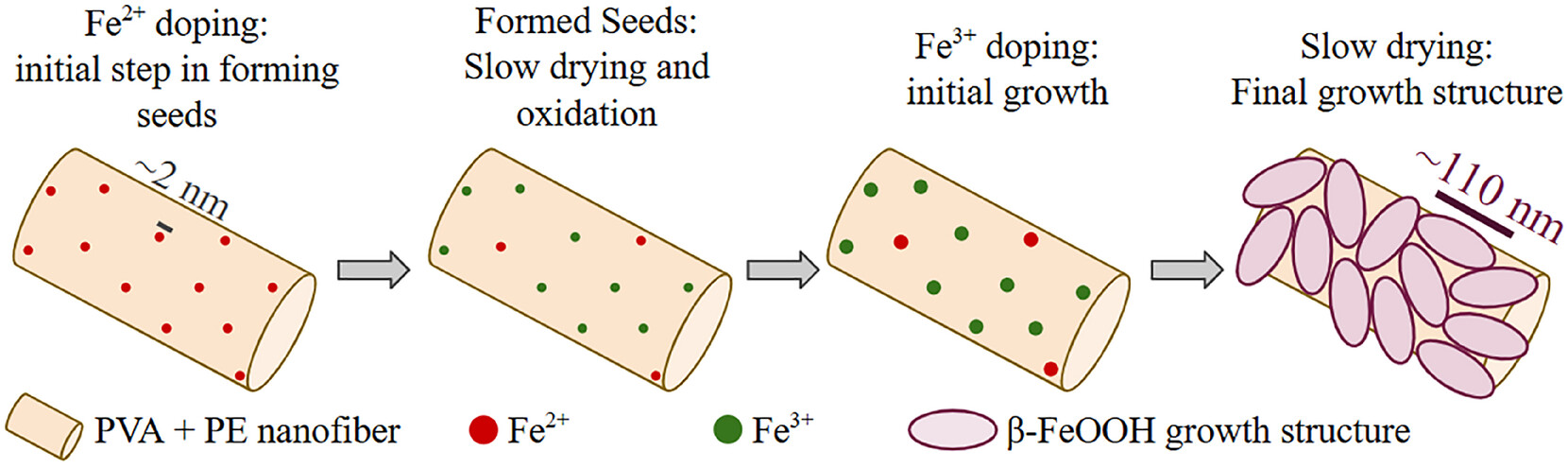
To grow high-density nanostructures without triggering particle agglomeration, a sequential, two-step chemical treatment is applied. First, the electrospun membrane is immersed in a solution containing iron(II) ions (Fe2+). The carboxylate groups on the pectin molecules coordinate with these cations, forming uniformly dispersed, nanometer-scale iron seed clusters (~2 nanometers in size) across the nanofiber surfaces as the material dries and oxidizes. In the second step, the seeded membrane is placed in a solution containing iron(III) ions (Fe3+). Instead of forming isolated new particles in solution, the newly added iron deposits onto the pre-existing seeds, driving controlled anisotropic growth along preferred crystallographic axes.
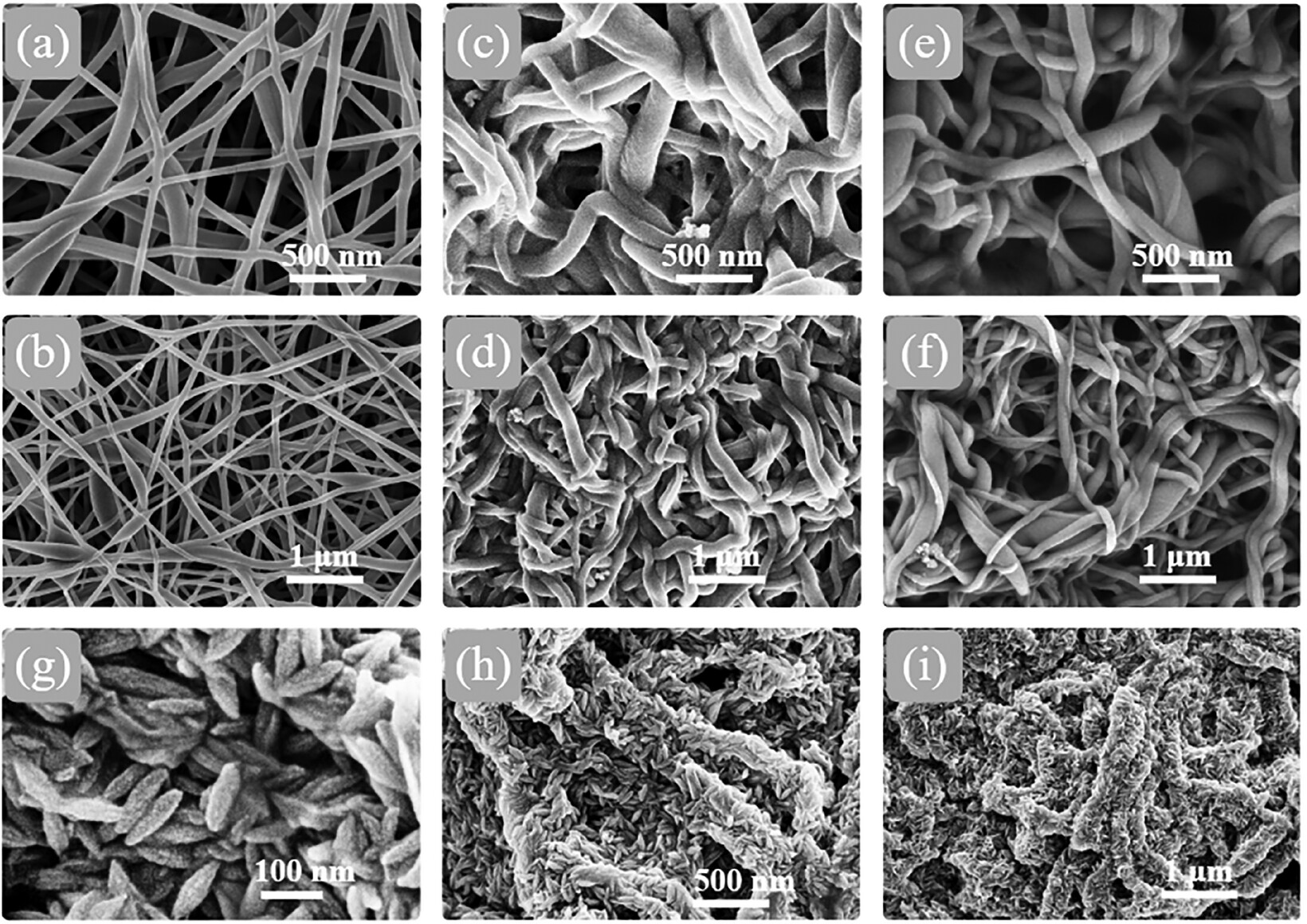
This seed-mediated approach yields an extraordinarily high density of surface-exposed iron nanostructures, achieving a 12-fold increase in surface atomic iron content compared to single-step doping methods. High-resolution electron microscopy reveals that these nanostructures adopt an elongated, rice-grain morphology measuring approximately 29 nanometers in width and 110 nanometers in length. Structural characterization using X-ray scattering, X-ray diffraction, and Mössbauer spectroscopy identifies the predominant active iron phase as akaganeite (β-FeOOH), a tunnel-structured, poorly crystalline iron oxyhydroxide known for its exceptional binding affinity toward arsenate.
When evaluated in water purification tests, the nanostructured membrane demonstrates exceptional superadsorbent performance. Using a minimal material dosage of 1 gram per liter, the membrane reduces initial arsenate concentrations from 1000 micrograms per liter down to below 10 micrograms per liter within 24 hours at pH 6, achieving roughly 99% arsenic removal and satisfying WHO safety limits. The material retains high efficiency across a broad operational pH range of 5 to 8, and ICP analysis confirms that iron leaching into the treated water remains safely below 5 micrograms per liter.
Kinetic and isotherm analyses reveal that arsenate removal occurs via surface chemisorption governed by cooperative binding behavior. As initial arsenate molecules bind to active sites on the akaganeite surface, local chemical and electrostatic interactions make adjacent sites even more receptive to further adsorption, resulting in accelerated uptake kinetics. Furthermore, the material performs reliably in complex water environments. Naturally occurring co-contaminants such as fluoride do not interfere with arsenate capture, and the presence of heavy metal cations—such as copper and cadmium—actually enhances arsenate removal by forming secondary surface complexes that create additional binding sites. Although chemical regeneration using sodium hydroxide solution results in a slight decrease in capacity over repeated cycles due to incomplete desorption, the membrane maintains an 81% to 87% removal efficiency, demonstrating strong potential for practical, reusable water remediation systems.
Author: César Tomé López is a science writer and the editor of Mapping Ignorance
Disclaimer: Parts of this article may have been copied verbatim or almost verbatim from the referenced research paper/s.
References
- A. C. Santos, S. Cerveny, C. Iacovone, C. P. Ramos, A. J. Marzocca, and S. Goyanes (2026) High-Density Iron Nanostructures Grown on Electrospun PVA/Pectin Fibers via Seed-Mediated Strategy for As(V) Remediation Small Methods doi: 10.1002/smtd.70975
The post A polymer membrane that grows its own arsenic-catching surface appeared first on Mapping Ignorance.

 点赞
点赞 收藏
收藏 点踩
点踩 分享
分享