In Nepal's Tragedy, a Warning for a Warming World

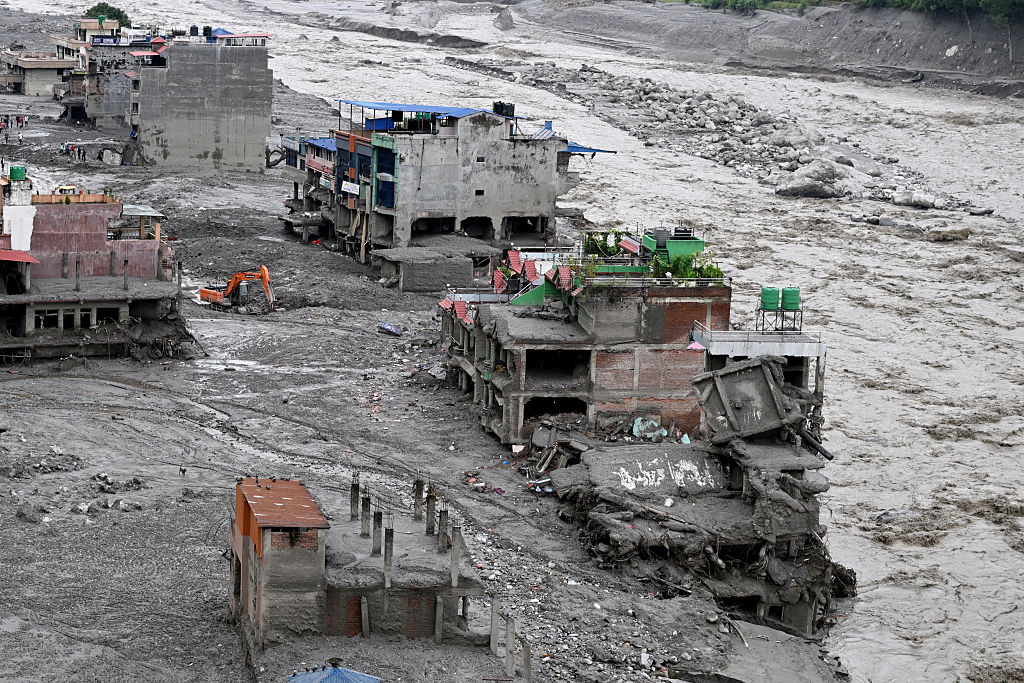
On Aug. 26, a landslide and a glacier collapse in the Himalayas sent an avalanche of water, rock and soil cascading down the Trishuli River valley, which sits on the border between the northern Rasuwa district of Nepal and Gyirong County in Tibet. The flood moved with overwhelming force and terrifying speed, sweeping away homes, schools, shops, vehicles, and people.
A week later, the reports are bleak: more 1,000 people have died in Nepal and Tibet and around 4,500 people remain missing. Some of the bodies carried away by the deluge were found hundreds of miles downstream in India. Rescue workers are still fighting to reach survivors. At least 900 workers remain missing from several hydropower projects along the Trishuli River, which runs through several remote, mountainous districts of Nepal. Hundreds of workers are believed to be trapped inside the tunnels in the hydropower projects.
A final accounting of lives lost is expected to be in thousands. In the Chitwan district of southern Nepal, some 120 miles from the mountain valleys where the glacial fury first struck, officials have buried nearly 200 unidentified bodies in a forested area because of a lack of morgue space. Mass burials have also started in a forest outside Kathmandu, the capital. DNA samples have been collected so the bodies can be identified later.
Families are still waiting outside hospitals in Kathmandu, the capital, for news of their loved ones. “Even if it’s just their bodies, at least we’d know,” Dil Kumari Masrangi Magar, a woman from Udaypur district in southeastern Nepal, told me outside Kathmandu’s Teaching Hospital. Magar was searching for her missing brother-in-law and a nephew, and had pasted their photos on a hospital wall already covered with images of the dead and names of the missing.
Many others were coming to terms with their loss after recognizing identifying details in photographs of the dead. Among them was Kesari Tamang, a woman, whose brother Sankha Budha Tamang ran a hotel in Betrawati town in central Nepal. He had been swept away by the flood and a body matching his description had been recovered 100 miles downstream in Kapilvastu. The family was travelling there to identify him. “If we start early tomorrow, we will reach there in about 10-11 hours,” Tamang told me. Another relative let out a deep sigh and said, “If it’s not him, we will just come back,” he said. “but it looks like it is him.”
The obliteration of the Gyirong port building on the Nepal-China border on the morning of Aug. 26, by a wave of mud and boulders, rising as high as 80 meters, has become a globally recognized image of the disaster’s scale and ferocity.
The landscape of loss in Nepal
The catastrophic floods have caused an estimated damage of $8 billion, according Nepal’s Finance Ministry. But the concentrated nature of this disaster, confined to a commercially important river valley, means the impact will be much greater. Fifteen hydropower plants—ten operational and five under construction—with a combined capacity of 753 megawatts have been affected by the floods. Roughly 11% of Nepal’s total power generation capacity has been knocked out. Multiple transmission lines and substations have been destroyed, severely crippling the country’s electrical infrastructure. Preliminary estimates by the Independent Power Producers’ Association Nepal put the damage to the hydropower plants at up to $230 million, a figure expected to rise.
More than 40 bridges have been destroyed or damaged, and 25 miles of vital roadways have been erased from the map, or buried under thick mud, cutting off remote mountain communities and compounding the rescue effort. At the same time, 69 schools have been damaged or destroyed, affecting 19,000 children, according to the charity Save The Children. At least 65,000 people have been directly affected.
Much of the downstream death toll was the result of poor planning and weak enforcement of zoning laws, which allowed settlements to be built along riverbanks. Yet nothing could have saved the hydropower plants, which Nepal needs both to wean itself off fossil fuels and to sustain its energy exports. Melting glaciers, a consequence of global warming, combined with high seismic activity, make the Himalayas a hotspot for catastrophic disaster risk downstream.
This is also a lesson for other vulnerable river valleys in Nepal. Four major hydropower plants backed by Indian investments sit in the Arun River basin, directly below Makalu, the world’s fifth highest mountain, at 8,463m, in eastern Nepal. The basin also lies downstream from the Tibetan region of China, where dozens of glacial lakes have swollen in size and could burst at any time. The Arun sits just across the border from the Indian state of Sikkim, where a $1 billion, 1,200-megawatt dam, the Teesta III, was wiped out by a glacial lake outburst in October 2023.
The Annapurna massif towers above the Marsyangdi River in Nepal, which flows through a valley next to the Langtang Lirung mountain where the glacier melted last week. Five cascade hydropower projects—operational and under construction—have been built on the Marsyangdi River. These sit directly beneath the Thulagi Glacial Lake, which has expanded in recent years because of global warming and is held back by a fragile moraine dam.
The science behind the flood
In the immediate aftermath, as is often the case with disasters, there was much speculation. A smaller flood struck the same river last year, caused by a glacier collapse in Tibet, leading many to assume this one had originated in from the same glacier. Online commentators quickly rushed to question why Chinese authorities had not sounded an alarm early on.
But it turned out to be an ice-rock avalanche on the north face of Langtang Lirung, a mountain in northern Nepal near the border with Tibet. At first, many linked the flood to a magnitude 4.4 earthquake near the Tibetan border. But the U.S. Geological Survey later revised that account, determining that the avalanche had triggered the earthquake, at 8:37 a.m. that morning in Nepal, not long before the floods.
Satellite photos now reveal a distinct 0.9 mile-wide break in a hanging glacier at 16,4000 feet, on the north face of Langtang Lirung, a 23,733-foot mountain in Nepal. Some scientists argue, however, that this was not a simple glacial calving but rather a bedrock failure, likely caused by melting permafrost seeping into a pre-existing fissure. This bedrock fracture sent a mix of rock and ice plunging more than 3,280 feet onto the flatter glacier below. The immense friction and kinetic energy from the drop melted much of the ice, producing collapse so vast that it triggered a localized magnitude 5.2 tremor.
The ice and rocks bulldozed surrounding debris down to the monsoon-swollen Lhende Khola and swept nine miles downstream to the Rasuwagadi border checkpoint between Nepal and China, sending a wall of mud and boulders racing down the Trishuli River into Nepal. Geologists estimate the avalanche displaced up to 200 million cubic meters of debris, making it the largest rock-ice event ever recorded.
A challenge and an opportunity for Balendra Shah
On Sept. 8, 2026 Gen Z in Nepal erupted in protests, which faced violent reprisals from then government, and forced its resignation. In the national election in March, Balendra Shah, a 35-year-old former rapper and independent politician won a major victory and was elected Prime Minister of the country. As the one-year anniversary of the protests approaches, my colleagues and I were planning to take stock of the protests, the reprisals, the election of the new government and its performance in the first six months in power.
The Aug. 26 flood is their biggest test yet. But the sheer scale of the Nepal-Tibet flood would have overwhelmed even the most well-equipped governments, as evidenced by the fact that it took the Chinese authorities three days to reach the disaster site. These are some of the most remote and extremely rugged mountain settlements in a geopolitically sensitive border region.
The Nepal government has deployed 19,000 security personnel and mobilized 16 helicopters in search and rescue operations, and more than 11,000 people have been rescued so far. Although news initially spread of the government refusing international assistance immediately after the floods, it reversed course later, requesting specialized technical personnel and equipment, especially to rescue workers trapped inside hydropower tunnels and to conduct DNA tests of unidentified bodies and remains.
Once the rescue phase and immediate relief efforts conclude, attention should shift to long-term rehabilitation and resettlement for survivors. Nepal’s Prime Minister’s Disaster Relief Fund has collected nearly $33 million in its domestic bank accounts, alongside more than $1.8 million in foreign currency accounts. International donors—through individual country pledges, multinational contributions, and local nonprofit relief efforts—have pledged over $200 million in combined emergency financial aid, potential loans, and dedicated reconstruction funds, alongside significant technical assistance.
How these funds and this assistance are managed and distributed, and whether affected families on the ground actually receive support, could set this government apart from its predecessors. This unprecedented flood, regardless of its colossal toll, also offers Prime Minister Shah and his government, an opportunity to demonstrate a proactive approach to search and rescue, rehabilitation, and a preparedness strategy for the future.

 点赞
点赞 收藏
收藏 点踩
点踩 分享
分享