Lumina Probiotic Response to Critics

A while back, blogger Trevor Klee posted a critical piece about Lumina Probiotic. Here it is. After some back and forth, he then posted an update saying we’re threatening to sue him to suppress his safety concerns.
Section 0: Did Lumina sue Trevor for libel?
No.
I was triggered and sent an angry email that said his post was defamatory. After that, a bioproduction contractor sent another email which explicitly threatened to sue for libel. I apologize for my part in this, and I apologize on behalf of the contractor, who acted impulsively and doesn’t represent the company.
Trevor, understandably, was pretty incensed by this — from his perspective, he was raising important questions about the safety of Lantern's product, and this felt like a bully trying to silence him. I imagine I would have felt the same in his place.
However, we’re very much not trying to suppress safety concerns. Since September 2023, Lumina has been paying out bug bounties to people who raise novel possible safety issues (screenshots below). Paying cash prizes to people who criticize us is embarrassingly peak EA, but this would be a pretty counterproductive thing to do if we were trying to silence whistleblowers.
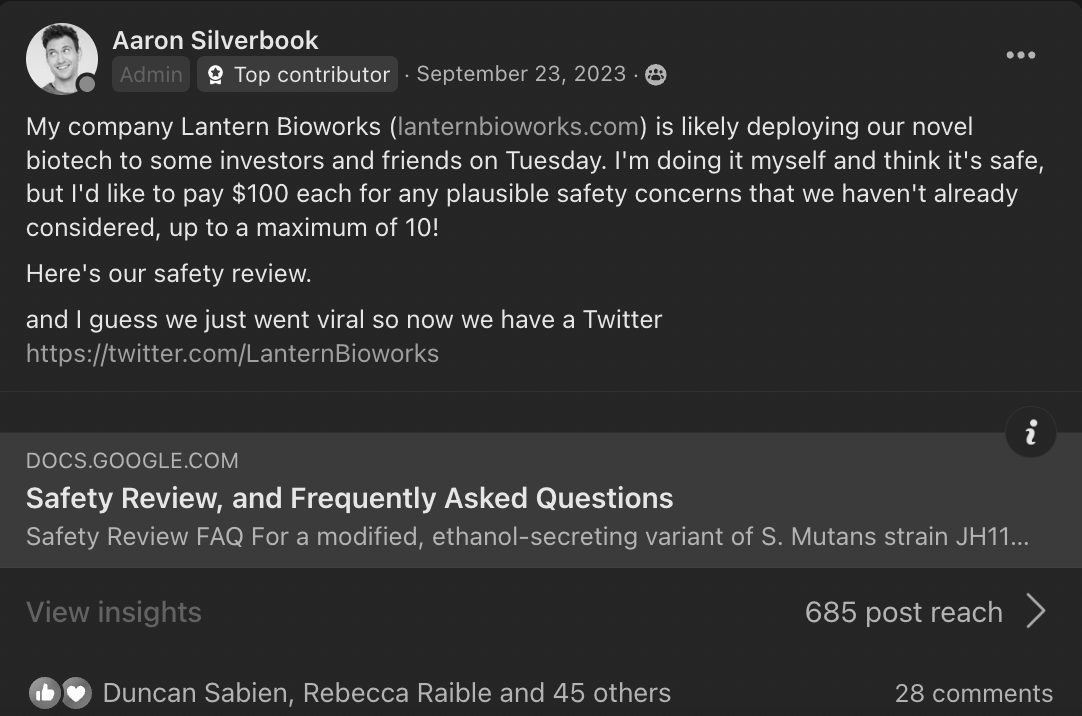
My facebook is in black and white, because I'm one of those dorks
Trevor made strong, false claims about our product without evidence, in a way which caused customers to seek refunds and caused supporters to reach out to me alarmed, and this made me annoyed enough that it was hard for me to treat his claims qua claims. Still, I should have gotten over that and done better at engaging with him in the cooperative spirit with which we've approached critics in the past. I shouldn’t have used language like “defamatory”, or mentioned that people were pressuring us to sue him. I should have been more mindful of how intimidating language like this can feel, and I apologize.
Now, to speak to the biology:
Section 1: Safety concerns about mutacin-1140.
The bacterial strain in Lumina Probiotic, BCS3-L1, secretes a lantibiotic, mutacin-1140. This allows it to gradually outcompete native S. mutans bacteria and colonize the teeth.
- Is there a health risk with intentionally introducing mutacin-1140 into the oral microbiome via inoculation with BCS3-L1?
(Responses from our science advisor Dr. Merritt)
There are a few key reasons why I am not particularly concerned about mutacin-1140 production from the Lumina strain. I'll briefly summarize them below:
Mutacin-1140 is synonymous with Mutacin III. This is a naturally occurring mutacin produced by certain strains of S. mutans. All wild strains of S. mutans produce at least 1 mutacin, with most strains probably producing multiple mutacins (see Mol Oral Microbiol. 2012 Apr;27(2):57-69. PMC3296966). Certain people already harbor S. mutans strains in their mouths that produce this mutacin. Bacteriocin production is a typical feature of virtually all Lactic Acid Bacteria, which include all Streptococcus species.
While the studies you cited imply potential negative impacts of systemic use of certain bacteriocins, this is not a fair comparison to the mutacin produced from the Lumina strain. The main reason is due to quantity. Bacteriocins are a natural component of normal growth competition between many different bacterial species (even inter-strain competition in some cases). The quantity of bacteriocins produced by bacteria in biofilms is only sufficient to kill organisms in the immediate vicinity (within millimeters at best).
- Will the mutacin from the bacteria reach the gut and give me diarrhea?
If mutacin from the mouth could reach the gut in harmful concentrations, we would already see people having gut issues from their normal, unmodified mouth bacteria.
(Again Dr. Merritt)
Bacteriocins, specifically, are very localized in their mechanism of action. Bacteriocins kill by forming pores in susceptible bacterial membranes. To do this, bacteriocin monomers need to oligomerize within the target bacterial membranes, and complete oligomerization only occurs when the effective concentration of bacteriocin reaches a required threshold, typically in the nanomolar range. The dilution provided by saliva production already ensures that bacteriocins cannot be effective beyond a very short distance away from the producer strain.
(He is, to my understanding, saying that tiny molecular threads of mutacin need to weave together with each other to open pores in cell membranes, and without a critical mass of those threads, no pores are opened.)
- Some bacteria swap genes via horizontal gene transfer, or via autolysis. Could the mutacin-1140 gene spread to other bacteria in my mouth, rendering them immune?
It is extremely unlikely. Gene transfer is rare, and rarer when you’re trying to transfer a rather large gene sequence (the gene sequence for mutacin-1140 is large). Also, BCS3-L1 lacks a different gene that makes gene transfer more likely, so the likelihood that BCS3-L1 transfers its mutacin-making abilities into another bacteria is very low.
It would be difficult to achieve this even if you were intentionally trying to make it happen in a lab.
(Again Dr. Merritt with more detail)
Firstly, S. mutans rarely lyses naturally, unlike some other streptococcal species. That said, S. mutans will still leak DNA into its surroundings as the cells die. This DNA could conceivably transform other naturally occurring wild S. mutans. Natural transformation is an exceedingly rare occurrence in nature and there are good reasons why this is so. The mutacin-1140 operon is quite large, as a number of different genes are required to produce this type of lantibiotic. This would make it even more difficult to move the mutacin-1140 phenotype into another S. mutans strain, especially when these strains are susceptible to mutacin-1140. They are far more likely to be killed by the mutacin first. There is strong evidence that bacteriocin genes are primarily shuttled around the biosphere by transposons, but little evidence implicating natural competence. The chances of mutacin-1140 moving into another S. mutans strain via natural competence are certainly not zero, but I would surmise it to be an exceedingly low chance.
Since the Lumina strain lacks comE [Editor’s note: a horizontal-gene-transmission facilitating gene], its ability to produce natural competence machinery is vastly impaired. That said, as mentioned above, natural transformation in vivo is exceptionally rare even for wild-type S. mutans. For a comE mutant, the rate of genetic exchange would be a fraction of this already miniscule chance. It would be tough to revert Lumina to a wild-type phenotype even in laboratory conditions.
Section 2: Concerns about manufacturing safety
Trevor has since edited out this section of his post after he and I spoke about his concerns, which I do consider honorable on his part.
Candidly, it didn’t occur to us that anyone might assume we weren’t abiding by good manufacturing practices. We’ve now updated our FAQ to reflect this.
Some notes:
-We autoclave all of our media, and use sealed, sterilized vessels for each stage of the growth process.
-Our contract manufacturer tests the batches to ensure an absence of contamination.
-We’re using industry-standard cell banking to ensure that the live bacterial cells are properly preserved & stored until use.
-We’ve sequenced the genome of the bacteria to confirm that it’s BCS3-L1, several times. You can evaluate that here; open the two html files for summary pages.
And maybe one day you’ll be able to torrent the strain to your benchtop bioprinter
Section 3: Miscellaneous concerns about the company
-Has Lumina given out free samples in exchange for positive press?
Nope! Though we’ve given out a lot of free samples, the majority of people don’t post about it. Though we appreciate the ones who do, especially if they post such a tour-de-force as Crem’s Thing.
-Trevor said you wanted to call him instead of emailing, to talk off-the-record. Why didn’t you want to email Trevor a lengthy writeup about BCS3-L1?
As we’re selling a probiotic product, I live in dread that I might accidentally post a druglike claim somewhere.
-Is Aella, the pornstar, associated with this project?
Yes. She advises us on marketing. And if you’ve heard of her, that’s an endorsement of her skills.
Section 4: Reflections
How did we get here? What could I have done differently?
One of the central jobs of the CEO is to be steady. It occurs to me now that everyone else in a startup will feel more agitated than the CEO does about external stressors, because they have less autonomy over the company’s actions. Folks with histories at big pharma companies, specifically, are going to feel a strongly “lawsuit”-flavored reaction towards what they read as over-the-line Fightin’ Words. I should have, honestly, listened less to investors and the team, rather than being amplified in the direction of outrage.
I was feeling rather activated, though, and wasn’t in a place for measured thinking. The correct move would have been to just post an updated Lumina FAQ which answered the concerns, and otherwise, completely ignore the post. Oops.
So, what do we do now?
Re: Trevor—the sense that I’ve gotten is that Trevor and I are both stubborn people who collided in a pretty inopportune way. We have very different perspectives on whether it’s good for people to have the right-to-try on new probiotics, and what different regulatory structures ought to cover.
I think that this is an important issue with a pretty clear crux—how many people are helped by institutions holding back worthless or hazardous products, vs harmed by delayed/prohibitive development pathways? I could see myself coming around to the other position, though it doesn’t seem likely to me right now.
Thanks.
Aaron Silverbook

 点赞
点赞 收藏
收藏 点踩
点踩 分享
分享