Theatre is bringing physics to new audiences but what is the definitive science play?
As audiences poured out of London’s Old Vic theatre on a crisp night in January, one theatregoer and their companion were overheard chatting about the second law of thermodynamics. “I wish I knew more about what they were discussing,” one remarked, referring to the characters in Tom Stoppard’s Arcadia. “It’s an unusual play,” the other responded.
Was this curiosity about thermodynamics a sign of confusion, that the production had failed to communicate its ideas clearly for a lay audience? Or had the evening in the theatre inspired a desire for these audience members to dig deeper and learn more about physics through the shared experience of watching a play?
Written in 1993, Arcadia is an early example of an ever-growing number of plays that have at their heart scientific ideas or scientists themselves. Newtonian determinism, chaos and iterated algorithms all crop up in Stoppard’s masterpiece, but Arcadia is a play about much more than just physics or mathematics.
With scenes alternating between a country house in the early 19th century and the present day, Arcadia is also a literary mystery about the poetry of Byron set against academic rivalry. Like all of Stoppard’s work, it’s an agile, clever and entertaining tour de force of ideas, led by characters who are just as concerned with traditional dramatic themes including love, jealousy and flawed ambition.
The Old Vic’s Arcadia was sufficiently popular with audiences that it received a transfer to London’s West End for an extended run in summer 2026. But it was not the only major revival of a classic “science play” in London this year, with Hampstead Theatre staging a new production of Michael Frayn’s Copenhagen.
Arguably no other play about physics has been as popular and successful as Copenhagen since it was first produced at the National Theatre in London 1998. It imagines what might have been discussed when Werner Heisenberg visited Niels Bohr at his home in the Danish capital during the Second World War. It also explores the implications of the meeting for the development of nuclear weapons.
Plays depicting physics or physicists fall into three main types. Some are straightforward biographical representations of physicists – from Lise Meitner to Stephen Hawking. Others focus on the process of “doing” physics. A third kind uses scientific concepts to structure the play itself. Copenhagen is perhaps unique in achieving all these feats at once.
Curtains up
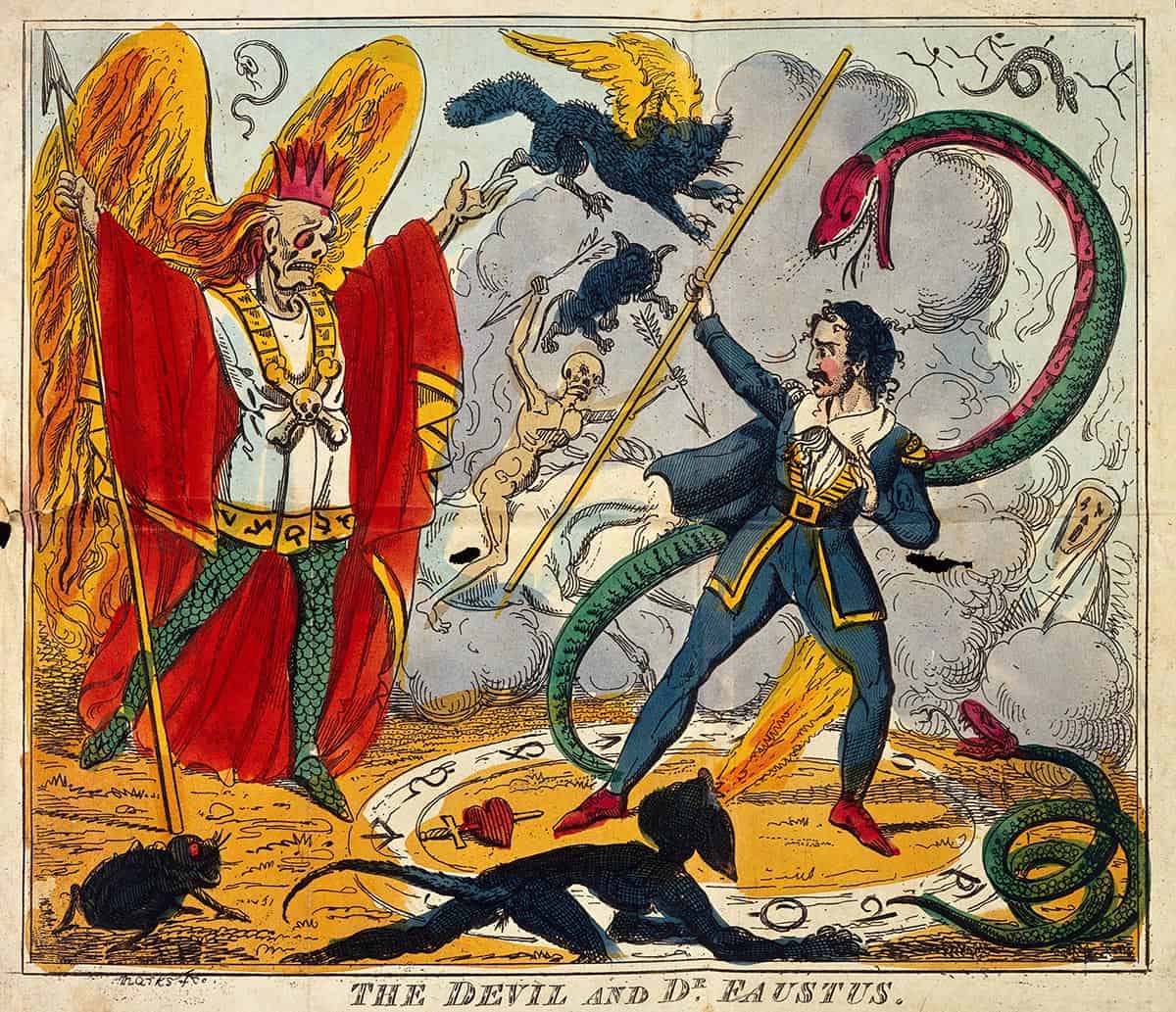
The representation of scientists on stage is not a new phenomenon. The ambitious alchemist and natural philosopher Doctor Faustus, who sold his soul to the devil in Christopher Marlowe’s 16th-century play of the same name, is one early example of a learned character who could be considered a scientist seeking worldly knowledge at a cost.
Later, in 1823, there was a highly popular stage adaption of Mary Shelley’s novel Frankenstein. Performed at the English Opera House in London, Presumption; or, the Fate of Frankenstein by Richard Brinsley Peake was what first brought Shelley’s book to public prominence, reigniting suspicions of the motivations of scientists as a potential force for good or evil.
While Frankenstein arguably led the way in the genre of science fiction, which I will not cover here, the notion of the “physics play”, where physics or physicists feature deeply, can be more readily traced to the 20th century. Bertolt Brecht’s A Life of Galileo, written in 1938, is perhaps one of the first clear examples to represent the life and work of a real scientist on stage.
First performed in German in Zurich in 1943, A Life of Galileo presents the audience with an account of a scientist whose life is well documented in the historical record. It depicts scenes from Galileo’s life including his prosecution for heresy by the church for promoting the heliocentric universe.
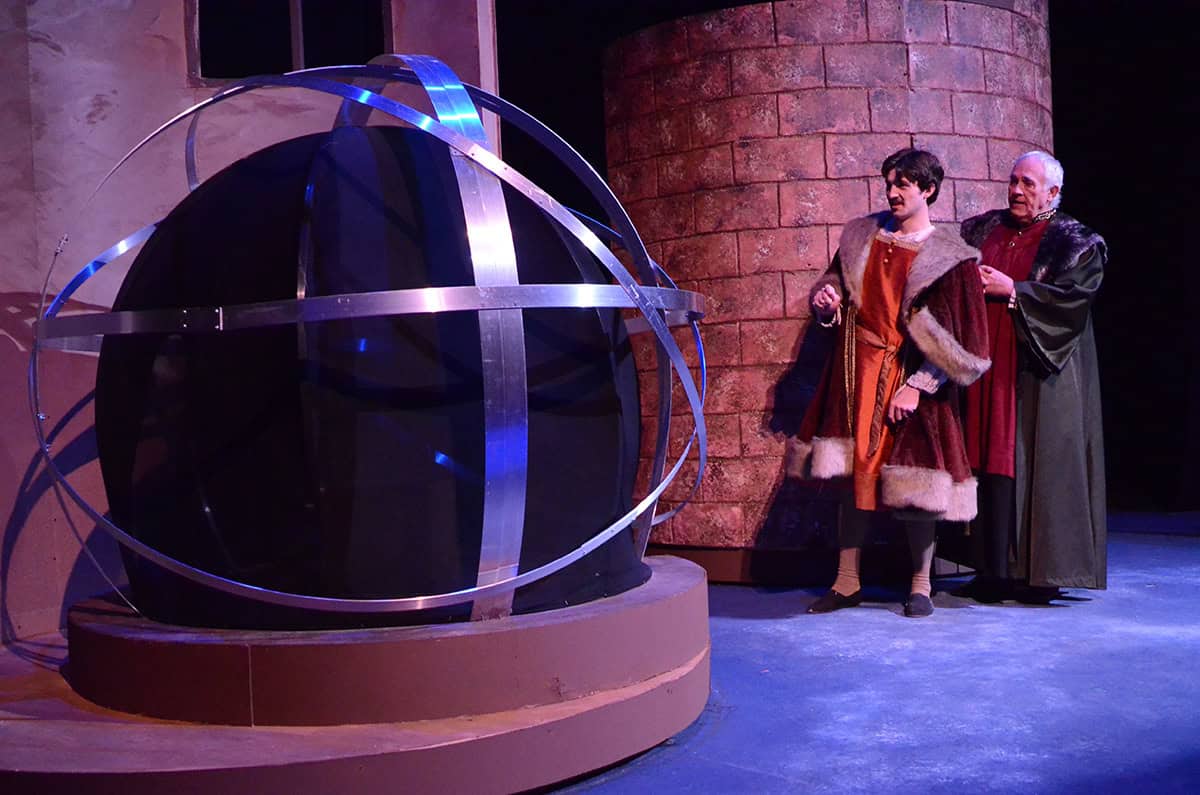
Since then we’ve seen plenty of other plays about real-life physicists. Also dealing with the heliocentric solar system is acclaimed science writer Dava Sobel’s short 2011 play And the Sun Stood Still (first published in her book A More Perfect Heaven). It concerns an episode in the life of Nicolaus Copernicus, depicting his discussions with mathematician Georg Rheticus when he visited Poland in 1539.
The period of scientific advancement that followed in the 17th century is represented in a number of plays depicting the life of Isaac Newton. A notable example is Craig Baxter’s Let Newton Be!, a verbatim play based on Newton’s own words that was written to celebrate the University of Cambridge’s 800th anniversary in 2009.
It was performed by the Menagerie Theatre Company for the first time in 2009 at Trinity College, Cambridge, where Newton had once been a fellow. Three actors simultaneously portray Newton at different points in his life, from boyhood to establishment figure, continually interacting with each other on stage. Baxter aims to give a less conventional perspective on Newton’s life than the usual image of a scientist beneath an apple tree.
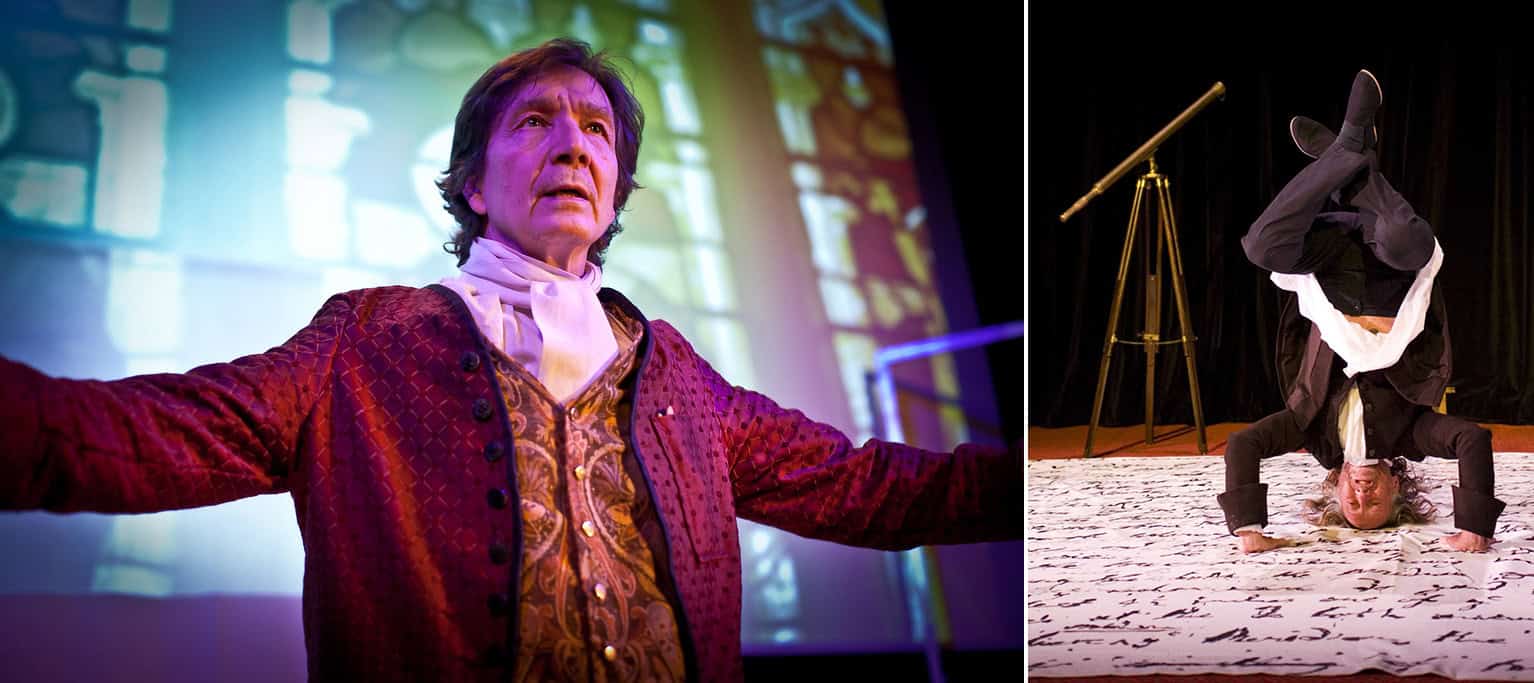
Newton’s contemporary and arch enemy Robert Hooke was also memorably represented by the actor Chris Barnes in Siobhán Nicholas’ 2008 one-man play Hanging Hooke. It was toured by Take the Space theatre company, which Barnes co-founded, to venues across the UK, including a performance at the Royal Society itself.
In a follow-up to Hanging Hooke, Take the Space also represented the contributions to astronomy of Caroline Herschel in the 18th and 19th centuries. Her work, which is arguably less well known than that of her brother William Herschel, appeared in STELLA: a Story of Women, Their Men and Astronomy, also written by Nicholas.
Centre stage
Some episodes in the history of physics are more thoroughly documented then others, lending rich source material for drama. Such is the case in Katherine Moar’s play Farm Hall about the German physicists who were famously held captive in a country house in Cambridgeshire, UK, at the end of the Second World War.
The play features six characters, all of them real scientists, including Heisenberg, Kurt Diebner and the pioneering radiochemist Otto Hahn. Their words were secretly recorded by their British military captors in 1945 in an attempt to find out how close, if at all, the German scientists were to developing a nuclear bomb.
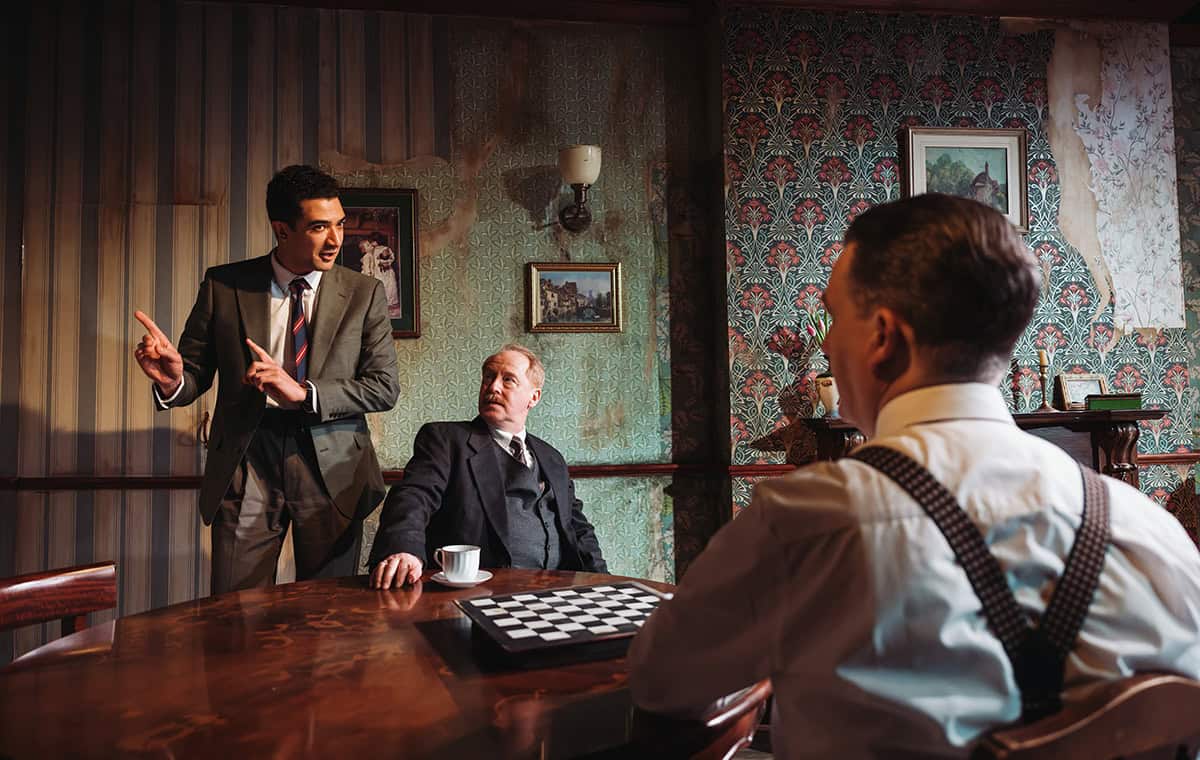
Moar’s play is one of several that use the Farm Hall transcripts as the basis of a play text, another being Operation Epsilon by US playwright Alan Brody. Originally written in 2013, it received its British premier at the Southwark Playhouse in London in 2023, and examines the ethics of those involved in nuclear weapons programmes.
That theme was also tackled in Christopher Nolan’s blockbuster movie Oppenheimer, which was one of the biggest film successes of recent years. However, J Robert Oppenheimer has been represented on stage too, not least in Tom Morton-Smith’s 2015 play Oppenheimer, in which key figures in the Manhattan nuclear-bomb project were re-enacted in a large-scale production at the Royal Shakespeare Company (RSC).
Morton-Smith’s play aimed to capture the scale and scope of a so-called Shakespearean “history play”, with a significant but flawed character at its heart, although this is arguably a tough feat to achieve. In fact, Oppenheimer played at the RSC in Stratford-upon-Avon simultaneously with Hamlet.
Dramatis personae
In each of the examples above, the physicists portrayed are real people, whose names and work will be familiar from textbooks and the historical record. Other physicists to have been the subject of plays include Jocelyn Bell Burnell, Ludwig Boltzman and Wolfgang Pauli, while Nicole Kidman played DNA-structure pioneer Rosalind Franklin in Anna Ziegler’s Photograph 51.
Physicists as fictional characters and the act of doing physics are also increasingly being represented on stage, with collaboration in big-science projects becoming central
However, physicists as fictional characters and the act of doing physics are also increasingly being represented on stage, with collaboration in big-science projects becoming central. Especially fruitful as source material have been activities at CERN and particularly the Large Hadron Collider (LHC), which gained growing public awareness during the hunt for the Higgs boson in the first two decades of the 21st century.
Playwright Lucy Kirkwood had already published a play with nuclear scientists as characters in The Children in 2016. But it was her play Mosquitoes, produced at the National Theatre in 2017, that centred scientific themes. Many scenes are set at the LHC and its central character, Alice, is a research physicist based in Geneva who has a complex relationship with her sister, Jenny.
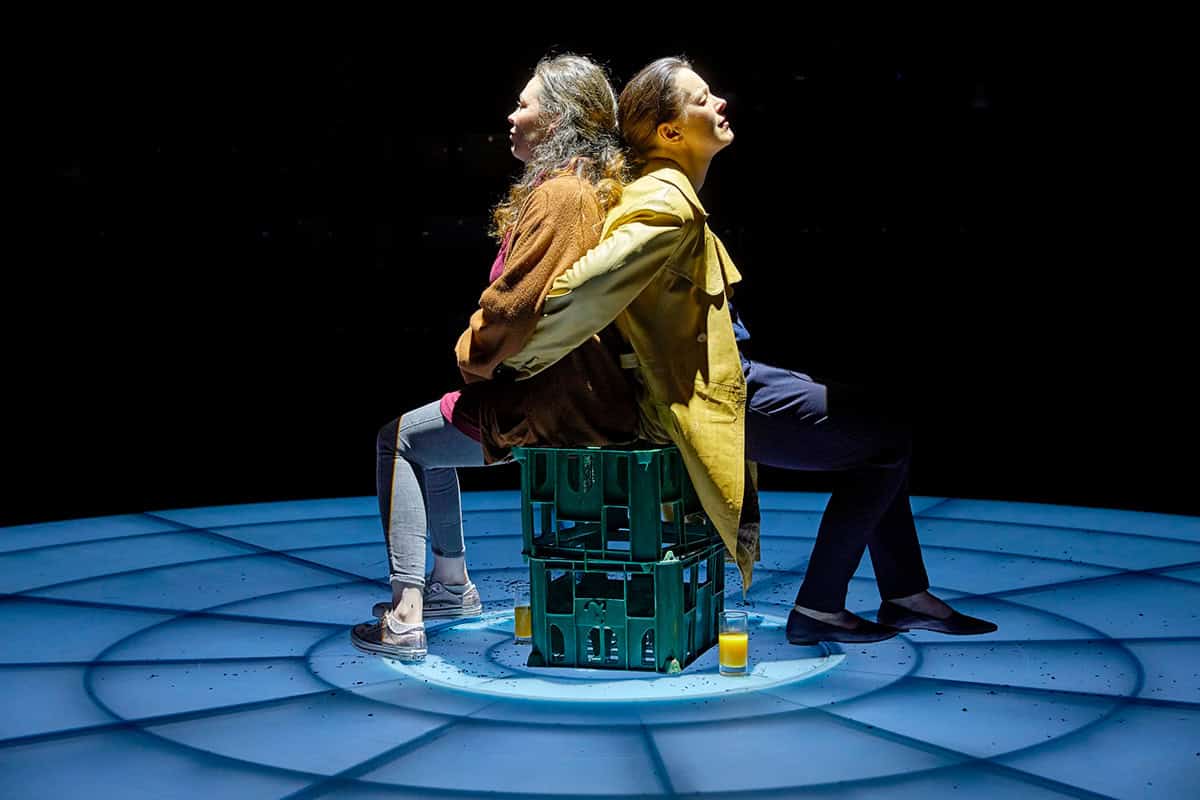
The play’s depiction of the two sisters centralizes the process of collaboration that is key to large-scale science research. Olivia Colman and Olivia Williams played the main characters in Mosquitoes in the National Theatre production, which benefited from some funding from the Institute of Physics, which publishes Physics World.
On a smaller scale to Mosquitoes, but also set in the periphery of CERN, is Morton-Smith’s one act play The Earthworks. Set on the eve of the switch on of the LHC, it features two strangers – a journalist and a physicist – who meet in a hotel bar in Geneva and talk about their loves and fears.
The anticipation and magnitude of the imminent new experiment gives the two characters cause to reevaluate their own lives and relationships. Although not widely produced, The Earthworks is an engaging short drama that again normalizes the process of big science in the wider cultural context through theatre.
Structured text
Featuring a physicist as a main character is also key to Constellations by Nick Payne, a playwright who has often included scientific ideas in his work. First performed in 2012 at the Royal Court Theatre, it features a physicist and beekeeper who meet at a picnic and begin a series of scenes replayed over and over again.
Unlike straightforward biographical-style plays, Constellations is a great example of a play that uses a scientific principle as a metaphorical device to help shape the play itself. Its structure is essentially inspired by the “multiverse” interpretation of physics, which implies there may be a potentially infinite number of copies of ourselves in different worlds.
The many iterations of similar scenes in Constellations make it a challenging production for actors – although not necessarily for audiences, provided the acting is good. And having only two characters on stage proved handy during the COVID-19 pandemic, when strict social-distancing rules meant it was helpful to have such a small cast.
In fact, when Constellations was revived in 2021 at the Vaudeville Theatre in London, different pairs of celebrity actors were used in different performances. Pairings included Peter Capaldi with Zoë Wanamaker, and Omari Douglas with Russell Tovey.
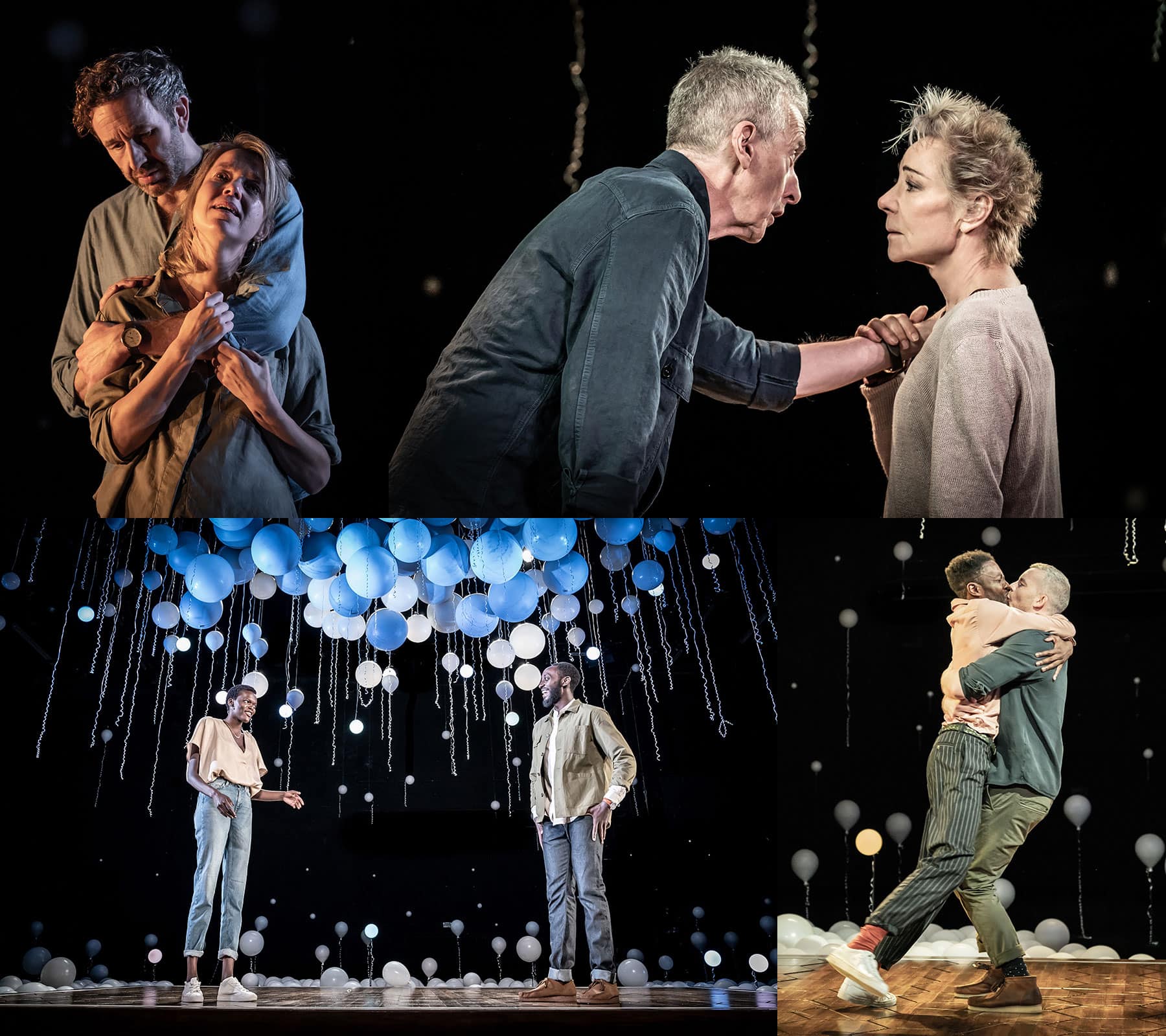
“I loved staging Constellations,” says the theatre director Michael Longhurst, who originally worked with Payne on the play. “When a writer does that work to understand the science for us lay audience members and then puts them into a human context in a dramatic setting, then I think there is a real gift.”
Incorporating physics into the structure of a play has also been tackled more than once by Tom Stoppard, who died last year. In Hapgood, his attempt at a spy thriller, quantum physics plays a role in structuring the play by experimenting with quantum uncertainty as a plot device. First performed in 1988, the complexity of the plot proved confusing for audiences and, although revived subsequently, it was one of Stoppard’s less successful plays.
The bewildering twists and turns of Hapgood are in strong contrast to Arcadia, which has proved a far more popular science-themed play from the great playwright. It toys with ideas of determinism and iterated algorithms in a rich drama.
Like many Stoppard plays, audiences appreciate the playfulness of ideas but can at times feel alienated by the complexity of the discourse. Nonetheless, Arcadia is a hugely significant play when it comes to science in theatre and its recent success at the Old Vic and subsequent West End transfer over 33 years later is evidence of its endurance.
It’s worth nothing, however, the existence of several plays that appear to have a strong physics connection – but in fact have very little at all. Notable examples include Friedrich Dürrenmatt’s 1962 play The Physicists (which was more of a satire) and Simon Stephens’ 2015 play Heisenberg: the Uncertainty Principle. Stephens was perhaps capitalizing on a growing public awareness of “uncertainty”.
Copenhagen: the definitive physics play
Conversely, you could be forgiven for thinking that a play called Copenhagen would be largely about the Danish city. But Frayn’s drama is one of the most significant examples of a play about and featuring physicists. With just three actors on stage and minimal set or plot, it is perhaps a surprise that Copenhagen could capture the attention of theatre goers for over two hours.
However, the text is a richly researched and thought-provoking drama that successfully achieves several things at once. First, it is a faithful account of the lives and work of Bohr and Heisenberg, insofar as we can know these two Nobel-prize-winning physicists, provoking historically meaningful questions.
Second, it gives an audience a sense of the excitement, frustration and invigoration of the act of doing science through the reminiscences and insights of its characters reflecting on the heyday of the development of quantum theory.
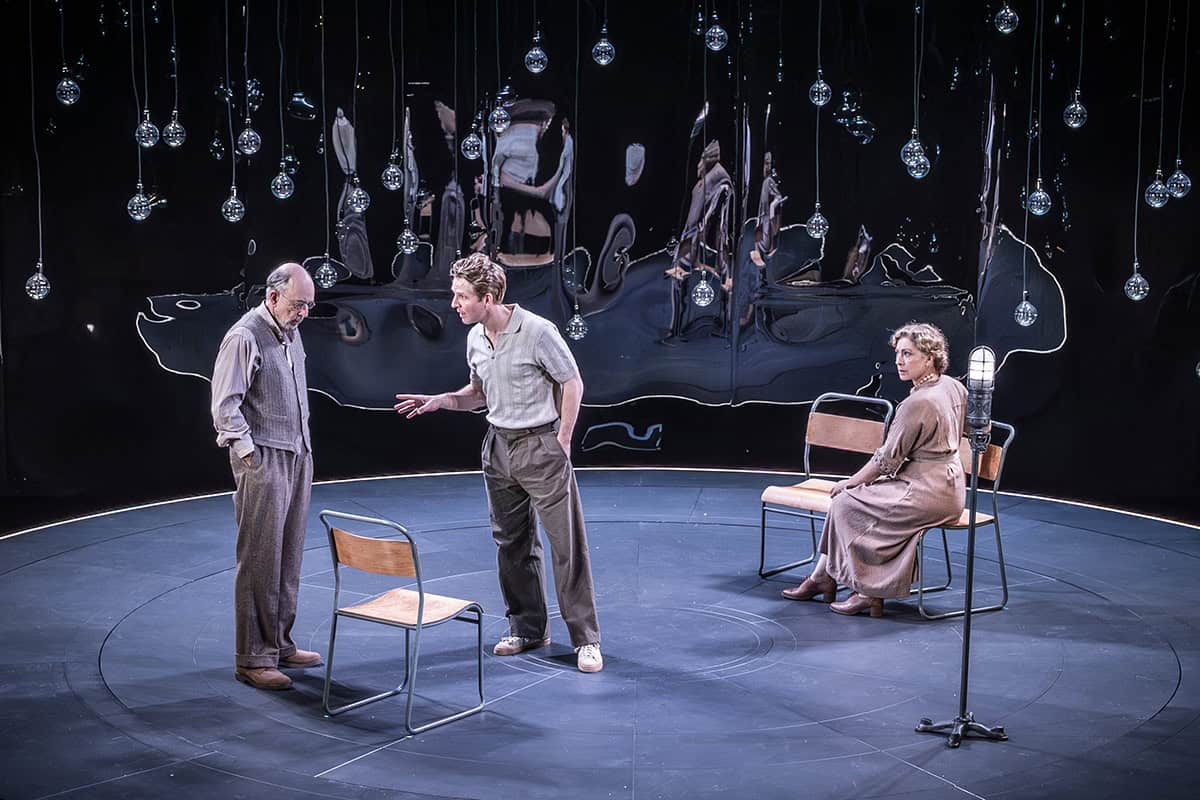
Third, it successfully embeds concepts of uncertainty and complementarity within the text and structure of the play itself – in a way that other writers have fallen short of achieving. Copenhagen perhaps stands out among all other plays that deal with physics as achieving all three of these things at once, accounting for some of its enduring appeal, not least to physicists.
In a conversation with Physics World earlier this year, Frayn admitted that physicists hadn’t held back in pointing out mistakes. “Some of the physicists who have seen Copenhagen have taken the trouble to write to me and to point out errors I had made in the science, in spite of all my efforts,” he says. “I have as a result made a number of corrections in succeeding productions over the years. I am very grateful to them.”
Copenhagen tackles the historical and moral dimensions of nuclear weapons in a way that is as relevant today as when it was written
The care with which Frayn researched and adapted Copenhagen enables it to tackle the historical and moral dimensions of the development of nuclear weapons in a way that has made it as relevant today as when it was written. The production at Hampstead Theatre in spring 2026 was the latest in a long line of revivals of the play around the world since its first critical and popular success in 1998. In addition to Howard Davies’ 2002 film version, Emma Harding adapted Copenhagen for radio in 2013, featuring Simon Russell Beale, Benedict Cumberbatch and Gretta Scacchi.
Curtains down
So were the Old Vic theatregoers wandering down the street after seeing Arcadia enthused or confused by their encounter with thermodynamics in the theatre? Should we celebrate or be sceptical of plays that put physics at their core? There is arguably no reason why physics should have a place in theatre any more or less than any other aspect of human endeavour.
However, as the importance of science becomes more embedded as an essential part of our culture in general, the role for physics in the theatre continues to grow. Current writers such as Moar and Kirkwood will continue to build on the achievements of the old guard such as Frayn and Stoppard, whether that be representing the history of physics, portraying physicists as characters or using science within the structure of a play.
In the rarest of cases all three can be achieved at once and it is intriguing to wonder how long it will be until another play comes along to match the might of Copenhagen as the definitive physics play.
- What do you think? What makes a good physics play and what’s your favourite production? Let us know by e-mailing pwld@ioppublishing.org
The post appeared first on Physics World.

 点赞
点赞 收藏
收藏 点踩
点踩 分享
分享