Running Business-Oriented Meetup in Rural Japan

My wife and I live and work in Kawaminami, a small rural town. While I’m primarily an independent mobile and web developer, I also work part-time as the community manager for a coworking space in Hyuga, and run a business-oriented meetup there once a month.
The past two years have proved to be both rewarding and challenging, as we’ve worked to build a group that values entrepreneurship, diversity and curiosity.
In the Japanese countryside, where networking opportunities are more limited than in a metropolitan area like Tokyo or Osaka, starting a meetup can be a great way to connect with your local community and find unique business opportunities.
You may be surprised what you all can create together, if you just jump in.
How it started
After a fun, yet suffocating, year of living in Namba, the heart of Osaka, my wife and I yearned for a slower pace of life. Osaka was fun at first, but we soon found the poor access to nature stressful and, despite being surrounded by people, felt no connection to our neighbourhood.
When we first started looking for a new home in the countryside, our priorities were warm weather, quick access to surf spots, and opportunities to get involved in a local community.
Japan’s Trial Stay programs
We soon found out about trial stay programs (variously お試し滞在, otameshi taizai, ちょっとぐらし, chotto gurashi, トライアルステイ, toraiaru sutei) available in many areas of rural Japan, and booked several one to four-week stays at various towns in Kochi and Miyazaki, as they are both prefectures that are well known for surfing.
Trial stays are programs run by many rural Japanese municipalities that lets people considering relocation live in the area for a short period, typically anywhere from a few days to a few months. The accommodation is provided by the town, and offered for free or at a heavily-subsidized rate.
The idea is to let prospective residents experience daily life, the climate, commuting distances, and the local community before committing to a move. Municipalities usually pair the stay with introductions to local support staff, home listings, and job or business resources.
Making those first connections
While on a trial stay in Hyuga, Japan’s surf capital with a population of roughly 56,000, I visited its local coworking space, Hyuga Base. I was first greeted by a friendly member of the space, Shuji, who coincidentally spoke great English and had studied for three years in my home country of Canada.
The coworking space is tucked in a quiet suburb, and was once a cafe operated by the owner’s parents. Inside there is space for 12, with a round center table and large TV display.
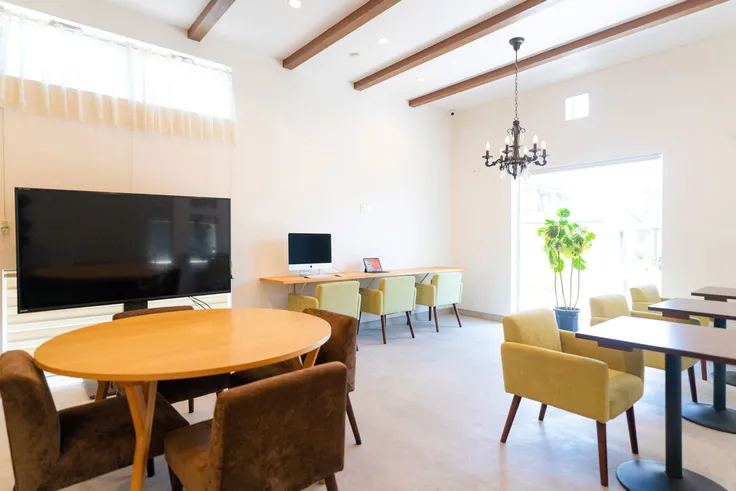
After using the space during my two-week-long stay in Hyuga, I had the opportunity to go out for dinner with Shuji and the owner of the space, Tsutsumi. Tsutsumi is actually based in Fukuoka but manages the space remotely as a passion project, in order to help revitalize the city. Hyuga, like most rural areas in Japan, is facing socioeconomic challenges due to population decline.
The initial proposal
After a few hours of dining on raw chicken sashimi and shochu, both local Miyazaki specialities, Tsutsumi proposed that—if I ended up moving to Hyuga—I should take on the role of community manager at the space, to organize some events and help bring in new members. To be honest, I thought he was a bit crazy asking me to assist him after meeting just one time. However, I could tell he was a very earnest man with a strong passion for helping his hometown.
Ultimately my wife and I ended up moving to nearby Kawaminami instead. However, Tsutsumi’s offer left a strong impression on me that I couldn’t forget, so I ended up committing to assisting the space as a community manager on a part-time basis.
Getting the meet-up going
When I joined the coworking space, I had total freedom as the community manager. The space had an Instagram account but no post history, aside from a pinned post showing the facilities.
Trying out different approaches
Given my part-time capacity, I made a few attempts at different types of meetups to see what stuck, including a business-exchange lunch and a start-up meetup.
Ultimately, I realized that Friday afternoons were a tough time to hold any sort of event, even among the self-employed in the town. What finally gained some traction was a monthly Friday evening meetup that was first focused on web development and design.
The first event
I’d been quite active in the local Osaka tech meetup, OKTech (formerly Osaka Web Development and Design Meetup), so I was passionate about creating a similar group in Hyuga. I wanted a community where local developers and designers could share the latest technologies they’ve been using and also network.
I started this meetup in the summer of 2024 by offering to present on one of my favourite web frameworks, Astro. After posting on Instagram, sending out invitations through our mailing list, and sharing via word-of-mouth, we had moderate turnout at the coworking space. We were also joined by a few remote attendees from the offices of Tsutsumi’s main IT firm in Fukuoka, who we were able to accommodate by pointing a laptop at the presenter.
I gave the presentation in English, with interpretation from one member. After the presentation, all the in-person attendees went out to an izakaya for drinks, where everyone was able to mingle further.
All in all, it was a great night and a turning point for the coworking space, as some attendees volunteered to give presentations at future events.
Evolving towards business
However, our original niche of web design and development was not sustainable.
We soon ran out of members willing to give presentations on web dev topics. Over time this triggered a shift in our group to be more broadly tech-related. More recently we’ve focused on business and entrepreneurship in general, covering topics such as how to run a business on your own terms and the psychology of branding.
While personally I miss the deeper conversations about web technologies, it’s been interesting to learn about a wider range of subjects. This is particularly true in the age of AI, as it seems every member’s industry is being impacted, from development and design, to videography, sales, education, and more.
How the meetup runs
Since then, we’ve continued this monthly meetup and typically have 6-10 attendees per night. We’ve have had presentations on a wide variety of topics, including:
- Node JS
- Headless CMS
- Career structuring for engineers
- Mobile app and game development
- Teaching programming to children
On months where we don’t have any volunteer speakers, we’ve defaulted to having a silent coworking session (もくもく会, mokumoku-kai) where everyone has a chance to share what they’ve been working on after an hour of focused work.
Outside of the monthly meetups, the group stays connected through a LINE group chat. Aside from being a gateway to weekend BBQ invitations, the group chat has also been a useful tool for members to share their latest projects and get feedback.
Since the time required for development has been cut so short, thanks to AI, it’s imperative to get real user feedback to determine whether to continue with a project or pivot.
How we continue to grow
Since we started, we’ve had attendees join our meetup organically by using the coworking space first. Many first-time users of the coworking space simply need a place to hold a meeting or study. As a community manager, I make sure to let them know about our monthly meetups. Many of them are surprised, but also delighted, to know that such a group exists.
Since we are based in Hyuga, we also have the occasional remote worker join our meetup after catching some waves in the morning.
While we’ve always posted still images about our meetups on Instagram and have gotten a few new members here and there from it, we are currently working on creating video content for the first time. We plan to showcase the coworking space, life in Hyuga, and our meetup community by posting short reels on Instagram. We hope these will do a much better job at showing the sort of warm and welcoming atmosphere we’ve created at the space.
As a leader of the meetup, I’ve also found it helpful to connect with members on a more individual basis when possible. An invitation out to lunch can go a long way in helping members feel more welcomed, as well as lead to possible collaboration opportunities.
Challenges in running a meetup in rural Japan
Size matters
As you’ve probably guessed already, the small population of the countryside is the biggest challenge we face with running our meetup. Over the past couple years we’ve hovered at around 6-10 participants per meetup, with spikes of 20-30 guests for larger events like our year-end party (忘年会, bounenkai).
While these numbers are only a quarter of the meetup size I experienced in Osaka, I’m still proud of the group given how much more rural Hyuga is in comparison.
At first glance a smaller group size may seem like a negative, but it’s also an advantage in the sense that members are less nervous and more open to giving presentations. It’s also been easy to stand out as a meetup, since there are few alternatives.
Language issues
I run the meetup primarily in my second language, Japanese, and that has brought its own challenges. I’ve given talks to our group in both Japanese and English with interpretation help, and naturally the ones I could give in English have gone more smoothly. Writing Instagram posts, introducing speakers, and chatting over drinks after presentations in Japanese is one thing, but going deep into the nuances of how headless content management systems (CMS) work is another. Still, it’s great practice.
We try to be a bilingual group by marketing in both English and Japanese, but the reality seems to be that there aren’t many other foreigners in Hyuga who are interested in a business meetup, or at least I haven’t found them yet.
Although our group has a surprising number of native Japanese members who speak great English, I would still recommend having a business level of Japanese for organizing a meetup like this in the countryside.
On occasion, Tsutsumi also has invited special guests like local business owners and the mayor and other politicians to our larger meetups such as our yearly end of the year party, which have been great opportunities for spreading the word about growing the community. During opportunities like these, it has been fairly crucial to have a strong grasp of Japanese in order to facilitate the meetup and network.
The measurable benefits of a business-oriented community
Both during my time in Osaka, and now in Miyazaki, participating in a meetup has been one of the best ways to further my career as an independent web and mobile developer. Our community in Hyuga has grown to be very collaborative. Some of the great opportunities our members have found include:
- Developers contracting with local IT firms on website and web app projects
- Designers doing illustration work for retail businesses
- A videographer creating a video series on remote workers that moved to Miyazaki, as way to pitch his services to local governments for marketing their townships
- The owner of a programming school facilitating a series of talks by other members on their respective industries for his young students
As for me, I started an event-management SaaS with another member, who also operates a lemonade brand out of a food truck on the weekend while working remotely for a game company in Tokyo. We began working on it after doing market research interviews with other members who own retail spaces or are involved with the planning committees for local events. Through one connection, we were able to pitch our product to Hyuga’s week-long Christmas Market, who will be using our platform this year to handle all their vendor management.
In addition to being a great place to exchange ideas, our community is also a supportive environment in a world that feels like it’s changing faster than we can keep track of. Many of our members are independent creative and knowledge workers who are required to quickly adapt to new AI-first approaches in their industries to stay competitive.
It has been tough for some, particularly those who need to continually market their services while also providing for their young families. We’ve found a sense of camaraderie in hearing how others are handling the AI shift in their respective industries.
Moving onward and upward
Going forward, our group is looking at ways to operate more as a non-profit organization.
Rural municipalities like Hyuga will often outsource projects to large cities like Tokyo or Fukuoka. Our hope is to be a gateway organization to find and hire talent at home, in order to improve the local economy.
Currently we are working on rebranding our group, and creating a website to showcase our members and the services they offer. If you’re interested in what we have going on in Hyuga, come visit us at Hyuga Base!
Can’t join ours? You should start your own
Meetups are great, and if there aren’t any in your area, I strongly recommend you start one. Aside from being a fun thing to do on a Friday night, they are a great way to make friends and find networking opportunities in your area.
While the countryside doesn’t initially seem full of hundreds of exciting business or startup opportunities like Tokyo or Osaka, you may be surprised by how many turn up once you jump into the local community.

 点赞
点赞 收藏
收藏 点踩
点踩 分享
分享