Production Companies, Literary Agents, Foreign Languages: AI-Driven Scams Continue to Morph


When I first began reporting on the aggressive AI-driven email scams that have been plaguing the Inboxes of authors everywhere for well over a year now, they were limited to marketing scams offering supposedly expert “visibility” for writers and their books.
In the year-plus since then, the scams have adapted and expanded in response to writers’ reactions and increasingly widespread reporting and discussion. In addition to marketing offers, they now include book club and review scams and a wide variety of impersonation scams, where the goal of initial contact is to steer writers through one or more referrals into paid editing or marketing arrangements. They’ve impersonated well-known writers, literary agents, editors at publishing houses, book festivals (with fake invites), and radio stations and hosts (with fake interview requests).
The one thing the scammers haven’t changed or adapted is the set of markers that have characterized the scams from the start: hyper-personalization coupled with lavish praise (thanks to generative AI) that makes it seem the sender has actual knowledge of the writer’s book; the almost universal use of Gmail addresses; banking/payment information that traces to scammers overseas; and extreme aggressiveness that paradoxically undercuts effectiveness (when you’re getting multiple flattering yet suspiciously similar solicitations every day, they start to seen a tad inauthentic). It’s a business built on volume, so only a small fraction of writers need to be fooled in order for the fraudsters to make money.
I’ve been trying to keep track of this scam wave, which is the most prolific and aggressive I’ve ever chronicled. Here, for example, is my list of frequently-impersonated companies and individuals, which I’m adding to daily, sometimes multiple times a day (not exaggerating here). And you can see all of my posts about the scams here.
All of this to say…sorry, I’ve got more for you.
Production Companies
While an earlier wave of foreign impersonation scams heavily focused on filmmakers and production companies, usually with the goal of tricking writers into paying big bucks for screenplays and other “book to screen” services that might or might not arrive and wouldn’t get them any closer to a movie deal even if they did, the current tsunami of AI-driven scams has exclusively–as far as I can tell–targeted books, publishing, and areas surrounding them (such as author interview shows).
Till now, that is. In recent weeks I’ve started getting reports of production company impersonations that bear the AI scams’ distinctive markers, including hyper-personalization and praise and the ubiquitous Gmail addresses.
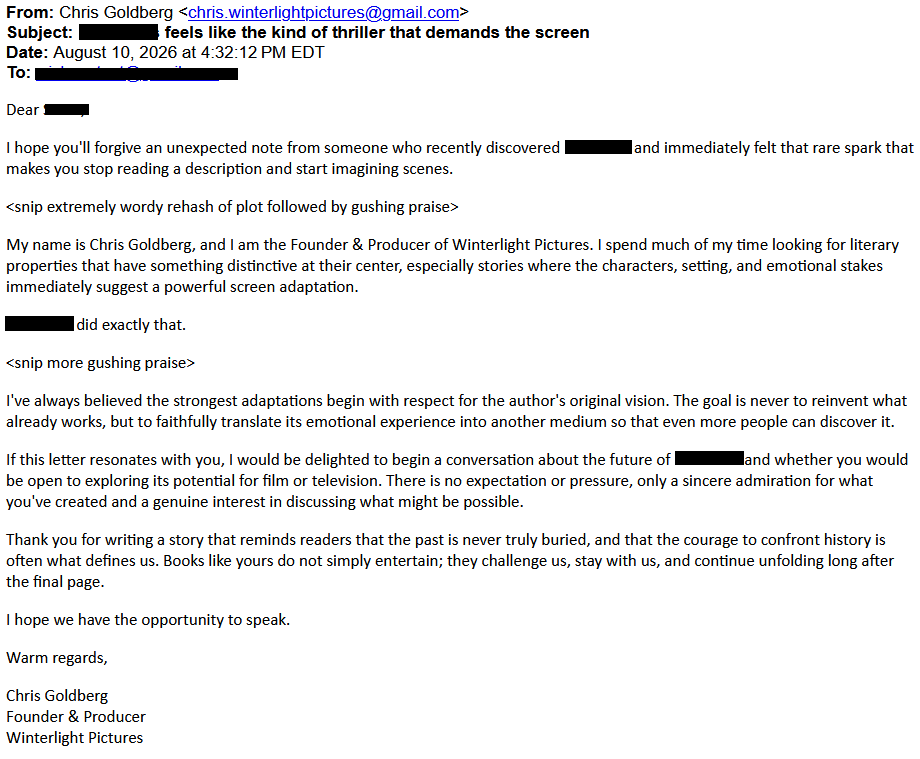
Note the way the address is formulated in the example above: sendername dot company name @ gmail.com. That’s very characteristic of impersonation scams (I’ve written a whole post about that and other scammer email tells).
The earlier production company impersonation scams are still active, so you could be targeted now on two fronts. The most important things to remember are that a) a production company reaching out to you directly is one of the least likely things ever to happen to you as a writer, and b) in the incredibly rare event that it does, the email will come from a company domain, not a Gmail or other non-professional address.
Literary Agent Impersonation Scams
This wouldn’t be the first time AI scammers have impersonated literary agents, but this new one I’m seeing is a bit different.
Basically, it’s a variation on the editor impersonation scam that is absolutely everywhere right now, except it’s a two step scam (fake agent to scam “editor”) rather than a three step scam (fake publishing house editor to fake agent to scam “editor”) and the emails tend to be less flowery and over-the-top. A literary agent (who, if you google them, is confirmably real) emails you out of the blue. As with the editor impersonation scam, they’re impressed with your work and want to know if you’re currently represented by a literary agent. Or they simply claim to want to know about you and what you’re working on. If you respond, the impersonator asks you to submit your query letter and manuscript, and after an improbably short period of just a few days, refers you to an “editor” who can fix whatever is wrong with your query letter or manuscript–for, of course, a sizeable fee. The scammer inhabits both personas.
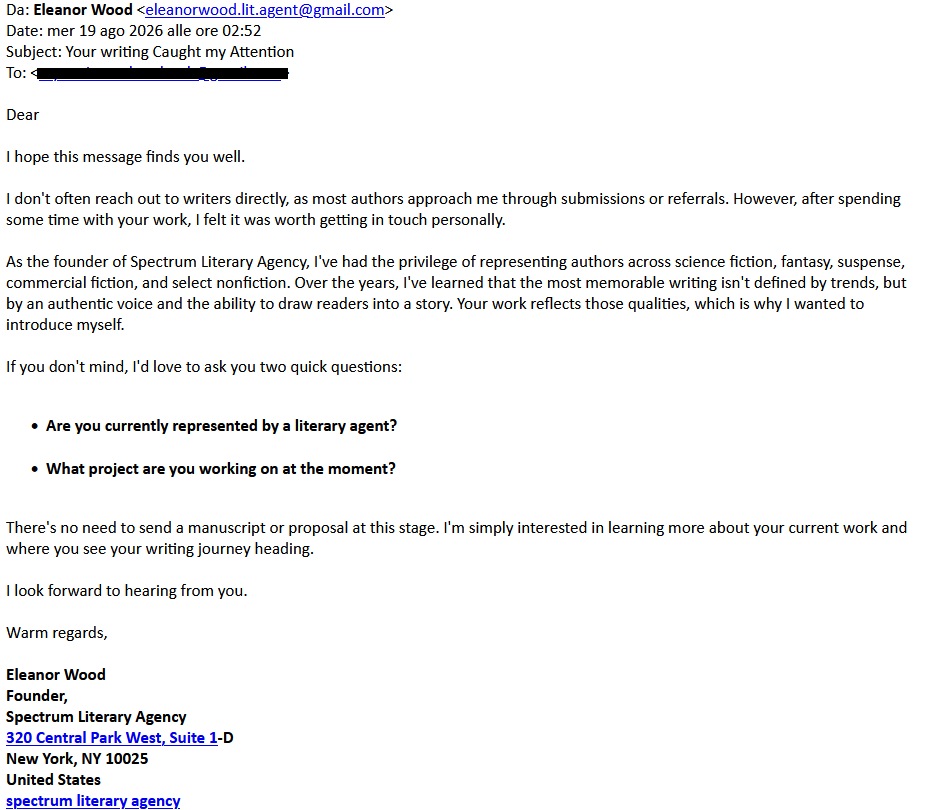
I’ve seen emails identical to the one above purportedly from Andrea Brown and Julia Churchill at AM Heath.
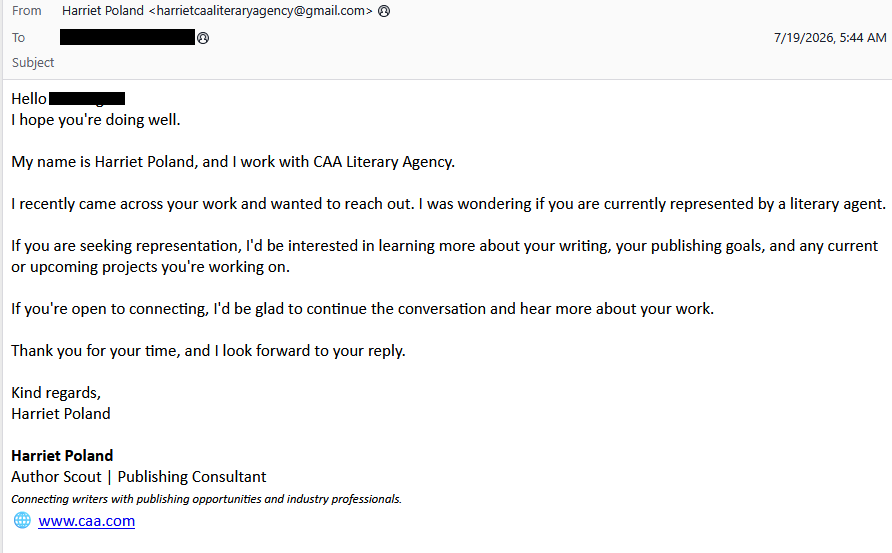
This one skips the flattery, but also features the type of wonky Gmail address formulation you often see with these solicitations, where the name of the impersonated person is mashed together with their agency or publishing house.
Congratulations, Non-English-Speaking Writers, It’s Your Turn
All of the foreign scams I’m tracking–publishing and marketing scams from the Philippines, ghostwriting scams from South Asia (which pose online as self-publishing service providers), and the current wave of AI-driven scams that I’ve repeatedly traced to Nigeria and Nigerian individuals–have exclusively focused their efforts on English-speaking writers in the US, UK, Australia, New Zealand, and wherever else they can be found. The solicitations, the websites, and the advertising are all in English–as are the phone calls (though the callers typically have heavy accents).
That may be changing.
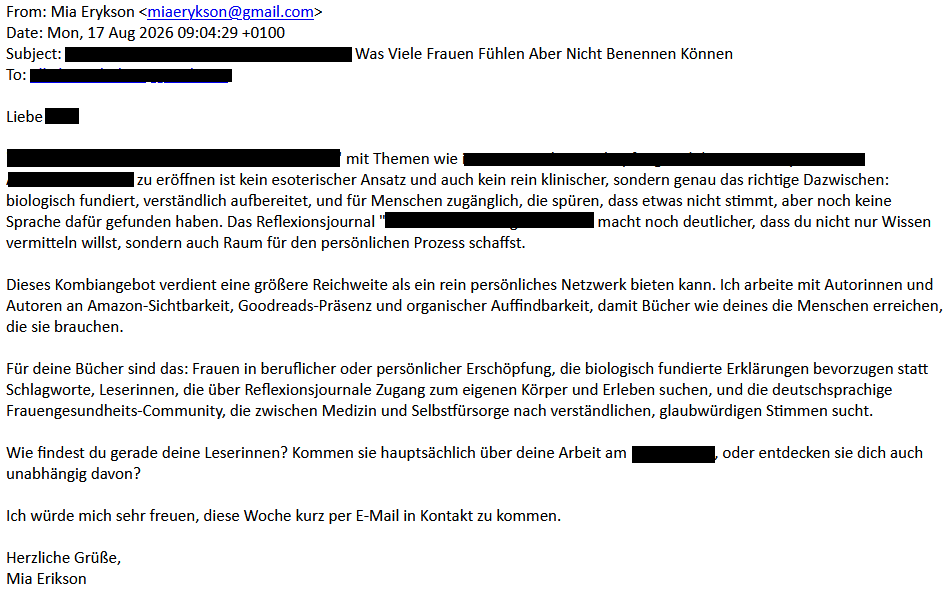
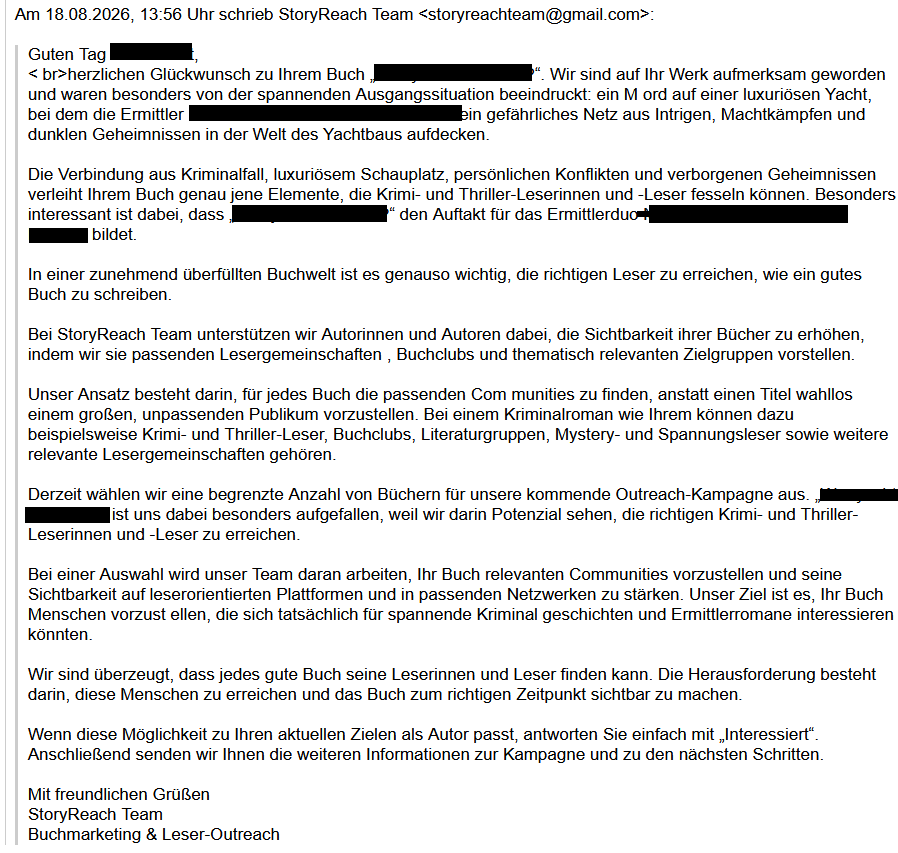
Just in the last couple of weeks, I’ve gotten several reports of marketing solicitations in German. Despite the language switch-up, they are clearly examples of the AI scam wave–Gmail addresses, personalization and praise, marketers who can’t be found online–and target authors in exactly the same way.
This one, whose Gmail address doesn’t quite match the name in the signature (Erikson vs. Erykson; such discrepancies are a common scam marker) is purportedly from a marketing expert who specializes in “Amazon visibility, Goodreads presence, and organic discoverability”–all offerings that will be very familiar to anyone who has been targeted by a Gmail marketing scam.
Note also the next to last paragraph, which invites the receipient to respond to a series of questions: “How do you find your readers? Do they primarily come through your work at the , or do they discover you independently?” This kind of friendly, open-ended inquiry is a common ingredient of AI marketing solicitations: it’s intended to incentivize response, so that the scammer can draw the writer in over an often-lengthy series of email exchanges designed to make it harder to say “no” when the money ask finally arrives.
This one is also a highly personalized marketing pitch, with the scammer (whose “team” has zero web presence) claiming to “increase the visibility of [authors’] books by introducing them to relevant readership groups, book clubs, and thematically appropriate audiences.” It too closes with an invitation to respond, but makes it super-easy: “If this opportunity aligns with your current goals as an author, simply reply with “Interested.” We will then send you further information about the campaign and the next steps.”
Additional AI-Driven Email Scam-Spotting Tips
As AI-driven scams continue to change and evolve, writers need to be ever more on their guard. We live now in a world where all writers are fair game, and any out-of-the-blue email or phone call related to your creative work has to be suspect, at least until you can determine that it’s not.
In addition to the specific warnings above and in my other posts, watch out for these:
Non-typical salutations. Using myself as an example: Dear Victoria Strauss, rather than the more normal Dear Victoria or Dear Ms. Strauss. Ditto for Dear Author. Or no salutation at all. (First name/last name is the one I see most often.)
Extended and apparently accurate discussions of your book’s theme and plot points, coupled with effusive praise. A genuine contact won’t necessarily not include these–but both are established scam M.O.s, and should always prompt extra caution.
Emojis. When I first started getting reports of AI-driven marketing scams in the summer of last year, many of the emails were littered with emojis (you can see an example toward the end of this post). Marketing professionals communicate professionally, which means not writing emails that look like social media posts. I’m not seeing this so often nowadays, but it is still something to watch for, and a big caution sign.
Interminable email exchanges. As noted above, AI-driven marketing scams, especially, employ a boiled-frog approach, where they ease you gently toward the actual money ask over the course of multiple emails, with each email re-emphasizing how great they think you are and how excellently they can help you. It’s classic emotional manipulation: the deeper you’re drawn into the interaction, the more invested you become, the more plausible the scammer’s promises start to seem, and the harder it will ultimately be (the scammer hopes) for you to say no.
Insistent nudging. Scammers want to close the deal as fast as possible, so if you don’t respond right away (especially to payment requests) they may repeatedly check back in with “just following up on my last email” or “wondering if you’ve had a chance to evaluate my offer” communications–sometimes within hours of when they last contacted you.
Fees where they aren’t normally charged.This is always a warning sign. For example, real book clubs, radio shows, and conferences don’t charge fees to invited guests. The process of rights acquiition–such as optioning your movie rights–should never involve a fee or purchase requirement.
Non-reversible payment methods. Instead of credit card transactions, scammers will often require payment by methods that are difficult or impossible to dispute or reverse: wire transfers, Upwork or Fiverr invoices, Paypal Friends and Family, apps like Zelle or CashApp.
Invoices that lack vital information like names, addresses, and phone numbers. Scammers want to avoid accountability. Never pay an invoice that doesn’t offer full disclosure of the provider, their business, and how to contact the person.
The post Production Companies, Literary Agents, Foreign Languages: AI-Driven Scams Continue to Morph appeared first on Writer Beware.

 点赞
点赞 收藏
收藏 点踩
点踩 分享
分享