Earthquake fault irregularities control rupture speed and influence ground motion

Earthquakes that propagate at higher speeds make the ground move more than it would in slower but otherwise comparable earthquakes, say geophysicists. Using physics-based models, Mohamed Abdelmeguid and colleagues at the California Institute of Technology in the US showed that so-called “supershear” ruptures produce stronger and longer-duration ground motion than equivalent subshear ruptures. Because models of ground motion that underpin infrastructure standards do not account for this effect, these models may need to be updated to accurately describe hazards such as the 2025 Myanmar earthquake, which produced supershear ruptures in both directions.
Geophysicists have identified two categories of earthquake based on how fast their ruptures propagate through the Earth’s crust. Shear waves, or S waves, travel at certain expected velocities (the shear-wave velocity) depending on the stiffness and density of the ground. When a rupture travels faster than the shear-wave velocity of the surrounding ground, it is termed a supershear earthquake. Otherwise, it is subshear.
Although Abdelmeguid notes that supershear ruptures were first predicted theoretically in the 1970s, and have subsequently been observed in both laboratory experiments and the real world, most previous studies focused on their underlying mechanisms and the transition from subshear to supershear. The new study, which appears in the Bulletin of the Seismological Society of America, goes a step further by examining how the ground motion in a supershear quake differs from that of an otherwise comparable subshear one. The question is relevant, Abdelmeguid says, because nearly 36% of strike-slip earthquakes during the past 15 years contained supershear rupture, yet existing models do not factor it in.
Supershear simulations
To address this gap, Abdelmeguid and colleagues developed a dynamic rupture model that generates simulated ground motion data and used it to identify the characteristics of supershear earthquakes. They found that prolonged supershear propagation produces what they term “a distinct spatial pattern of stronger and longer-duration shaking”. However, episodic supershear segments, where rupture speed intermittently changes between supershear and subshear, produce ground motion similar to subshear ruptures.
Simulations like these are important because some supershear rupture scenarios are poorly represented in the observational record. This record is used to develop ground motion models, so simulations can “reveal physical dependencies that may not be apparent from existing observations,” Abdelmeguid says.
Characterizing the 2025 Myanmar earthquake
The 2025 Myanmar earthquake – a supershear quake in which many regions experienced higher than expected ground shaking – is a case in point. It occurred on the 1200-kilometre-long Sagaing Fault, which lies at the boundary of the Burma microplate and the Sunda plate and is not far from Mandalay, the country’s second-largest city. At magnitude 7.7, it was the largest earthquake in Myanmar in over a century, and the long rupture meant that large parts of Myanmar and Thailand were affected, with thousands of deaths and injuries as well as severe damage to infrastructure.
Initial studies were inconclusive about whether this earthquake’s rupture exhibited intermittent or sustained supershear speed. This lack of consensus is partly because recording intermittent supershear rupture is challenging when near-fault sensors are sparse, as is the case in Myanmar (and indeed most countries, with notable exceptions such as Japan, Taiwan, New Zealand and parts of the US).
A new study published in PNAS addresses this question. Using satellite earth observations, teleseismic data and CCTV footage as well as the available near-fault seismic sensor data, researchers led by Lingling Ye at China’s Southern University of Science and Technology modelled the rupture process of the Myanmar quake. The result, Ye says, is a “well-resolved rupture process” that “reveals previously unrecognized dynamic rupture features”. Notably, the team’s simulations showed that the rupture transitioned between supershear and subshear as it tore through around 460 kilometres of the country.
Influence of geometry and stress distribution
To understand the cause of these variations, the researchers examined the geometry and stress distribution along the fault. Based on an existing fault model, they calculated a parameter called fault misalignment, which acts as an indicator for irregularities in the fault geometry. Higher fault misalignment, for example, indicates higher bends and branches in the fault.
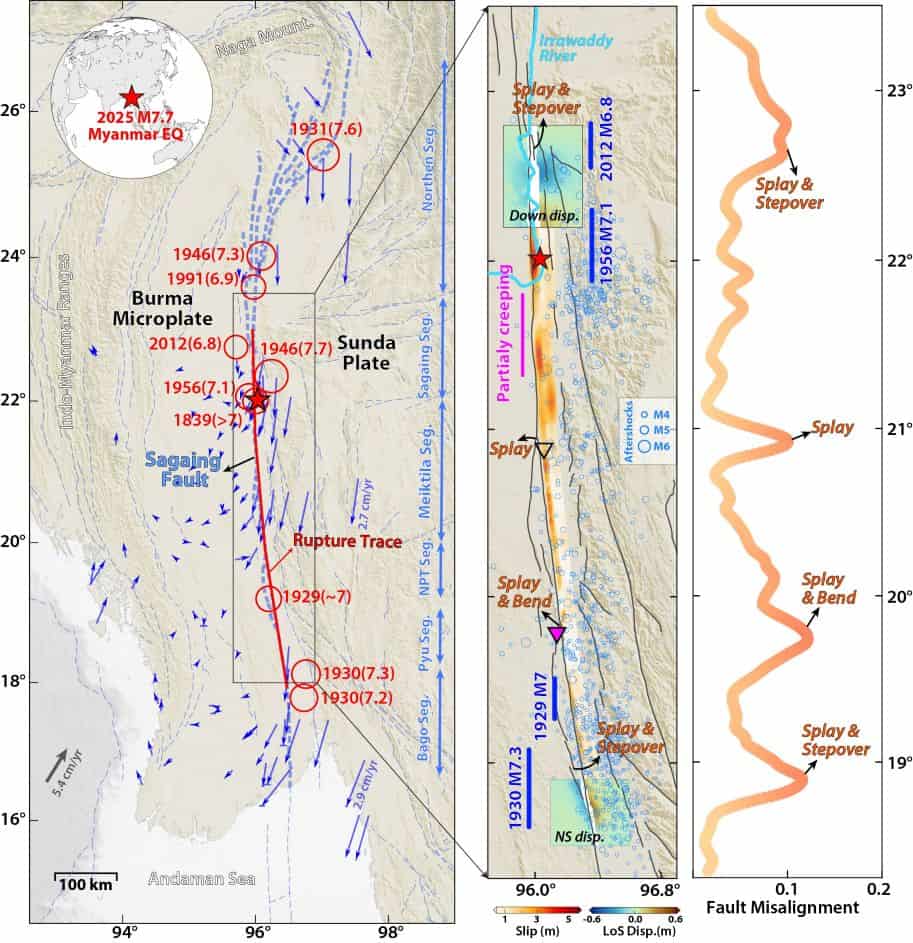
When the researchers overlaid fault misalignment with the observed rupture speed, they noticed that supershear speeds coincided with fault stretches that had lower misalignment. For fault stretches with higher misalignment, subshear speed prevailed, meaning that the rupture decelerates at locations with high fault misalignment, transitioning from supershear to subshear. The researchers also found that the rupture speed, whether supershear or subshear, responded to the varying levels of local stress, with higher stress levels inducing faster rupture speed.
Although not unique in exhibiting supershear behaviour, the 2025 Myanmar earthquake was the first known instance where supershear rupture propagated away from the epicentre on both sides, travelling around 80 kilometres to the north and 380 kilometres to the south. The researchers claim that the shorter northern rupture length is caused by a combination of the fault’s complex structure and low accumulated stress resulting from the magnitude 6.8 earthquake that struck in 2012.
“Every earthquake has unique behaviour”
In future work, Ye is eager to revisit the 2023 Turkey doublet earthquakes, which she says have many more near-fault strong motion observations than the 2025 Myanmar quake, as well as a now well characterized complex fault system. “Every earthquake has unique behaviour,” she says. “Determining the key features that control their rupture processes is still underway.”
For Abdelmeguid, who recently started his own research group at the University of Houston, US, understanding these complex rupture processes is important because it will ultimately improve our understanding of geophysical processes and the ground motion models that are used for engineering applications. “We are currently extending this work to examine ground motions generated by ruptures on more complex faults, including cases in which fault geometry and heterogeneity influence both ground motion and the dynamic process, as observed during the multiple earthquakes,” he tells Physics World.
The post appeared first on Physics World.

 点赞
点赞 收藏
收藏 点踩
点踩 分享
分享