Trump Administration Executive Order for New AI Regulator Stalls

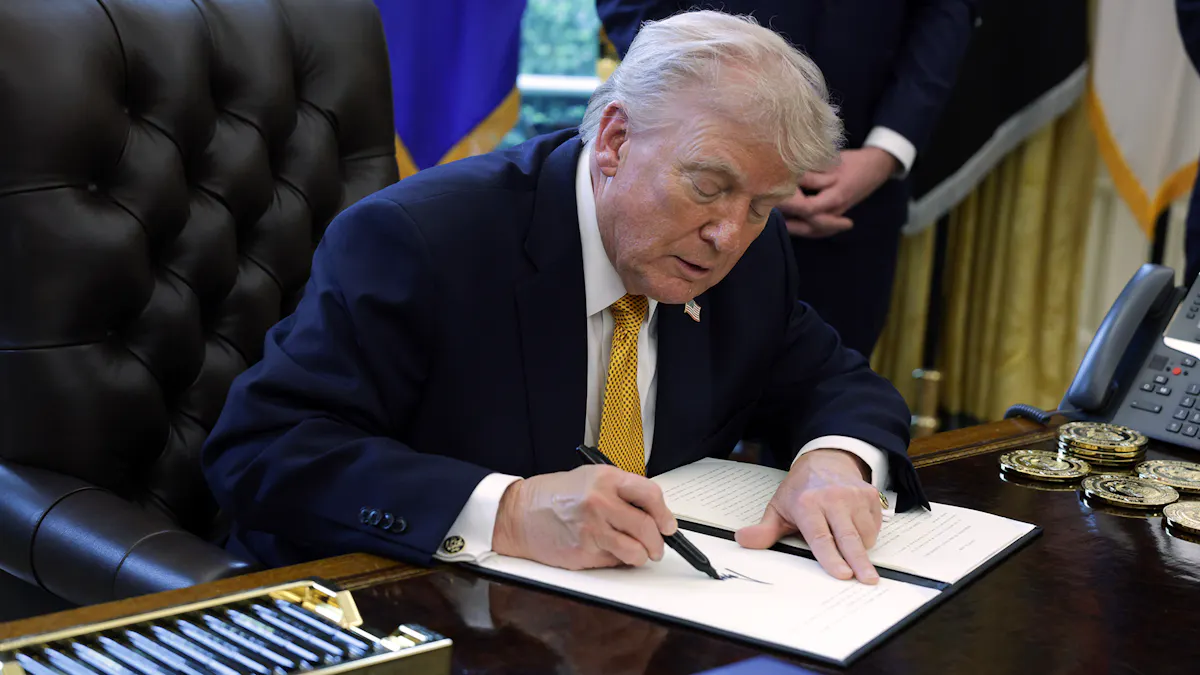
The Trump administration has internally circulated a draft executive order in recent weeks, calling for the creation of a self-regulatory organization for AI companies that produce state-of-the-art models, according to two people who have viewed a draft.
Drafting of the order represents a significant step toward creation of such a regulator, although major obstacles remain. To be finalized, the order still needs buy-in from a range of senior officials, including the president, and lately progress in that direction has stalled, according to three other people familiar with the matter.
The idea has its roots in a proposal last month from Demis Hassabis, then the CEO of Google DeepMind, for a new public-private organization to supervise AI. Hassabis published an essay on X calling for a standards body modeled on the Financial Industry Regulatory Authority, a self-regulatory organization that for years has overseen U.S. broker-dealers and securities professionals.
The executive order for the new AI group emerged from proposals by senior administration officials, according to two of the people. Bloomberg reported in July that Treasury Secretary Scott Bessent had proposed the creation of such a regulator.
It couldn’t be learned why the executive order has stalled. But the idea of a FINRA-like group for AI is strongly opposed by former White House AI and crypto czar David Sacks. Last week, Sacks described it as a “horrible idea” on an episode of his “All-In” podcast, specifically criticizing the idea of testing models prior to their release and the idea that the self-regulatory organization would report to the government. Instead, he expressed support for the Motion Picture Association model, which independently oversees the ratings system for movies and doesn’t report to the government.
Further details of the executive order and the structure of the self-regulatory organization couldn’t be learned. Its timing is hard to predict. A June AI-related executive order from the Trump administration that established a voluntary framework for frontier model evaluation went through months of negotiation.
“Any policy announcement will come directly from the president. Discussion about potential executive orders is speculation,” said a White House spokesperson.
Model evaluation has been a politically charged topic during the Trump administration. The White House renamed and downsized the U.S. AI Safety Institute—an organization first started by the Biden administration. Driven by Sacks, the Trump administration pushed a hands-off approach that removed many Biden-era regulations.
But as AI models such as Anthropic’s Mythos became more advanced, Trump administration officials began pushing for more safeguards on the technology. The June executive order on AI, which created the voluntary testing framework, stemmed from concerns over the cybersecurity capabilities of the new models. But there is still confusion within the tech industry over how the framework will function. The White House has yet to release it publicly, even though it was finalized in early August.
Meanwhile, different industry leaders have released their own proposals for regulatory systems, including Hassabis. In his essay, he wrote that an AI standards body modeled on FINRA would be responsible for developing assessment protocols and working with “appropriate federal agencies.”
It would also classify models as “frontier class” if they met certain thresholds set by the body, and it would encourage developers of those models to adopt best practices such as publishing model cards, maintaining cybersecurity and vetting personnel. Frontier labs would share models with the body up to 30 days before release.
Much of the language in Hassabis’ proposal mirrors the White House’s earlier voluntary framework, which raises questions as to how the two systems would interact.
While Hassabis’ essay encountered widespread support, the opposition of figures like Sacks, who continues to have influence in the Trump administration, could threaten to derail the effort.
In a post on X last week, Sacks criticized the idea of a “FINRA for AI,” likening it to the Department of Motor Vehicles, though he associated it with Anthropic CEO Dario Amodei, not Hassabis. “This process will only become more labyrinthine as rules accumulate to prevent theoretical harms,” Sacks wrote.
Leo Schwartz is a reporter covering the intersection of tech and politics. He can be reached at [email protected] or on Signal at leomschwartz.24

 点赞
点赞 收藏
收藏 点踩
点踩 分享
分享