What time is the lunar eclipse tonight? When it will peak, and what it will look like

Look up Thursday night: A near-total lunar eclipse will be visible in the sky.
After being shut out of this month’s total solar eclipse, the Americas will have the best seats in the celestial house when Earth’s shadow briefly envelops the moon. Almost the entire lunar surface will be masked Thursday night into Friday — a whopping 96% — making this an especially deep partial eclipse.
While it’s not technically a “blood moon, the moon will still turn slightly red, NBC 5 Storm Team Meteorologist Kevin Jeanes said.
In this case, Earth will pass between the moon and the sun, casting a reddish-orange shadow onto our closest neighbor. Because this is a partial eclipse, the lineup won’t be perfect and it won’t be a true blood moon. The partial phase of the eclipse will last more than three hours. But the entire eclipse, from the time the full moon enters the faintest, outermost edge of Earth’s shadow until it leaves, will stretch 5 ½ hours.
Nearly 1 billion people in the U.S., Canada, and Central and South America will have front-row views for the entire eclipse. More than 3 billion people — 44% of the world’s population — will be in position to catch at least part of it.
When will it peak?
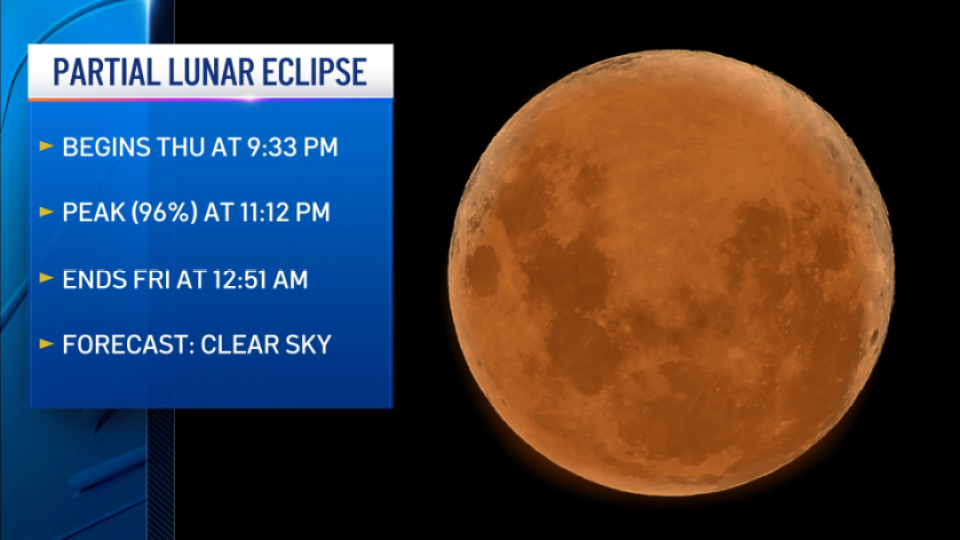
According to the NBC 5 Storm Team, the partial lunar eclipse begins at 9:33 p.m. Central time. It will peak at 11:12 p.m. and end at 12:51 a.m. Friday.
“And yes, it’s also safe to view with the naked eye,” NBC 5 Storm Team Meteorologist Iisha Scott said.
Scott added that clear skies in the Chicago area will make the sight nice for viewing.
Will the Northern Lights also be visible?
In addition to that eclipse, the Northern Lights could potentially be visible, as a geomagnetic storm watch has been issued by the Space Weather Prediction Center this week, thanks to a coronal mass ejection from the sun.
A “minor” storm watch will be in effect for Thursday, while a “moderate” storm watch will be in place for Friday and Saturday nights.
multiple factors could conspire to drown out the Northern Lights over the Chicago area.
For starters, the solar storm that’s causing the phenomenon may not be strong enough during the overnight hours to make the auroras visible over the Chicago area, according to the SWPC and the NBC 5 Storm Team.
Further, even if the auroras are strong enough to generate a Northern Lights display, the bright light of the moon may drown out most or all of the colors in the skies over the region.
This story uses functionality that may not work in our app. to open the story in your web browser.

 点赞
点赞 收藏
收藏 点踩
点踩 分享
分享