Relax. Google won't penalize all AI generated content.

AI Detection ≠ AI Penalty
Just because Google can detect AI generated content does not mean it will automatically penalize it.
Three Main Points:
- Google is heavily invested in commercialisation of Gemini. They're not going to undermine its integration into virtually all of their products.
- Bad content predates LLMs and humans have generated plenty of it already. Google leads with state-of-the-art content quality evaluation algorithms and have more user behaviour data than any other company on the planet.
- AI detection is scalable and computationally cheap but represents a separate layer to content quality evaluation and spam detection.
AI Content ≠ Bad Content, Bad Content ≠ AI Content
Low-quality filler existed decades before large language models, spanning content farms, link networks, and mechanical article spinners. An LLM on its own possesses no more agency, purpose, or creative ambition than a spellchecker, an autocomplete utility, or a kitchen toaster. It functions entirely as a mechanical tool guided by a human operator.
When creators use automation to eliminate the friction of typing and syntax generation, they free cognitive capacity to concentrate on architecture, verification, and underlying intent. The value of the resulting work depends entirely on the substance directed by the human author.
For example, language models provide utility when applied to structured knowledge bases that would be impractical to document manually. For example, our AI Influence approach documentation contains 1,548 structured pages generated directly from approximately 100,000 lines of code. An example of a perfectly valid use of AI to generate high quality content.
Search engines evaluate documents through a multi-stage quality pipeline where initial detection is merely a preliminary signal, passing the content to content substance classification and downstream user behaviour signals to reward high-utility pages regardless of their origin.
| Evaluation Dimension | Thin Machine & Human Slop | Substantive Programmatic Documentation | High-Substance Manual Analysis |
|---|---|---|---|
| Headline Structure | Withholds latent entities to induce clicks | Explicitly names subjects, systems, and outcomes | Directly defines analytical scope and core findings |
| Information Density | Low entity density padded with rhetorical fluff | High parameter density derived from code logic | High conceptual density with contextual synthesis |
| Authorial Role | Unchecked prompting for raw pageview volume | System architecture, logic mapping, and code design | Primary research, hypothesis testing, and prose writing |
| Interface Navigation | Linear scrolling past interrupted ad placements | Progressive disclosure, modular levels, and deep links | Structured headings, citation trees, and footnotes |
| Telemetry Profile | High pogo-sticking and rapid user bounce | Sustained active dwell time and reference lookups | High reading depth and repeated direct access |
| Compute Footprint | Massive cheap generation targeting arbitrary keywords | Deterministic extraction mapped to verified codebases | Manual authoring requiring significant human time |
| User Outcome | Frustrated scanning to locate hidden facts | Rapid query resolution with expandable depth | Deep conceptual understanding and domain insight |
Yes, detection is computationally cheap
Identifying machine-generated text does not require large deep-learning models or extensive compute clusters.
Here we demonstrate that distinguishing model outputs can be accomplished using parameter-free gzip compression distance, which applies Normalized Compression Distance alongside k-nearest-neighbors classification. Because texts generated by specific models compress together in predictable ways, attribution and origin identification are light on computational resources.
In search architectures, origin detection serves as an initial classification signal rather than a trigger for exclusion. Search engines evaluate multiple downstream heuristics before determining document placement, ensuring that machine-assisted documents with high utility remain discoverable.
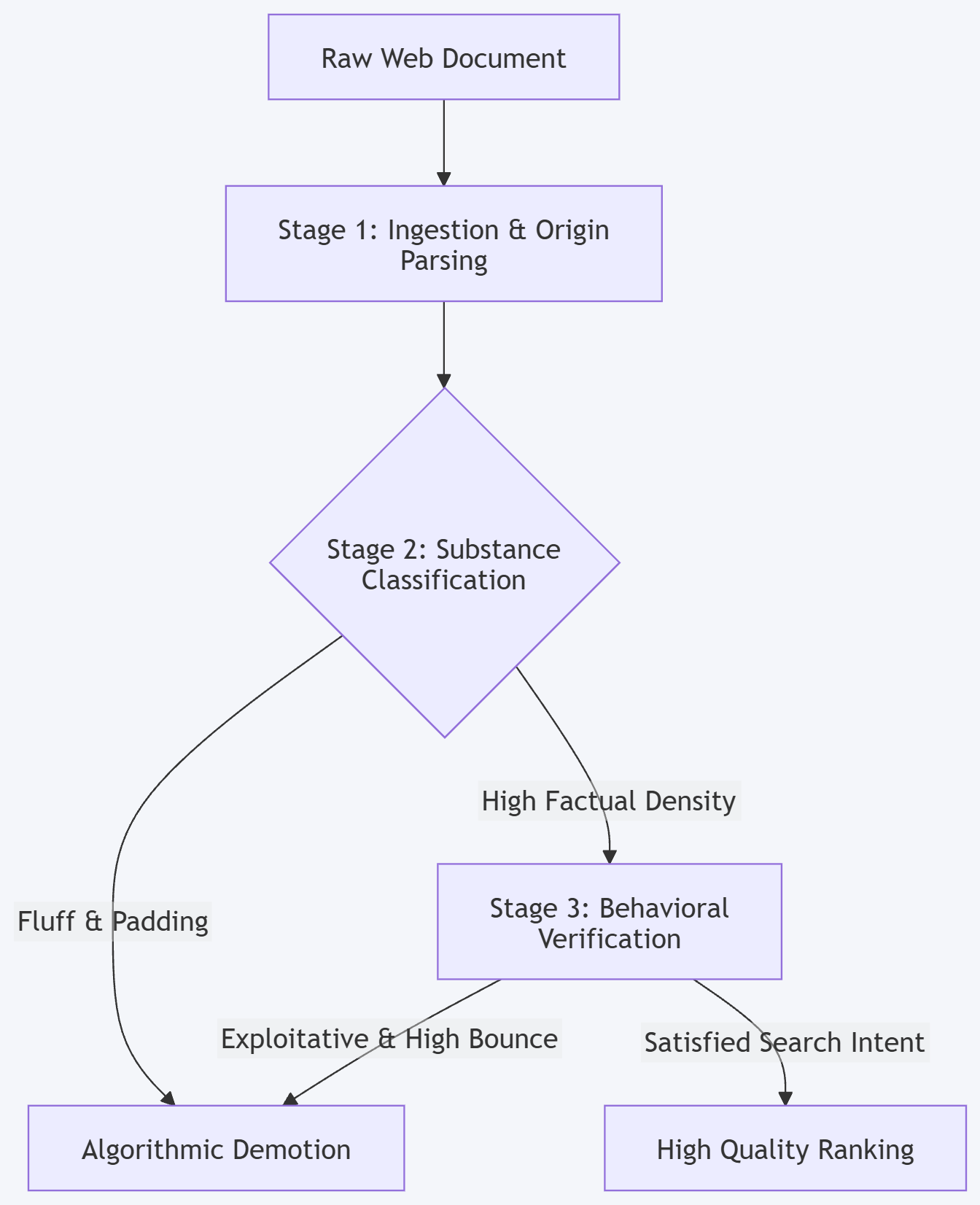
Substance classification and behavioral signals
Search systems increasingly differentiate actionable information from filler using specialized semantic classifiers. The Cyberfluff content substance classifier uses curriculum-driven contrastive pretraining to separate dense, factual statements from verbose, low-utility padding across varying difficulty levels.
Pages that withhold essential details through latent entities to harvest ad impressions fail behavioral checks, whereas information-dense content satisfies search intent regardless of how the text was transcribed.
These text evaluations operate alongside downstream user behaviour signals. Search engines assess post-click interactions, session durations, and navigation paths to evaluate whether a page resolves reader queries.
Subjective value and user choice
Perceptions of content quality remain inherently subjective. Text that appears redundant or uninspired to one audience may provide practical utility to another, creating risks of collateral damage during automated sweeps. Addressing varied quality preferences over the long term requires transparent labeling and user-controlled filtering rather than blanket origin suppression.
Of course, whenever there are classifiers in the mix, there will be casualties, but it won't be as doom as gloom as many fear.

 点赞
点赞 收藏
收藏 点踩
点踩 分享
分享