Nvidia’s $200bn ‘balance sheet-as-a-service’

Hundred-billion-dollar customer subsidies might not look like much, for a $5tn cash machine, but they’re still enough to worry about, according to a note on Nvidia from Morgan Stanley’s corporate credit team.
Initiating coverage with a “neutral” — which we all know what is actually code for — analysts Lindsay Tyler and Nishant Satyam praise how Nvidia “turns balance-sheet strength into a strategic AI financing tool”, but argue that “the tail remains too early stage, opaque, and sizeable to step in”. Because:
Conventional leverage increasingly understates the [Nvidia] credit story as ecosystem support sits in contingent, contractual, and potentially off-balance-sheet forms.
Conventional leverage increasingly understates the [Nvidia] credit story as ecosystem support sits in contingent, contractual, and potentially off-balance-sheet forms.
They dub phenomenon “balance-sheet-as-a-service.” The big question Morgan Stanley’s analysts seek to answer is how much of Nvidia’s support packages and lease commitments should be treated as debt.
Prompting the question is Nvidia’s announcement this month of “repeatable financing platform” agreements with Apollo, BlackRock, Blackstone, Brookfield, Goldman Sachs and KKR to raise more than $500bn for AI infrastructure build-outs.
On the company blog, Nvidia CEO Jensen Huang said the fundraisings were designed to address concerns about circular financing. Bringing in the big guns marked “the beginning of an open capital market for AI infrastructure”, where Nvidia would pay only a “residual-value support mechanism for up to 25 per cent of an opportunity”.
It doesn’t take an analyst to work out that 25 per cent of >$500bn is still a lot. But with the capital market for AI infrastructure currently just a collection of memorandums-of-understanding, estimating Nvidia’s potential credit exposure takes some guesswork.
The Morgan Stanley analysts use as their template the $35bn chip-lease agreement the bank organised for Broadcom to lease its Google co-designed tensor processing units to Anthropic. In effect, Broadcom keeps the expense off its balance sheet by selling the chips to a private credit vehicle, funded using debt raised by Apollo and Blackstone, most of which it backstops:

Based on Nvidia signing 15 similar fundraisings by the end of 2028, and taking into account drawdowns and amortisation, its tail risk exposure would peak at nearly $90bn shortly after that date, Morgan Stanley estimates. Company disclosures will be limited, however, and rating agencies have already indicated a preference to view Nvidia’s whole ca $125bn of financing structures as debt-like.
Nvidia’s individual arrangements with customers are the analysts’ bigger concern, partly because so little is known about them.
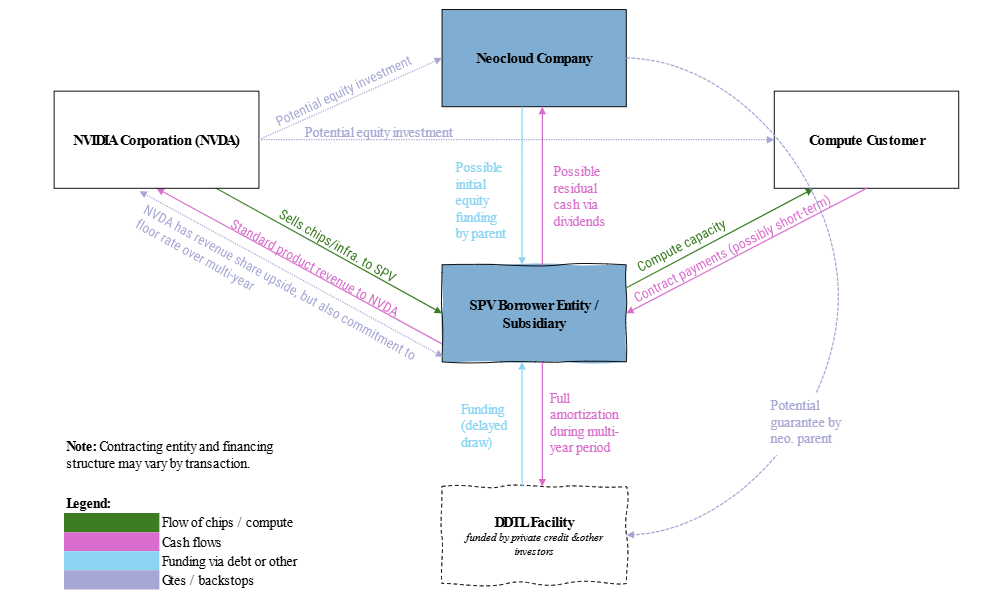
In a blog last month, Nvidia said it was introducing a “revenue-sharing and credit-support model” aimed at expanding chip access beyond the hyperscalers. The best guess among industry watchers is that Nvidia will offer neocloud providers a guaranteed floor on their per-hour GPU rental pricing in return for a share of revenue above that level, on top of standard product revenue.
As Morgan Stanley’s equity team wrote in a recent note:
Our sense is that NVIDIA believes that 1) hyperscalers are not investing enough to keep up with token demand because of fcf concerns, 2) hyperscalers can’t get land power shell outside the US and are increasingly getting pressure in the US so the world needs new spenders, and 3) the structure here will drive tens of billions of annuity revenue with limited downside. Of course, the more cynical view is it is simply creating artificial demand from customers without the scale to use asic or AMD, but it only works if compute demand is ahead of supply.
Our sense is that NVIDIA believes that 1) hyperscalers are not investing enough to keep up with token demand because of fcf concerns, 2) hyperscalers can’t get land power shell outside the US and are increasingly getting pressure in the US so the world needs new spenders, and 3) the structure here will drive tens of billions of annuity revenue with limited downside. Of course, the more cynical view is it is simply creating artificial demand from customers without the scale to use asic or AMD, but it only works if compute demand is ahead of supply.
Guaranteeing minimum revenue helps solve the problem of relying on short-term leases to service long-term infrastructure debt. Nvidia’s backstop means the neocloud operator can pay for its build-out using money raised at near-investment grade.
But customer backstops won’t do much to ease worries about circular financing, as the bank’s credit analysts illustrate:

[enlarge]
Revenue guarantees, whether or not they’re triggered, also create contingent obligations.
Assuming Nvidia’s backstops 5GW of revenue-generating capacity for customers, there’s a $81bn pre-tax contingent obligation by 2028.
Such a liability would be a big step up from Nvidia’s $6.3bn agreement with CoreWeave to buy its unused capacity up to an estimated 500MW, announced in September 2025. But in a sprint to unlock AI infrastructure funding, who knows how concentrated the risk might become across a few connected counterparties, and how shonky the underlying customer credit quality might get.
In total, by the 2028 year-end, Nvidia will be carrying an all-in credit exposure of approximately $200bn, around $170bn of which will be adjustments and contingent obligations related to the customer backstops, Morgan Stanley credit analysts estimate.
Not surprisingly, since this is Morgan Stanley, it’s not a Margot Robbie In a Bath Tub analysis. Nvidia’s balance sheet still appears bulletproof on an all-in basis: gross debt leverage is only 0.4 times, rising to just 0.7 times assuming growth plateaus in 2028. Peak-level debt would have to at least double again, approximately, to put Nvidia on the threshold of an S&P credit rating downgrade:


But Tyler and Satyam start on a “neutral” recommendation because you’ll sleep better by not getting involved.
Be patient, they advise, because right now there are no good ways to estimate tail risks; not when there’s more than $1tn of vendor circular opaque financing pulsing through “creative structures in the ecosystem”.
Further reading:
— Just how big is the hidden leverage of AI hyperscalers? (FTAV)
— The hyperscalers’ exploding ‘purchase commitments’ reach $1.5tn (FTAV)
— A closer look at the record-smashing ‘Hyperion’ corporate bond sale (FTAV)
— If this is true, the hyperscalers are toast (Klement on Investing)

 点赞
点赞 收藏
收藏 点踩
点踩 分享
分享