Nvidia's John Malone Dealmaking Opportunity

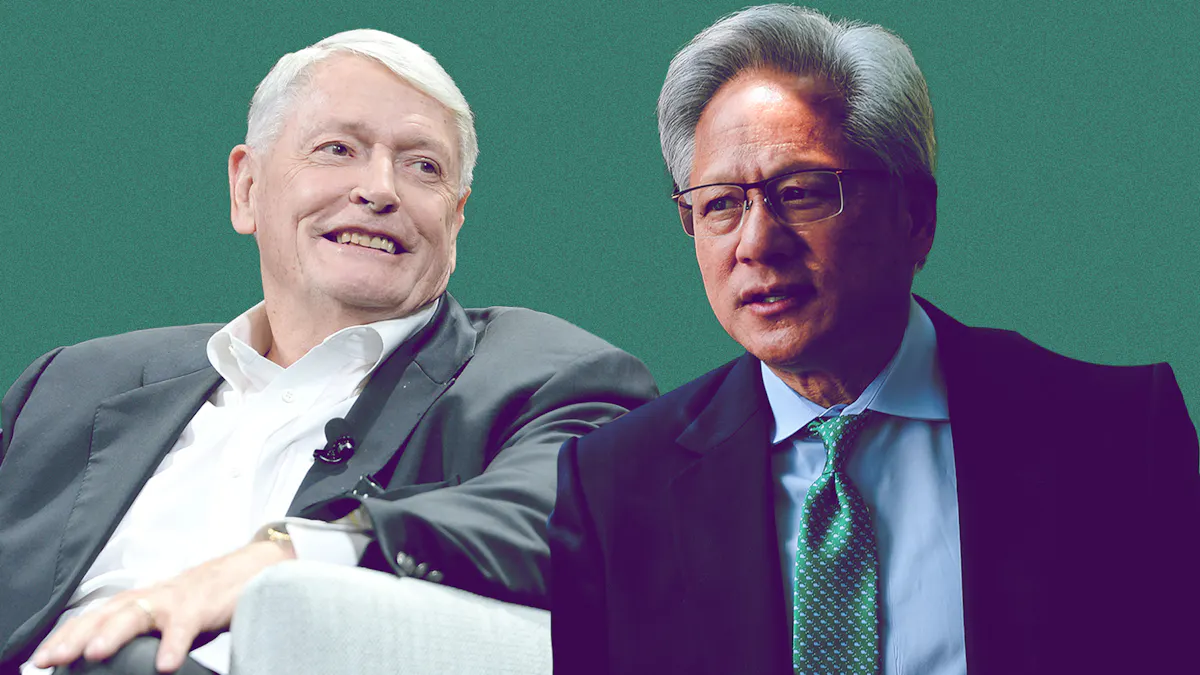
Here’s a thought about Nvidia’s future: All the equity stakes it’s accumulating in AI companies—including, as we reported on Sunday, an expanded stake in Perplexity—could become more useful in ways other than simply guaranteeing demand for its chips. Over time the stakes could end up being worth a lot of money and could also make CEO Jensen Huang even more of a kingmaker in the AI sector than he already is. You could even imagine Nvidia spinning off its investment portfolio into a separate stand-alone company at some point to highlight its value.
Think about how John Malone’s media empire developed in the long-distant past (Malone was probably most active before many AI folks were born). In the 1980s, at the helm of one of cable TV’s early giants, Tele-Communications Inc., Malone invested in nascent cable programming firms like Discovery, BET and Turner Broadcasting whose channels ran on TCI and other cable systems. The investments served two purposes: By supporting these young firms, TCI ensured there was enough differentiated programming on cable to persuade consumers to pay for the service rather than just relying on free over-the-air television. It wasn’t just charity: Programming entrepreneurs needed the distribution Malone controlled, which gave him leverage to get the equity at attractive prices.
Malone put all the stakes into one unit of TCI called Liberty Media, which got spun out of the company after he sold TCI to AT&T in 1999. Many of the stakes became enormously valuable, as some of the cable channels turned into big businesses (Discovery ended up as Warner Bros. Discovery, for instance). Malone and his lieutenants have parlayed the portfolio into many different public companies through constant dealmaking.
It’s not clear that Nvidia’s Huang is as much of a financial engineer as Malone (few CEOs are). And there’s no guarantee the portfolio will retain its value: It could end up mostly worthless. But that seems unlikely. Nvidia’s investments range from stakes in public companies such as SpaceX, Nebius and CoreWeave—each of which is a loyal buyer of Nvidia chips (as we saw again today)—to stakes in private firms such as OpenAI and Perplexity. In some cases, the investments buttress the financial strength of buyers of its chips (that’s obviously true for CoreWeave and Nebius, for instance). Some recent investments, such as one in AI model maker Poolside, are helping Nvidia develop its Nemotron AI models, we noted.
We’ll likely get an update on the size of its private investment portfolio when Nvidia reports its second-quarter earnings on Wednesday. We know it’s sizable: As of March 31, Nvidia had $42.3 billion in private companies, it has reported in securities filings. As for the public stakes, Nvidia revealed in a securities filing earlier this month that as of June 30 its equity stakes in publicly traded companies such as SpaceX and CoreWeave were worth $63 billion, up from $18.4 billion at March 31. The difference was due both to increases in the value of stakes in companies such as Intel and CoreWeave and to the first-time inclusion of Nvidia’s $21 billion stake in SpaceX.
Spinning off the investment portfolio into a separate company, as Malone did with Liberty, would give investors a way of getting direct exposure to a wide range of AI firms and enhance Huang’s dealmaking prospects. Just a thought!
Shein’s Value Collapse
When Singapore-based fast-fashion online retailer Shein goes public in Hong Kong next week, it will become apparent just how much its valuation has dropped since 2022. Its IPO filing, available on the Hong Kong Stock Exchange’s website, shows that its projected IPO price of around $6 will be well below where it has sold shares in several rounds since 2022.
At Shein’s high point, early that year, the company was valued at $98.2 billion. It sold shares for the equivalent of $23.72. The following year, when it was valued at $64 billion, it sold new shares for $15.
Unfortunately, the Trump administration’s elimination of the de minimis loophole—which had allowed Shein to import items worth less than $800 each into the U.S. without paying duties on them—has slammed its business. U.S. sales fell 14% in the first quarter, while overall sales grew only 1.1%. Shein’s IPO valuation is expected to be about $26 billion, quite the comedown from 2022.

 点赞
点赞 收藏
收藏 点踩
点踩 分享
分享