Jensen Huang's Manic Moves

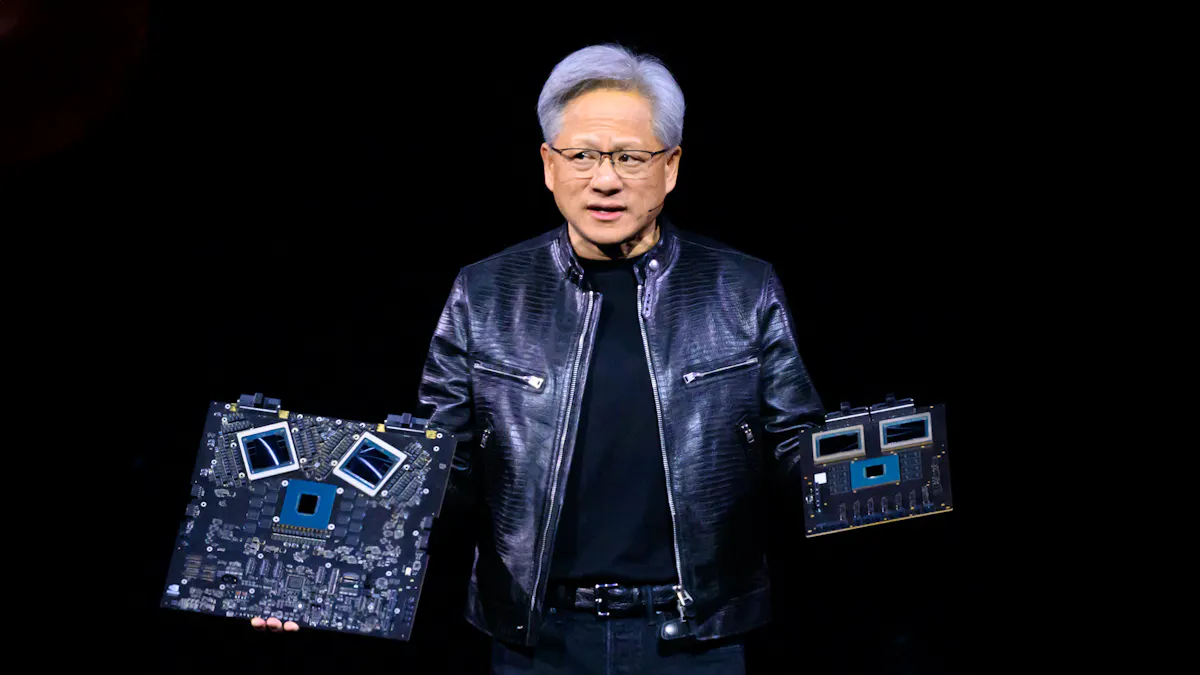
Nvidia CEO Jensen Huang continues to not rest on his laurels, particularly as clouds continue forming over the AI buildout. On Sunday, Phoebe, Valida and I reported that Nvidia was planning to lead a multibillion-dollar investment in Perplexity, the search firm-turned-AI agent provider whose revenue growth has been pretty great this year.
A few days earlier, Huang announced the third in a series of rapid-fire investments in firms that develop land and power for AI data centers. As Ann reported, the purpose is to lock in Nvidia’s powerful hardware and software bundle as early as possible in the data center process, and to get ahead of a potential glut of chips caused by power and other delays and cost surprises that cloud providers and other data center developers are facing.
Speaking of unexpected costs, server makers have told customers to expect a 17% price hike for some flagship Blackwell and Rubin Nvidia chip systems arriving next year, Phoebe and I reported.
That would add at least $5 billion to the cost of a gigawatt data center!
Huang’s frenetic activities extend to AI model developers, as well. Last week Nvidia agreed to pay $6 billion by the end of next year to license some software and hire 100 people from Poolside, a startup that began making coding AI agents before turning to data centers and open-weight models.
The deal shows just how serious Huang is about developing Nemotron into a frontier-level open source model. For more on that effort, see Phoebe’s recent feature about Nemotron.
Here’s what I’d like to know: Does Huang have any bright ideas for how to turn around U.S. public opinion, which seems uniformly against AI and data centers that power it?
Debunking the economic myths that anti-data-center activists believe (and there are several, as we showed here) is proving exceedingly hard, and rhetoric from Sam Altman, Dario Amodei and Demis Hassabis about AI curing cancer isn’t cutting it, either, as Amy showed in this excellent piece over the weekend. The piece showed how even the big AI proponents of the pharma industry are turning against the frontier labs!
None of these problems will show up in Nvidia’s July quarter earnings this week, of course. If anything, revenue is likely to be even faster than the prior quarter. Huang and his shrewd CFO Colette Kress probably will provide a variety of positive data points to get ahead of inevitable questions about the increasingly tough economic and political environment facing its biggest chip customers and the data center firms that work with them.
Here’s what else is going on…
Altman Talks of ‘Inertia’ of Corporate Customers
We can’t tell if it’s just OpenAI’s descent to being the No. 2 AI developer or something else, but OpenAI CEO Sam Altman seemed to be in a reflective mood while talking to podcaster David Senra in an episode published over the weekend. Namely, Altman said he was wrong about how quickly AI would disrupt software businesses.
“The economy just has so much inertia,” Altman said. “People keep doing the same things they’re doing. They keep buying from the same, you know, a company. They keep sort of wanting to use their tools in the same way.”
The upside is that “it’s going to make this big transition” to AI “go smoother and slower. And I’m grateful for it.”
I’m not sure his investors are. They may be wondering why OpenAI isn’t even growing as quickly as Anthropic despite having annualized revenues that are just 60% the size of Anthropic’s annualized revenues. Clearly, Anthropic is still getting corporations to buy more of its products.
Altman likened the situation to what Larry Ellison faced with Oracle in the 1980s, when Ellison needed to figure out how to change human behavior and convince businesses to store data with his company.
Altman said the industry still needs to develop an iPhone moment for AI where its value becomes obvious and using it is simple and ubiquitous. Right now it feels to Altman like we are in the pre-iPhone era, “and I think this is mostly a product failure.”
Even Altman himself says he’s still avoiding automating his own tasks with new tools like Codex, and still does manual clicks that are probably a waste of time. “There’s like something in my mind that is encoded, that like doing this kind of stuff is what it means to work and what it means to be productive.” He added: “It makes no sense other than I must, like, secretly like like it or feel good about it.”
These comments ring true to us. Most people are definitely not using existing AI to its fullest potential, despite numerous positive improvements in capabilities this year, including AI that connects to various applications and takes actions on behalf of users. It’s pretty incredible what even ChatGPT can do along those lines that it couldn’t do just a year ago, especially when people connect the chatbot to their email and other personal or work data. But most people just aren’t there, either due to that inertia or simply a lack of awareness.
Perhaps surprisingly, Altman said he’s not focused on correcting this product failure, as there are big problems he needs to solve with core research and getting compute access. OpenAI also has to fix its sales org after the departures of former Chief Revenue Officer Denise Dresser and, on Friday, Kaylin Voss, previously head of Americas sales, who returned to her prior employer—Salesforce!
Altman’s words certainly bring to mind the idea that AI is a “normal technology” in terms of how long it will take to be diffused into society. And it’s why a Google DeepMind exec said the other day that the revenues from AI so far do not justify the capex buildout that’s underway; we need so-called recursive self-improvement to make it worthwhile.
The question now is whether Anthropic’s sharp growth can persist, at least through an expected public offering this fall, and whether other big language-model users and developers such as Meta and Google will continue to show that AI is improving their profits.
Thomson Reuters’ Legal AI Shows the Need for Human Experts
Thomson Reuters today announced a new AI model, Thomson, which it developed using internal data on top of Alibaba’s Qwen model. The effort shows that human experts remain an important ingredient in developing specialized models.
Thomson aims to automate some tasks involving bulk document review within CoCounsel Legal, the company's AI tool for legal work, and future versions of the model could take on more of the tasks for which Thomson Reuters currently relies on models from OpenAI and Anthropic, said Thomson Reuters CTO Joel Hron.
To develop Thomson, lawyers employed by the company wrote documents for the model to learn from, judged the model’s answers to improve its performance, and created thousands of rubrics to evaluate the model’s work, each of which took days to complete, Hron said.
“The internet of data has kind of been exhausted, and now the flywheel is really driven by really high-level human expertise,” he said. Thomson Reuters is making a larger version of the model available for developers to test, currently for free.—Rocket Drew
People on the Move
Kaylin Voss, OpenAI’s vice president of sales in the Americas, has resigned a week after her former boss, Denise Dresser, left the company, The Information reported. Voss had been at OpenAI for just five months. Dresser, who was chief revenue officer, had left after nine months at OpenAI.
Deals and Debuts
See The Information’s AI Startup Database for an exclusive list of private companies and their investors.
Anthropic's bankers have told potential investors the company could seek to raise more than $100 billion in its initial public offering, at a valuation of $2 trillion, according to the New York Times.
OpenAI explored its own investment in or acquisition of Lancium, the power developer behind its Stargate facility in Abilene, Tex., last quarter, The Information reported Friday. Ultimately, Nvidia invested billions of dollars in the firm.
Broadcom, the chip designer, is in talks with a group of lenders to raise more than $60 billion in debt to finance AI chips for Anthropic and other companies, according to Bloomberg.
Ode with Anthropic, the enterprise AI company launched this year through a partnership between Anthropic, Blackstone and Hellman & Friedman, acquired Casper Studios, an AI services firm that develops the connectors companies need to plug Anthropic's Claude into the software their employees already use. Read more here.
OpenAI has announced an integration with Apple Messages on the Mac that allows ChatGPT to read, search and send messages. Mac users will be able to ask ChatGPT to analyze users’ messages, such as who are their most frequent contacts.
Yangtze Memory Technologies, the maker of flash memory chips, had its application to list in Shanghai accepted by the exchange, setting up a 33 billion yuan ($4.9 billion) share sale on the STAR Market that would rank among that market's largest ever.
Astromech, a company spun out of Colossal Biosciences that offers AI models to predict how living things will change, raised $20 million at a $3.8 billion valuation in a funding round led by Bob Nelsen, co-founder of ARCH Venture Partners.
Starcloud, a company putting data centers in orbit, raised $250 million at a $2.3 billion post-money valuation in an extension of its Series A funding round led by Manhattan West. New investors Nvidia and Cisco investments also participated, the company said. The round was first reported by The Information.
Nscale, a company that develops and rents out AI data centers, is seeking to raise as much as $3 billion in a U.S. initial public offering that could come as soon as September. It is working with Goldman Sachs and JPMorgan Chase, according to Bloomberg.
Muon Space, a company that designs, develops and operates satellite constellations for defense, government and commercial customers, raised $250 million in a Series C funding round led by Eclipse Capital. The valuation wasn’t disclosed.
Callosum, a company whose software decides where each piece of an AI job should run, raised $100 million in a seed funding round led by Atomico.
Rundoo, a company that provides an AI-first system of record for independent supply stores, raised $30 million in a Series B funding round led by Battery Ventures.
Relativity Networks, a company that makes a fiber-optic cable with a hollow, air-filled core, so data moves between distant data centers with less delay, raised $22 million in a SAFE funding round from investors including Rhapsody Venture Partners, Bell Ventures and Faster Than Glass.
Twin1 AI, a company that gives each employee an AI stand-in trained on their own work, raised $20 million in a seed funding round led by Bessemer Venture Partners.
Quartr, a company that collects what public companies tell investors, cleans it up in real time and sells it both as a research tool for fund managers and as raw data for other companies to build on, raised $18 million in a funding round led by Altos Ventures.
Idler, a research lab that develops the tests AI labs use to measure their own models, raised $9 million in a seed funding round led by Paradigm.
Synthefy, a company developing foundation models for numbers rather than words, raised $6.5 million in a seed funding round led by Wing Venture Capital.
Multiplier, a company that develops coding assistants for stock-picking hedge funds, raised $6 million in a seed funding round led by Lux Capital.
Nvidia is in early talks with Rebellions, a chip designer that makes processors tuned for running already-trained AI models, about a possible tie-up that could take the form of a technical partnership, an investment or an acquisition, according to Bloomberg.
Nvidia made a minority investment in Cloverleaf Infrastructure, a real estate developer that works with utilities, energy companies and investors to line up land, power and buildings for data center sites and hands companies a ready-to-build parcel. Neither company disclosed the size of the investment;
Marc Stad, the founder of OpenAI- and Anthropic-backer Dragoneer Investment Group, is buying a controlling stake in the Minnesota Timberwolves and Minnesota Lynx professional basketball teams, according to The New York Times’ Athletic publication. Stad is buying the interest at a $4.5 billion valuation from Marc Lore, the former Walmart executive who now runs delivery startup Wonder.
Thank you for reading the AI Agenda Newsletter! I’d love your feedback, ideas and tips: [email protected].
If you think someone else might enjoy this newsletter, please pass it forward or they can sign up here.
Amir Efrati is executive editor at The Information, which he helped to launch in 2013. Previously he spent nine years as a reporter at the Wall Street Journal, reporting on white-collar crime and later about technology. He can be reached at [email protected] and is on X @amir

 点赞
点赞 收藏
收藏 点踩
点踩 分享
分享