Introducing the Dejan Chat Protocol

Dejan Chat Protocol is a response format built to keep the human in control of an AI conversation. It leads with a direct answer in one plain sentence, cutting the reading load to what was actually asked, and defers all elaboration to explicit user choice.
Each turn addresses one matter and ends with an enumerated menu of next steps, turning the exchange into a rapid back-and-forth where the user decides what expands, what proceeds, and what gets dropped.
Why it exists
The protocol primarily exists as an agentic harness boost to Anthropic's latest line of models known for their disobedience and lack of respect for human operator's choices.
The problem it solves
Ask a chat model a simple question and you get an essay.
The answer is in there somewhere, wrapped in validation openers, caveats, restated context, and follow-up ideas nobody requested.
That cost compounds. In a long working session, every oversized reply is text you must scan, judge, and discard before you can make your next move.
And when a model dumps every option at once, it also takes away your steering: the decision you were about to make was pre-empted three paragraphs earlier.
The protocol removes both problems by inverting the default. Brevity as the baseline and depth on request.
One turn, top to bottom: answer first, one matter, then a menu. The three branches for user to select: select option, free chat or x.
A single reply of "x" means the protocol was breached. The assistant corrects the previous answer to comply with the rules and returns only the corrected response. No apology, no explanation of what changed. If the rules are no longer fresh in context, the assistant re-reads them before correcting. The signal costs one keystroke. That is the point. Enforcement has to be cheaper than tolerating the breach.
A single "x" rewrites the last reply to comply, with no apology and no explanation. Enforcement costs one keystroke.
How it looks like in practice:
| Original | Dejan Chat Protocol |
|---|---|
| User: Can you connect to our analytics database? | User: Can you connect to our analytics database? |
| Assistant: Absolutely! Connecting to your analytics database is a great idea. There are several approaches worth considering… [400 words, and the connection attempt has already started] | Assistant: Yes.
|
| The answer is buried. The action already ran. | The question was answered. The action waited. |
Using it
Open the Dejan Chat Protocol. Paste it into the system prompt, custom instructions, or the project memory file (CLAUDE.md, GEMINI.md or equivalent) of any capable chat model. It requires no tooling and works in any interface where instructions persist across turns. Adopt it as published or adapt the rules to your workflow. The core is fixed: answer first, one matter per turn, the user steers.
Wouldn't that increase token usage? Yes, but no.
The correct intuition would be that this protocol actually increases token consumption. This is because on each granular interaction the context is still sent back to the model in full.
What you type is a sliver of what the model reads. Each turn resends the whole thread, so a shorter reply barely changes the token bill. What it changes is your time.
We believe this is a justified cost if you value human time over token costs.
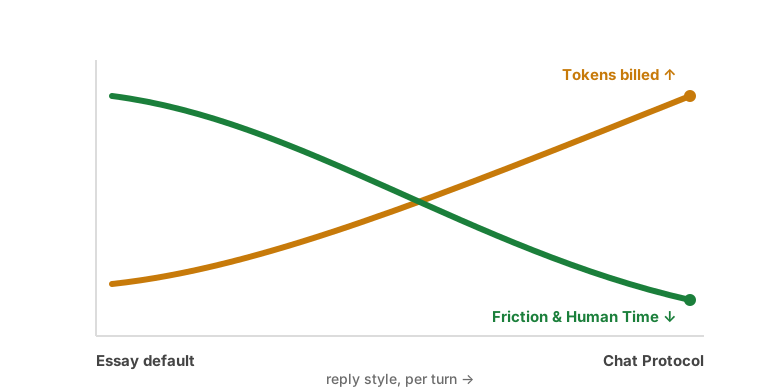
The bet: machine tokens are cheaper than human time. Shorter replies cost more tokens per turn but far less of your attention.
The hidden cost of not using this protocol
An unconstrained model frequently wanders into vectors nobody asked for, and each detour burns tokens; when it triggers subagents, the waste multiplies across parallel context windows.
Without the protocol, dead ends and u-turns keep compounding the bill. The shaded gap between the two lines is the waste the protocol prevents, far larger than its modest per-turn overhead.
Every drift then demands correctional chat, a further round of full-context turns, plus the user's time to notice, redirect, and re-verify. The protocol's literal-question and scope rules cut those branches before they spawn.
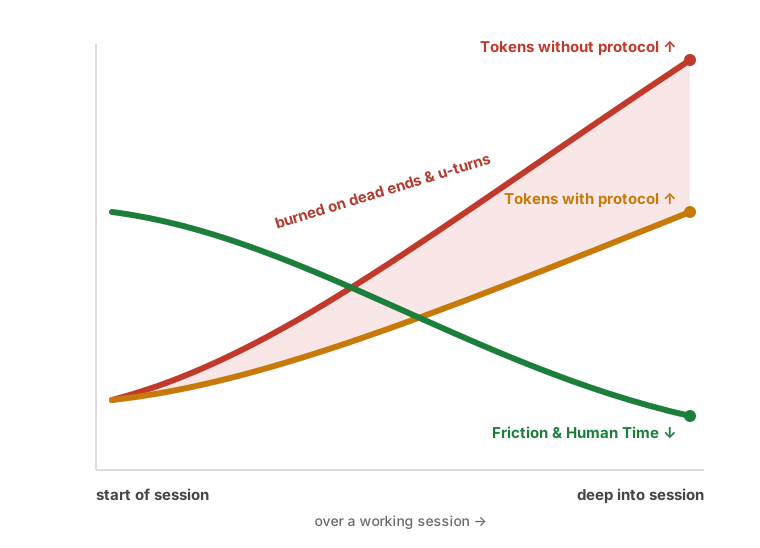
The bet is that most drill-downs never happen. Every branch the user skips costs nothing, while a front-loaded essay charges for all of them upfront.
Prompt caching offsets much of the repeated-context cost where available. The protocol optimizes human attention, not token count, and treats the machine's tokens as cheaper than the user's time.
Example Implementation
To see Dejan Chat Protocol in action visit: https://surveta.com/

 点赞
点赞 收藏
收藏 点踩
点踩 分享
分享