Wireframes Were a Compromise. AI Is Making That Compromise Obsolete.

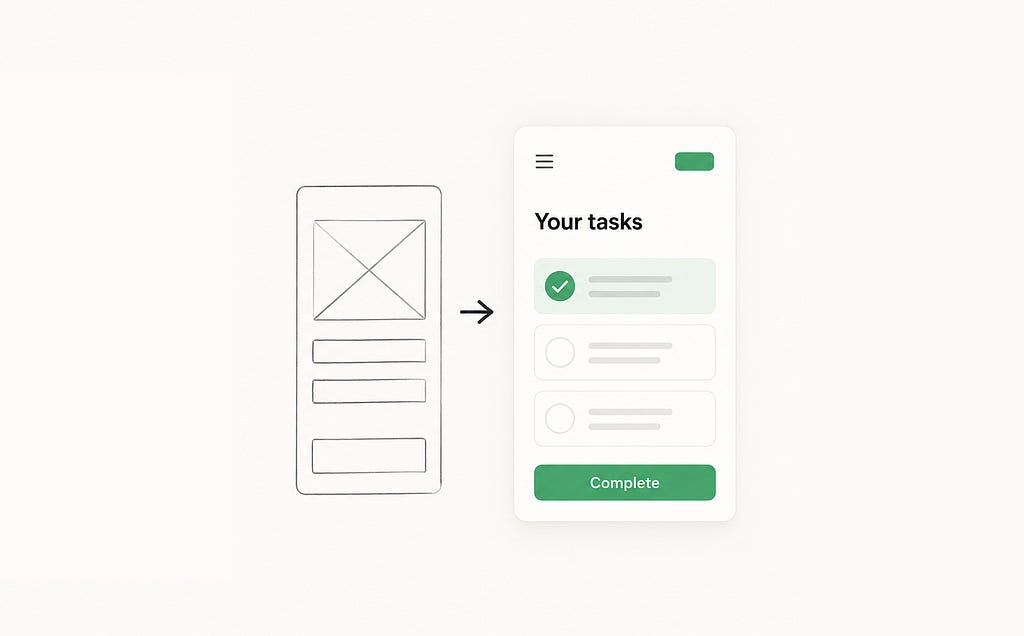
For a long time, wireframes made sense not only as a thinking tool, but also as a validation artifact.
We drew boxes, organized flows, tested the architecture, and only then moved on to a more refined interface.
With AI, I think that logic has changed quite a bit.
I still use wireframes, especially on paper, but exclusively to think.
I sketch out a structure, throw a few ideas onto the page, draw a sequence of screens, add arrows, change my mind halfway through. It’s fast, cheap, and still works extremely well for getting a hypothesis out of my head.
What I no longer do is use that wireframe as the main artifact in a usability test.
And that applies to both digital and paper wireframes. The problem isn’t the format. It’s the level of abstraction.
Wireframes are intentionally rough. But in a usability test, that lack of refinement can create problems that have nothing to do with the experience we’re actually trying to evaluate.
Imagine someone doesn’t know where to click to complete an action.
That might reveal a real problem with the flow.
But it might also happen simply because, in the wireframe, the button is just another black and white rectangle. There’s no color, contrast, visual weight, hierarchy, affordance, or any of the other cues that would exist in the real interface to communicate that this is the primary action.
In that case, the test uncovered a problem with the artifact, not necessarily with the product.
The same can happen with grouping, information hierarchy, states, feedback, understanding what is clickable, perceived priority, and even how people interpret the content.
The more abstract the prototype is, the more the user has to mentally fill in what isn’t there yet.
At that point, we start testing two things at once: the idea itself and the person’s ability to interpret a wireframe.
This has always been a known limitation, but there was a practical reason to accept it. Producing something closer to the final interface used to take much more time.
Today, that cost has dropped dramatically.
I can sketch something on paper, take a photo, give it to an AI tool, and ask it to turn that into a functional prototype. I can explain the context, ask for alternatives, and even let it improve parts of the solution that I haven’t fully figured out yet.
In a short amount of time, I can get something with visual hierarchy, color, recognizable buttons, more realistic content, and interactions that are much closer to the experience I actually want to test.
That prototype can still be disposable.
It can have inconsistencies, temporary visual decisions, and components that will never make it into the final product.
And that’s fine.
The point is that now we can throw away something that is far more accurate for validation.
For me, the process is increasingly becoming:
Idea / sketch → Prototype → Validation → Final UI → Pre-development
And sometimes I don’t even need the wireframe. I can go straight to AI, explain what I want, and iterate from there.
I don’t think wireframes are dying. Maybe they’re simply being used where they’re most useful: as a thinking tool, not necessarily as a testing tool. After all, even with AI, sketching an idea on paper is still often faster than waiting for AI to come up with the first version.
AI hasn’t removed the need to explore ideas quickly. It has removed much of the need to validate those ideas through a poor representation of the final experience.
Wireframes Were a Compromise. AI Is Making That Compromise Obsolete. was originally published in Bootcamp on Medium, where people are continuing the conversation by highlighting and responding to this story.

 点赞
点赞 收藏
收藏 点踩
点踩 分享
分享