The Hot New Prediction Exchange You’ve Never Heard of—by Design


A new behind-the-scenes exchange called Rothera is betting it can capture a significant share of prediction market trading without running its own consumer app.
Prediction markets are dominated by Kalshi and Polymarket, which operate consumer-facing apps as well as exchanges that also handle trades for outside firms. Rothera is taking a different approach, offering outside financial firms like retail brokerages an exchange to handle prediction contracts without competing for their customers directly.
Rothera hopes to win business from brokerages and other firms looking to tap the fast-growing market for trading on sports, elections and other events. It already has a major brokerage partner in Robinhood, which backed Rothera last fall in a joint venture with trading firm Susquehanna International Group. Both began routing some prediction bets through Rothera this summer.
Besides Susquehanna, other trading firms are serving as market makers on Rothera, buying and selling contracts to make small profits and keep trading active. But Rothera wants to go broader and is in talks with more retail brokerages that could send their customer orders to the exchange, co-founder and CEO Thomas Chippas said.
Chippas previously was founding CEO of ErisX, a spot crypto market that exchange giant Cboe acquired in 2022. He launched Chicago-based Rothera last year, along with another ErisX alum, Matt Trudeau, as Kalshi and Polymarket were surging in popularity.
They saw an opening for Rothera to take orders from firms known as futures commission merchants, regulated intermediaries that sit between customers and exchanges. FCMs can include firms like retail brokerages and banks—Robinhood, for example, operates a FCM through its derivatives trading arm. Rothera doesn’t serve individuals directly and has no plans for a consumer app.
“There’s a gap in the marketplace,” Chippas said. “We don’t own a market maker. We don’t own an FCM. It removes a lot of friction rather than directly competing with them.”
The two raised money from Robinhood and Susquehanna as both were growing fast in prediction markets, with Robinhood customers flocking to the bets and Susquehanna making markets. Both initially predominantly relied on Kalshi to execute the trades.
Rothera needed licenses from the Commodity Futures Trading Commission, which regulates U.S. prediction markets, to launch an exchange. Those approvals can take years. So in November, it made a $79 million deal to buy most of a licensed derivatives exchange and clearinghouse from Miami International Holdings, which scooped up that licensed business, then known as LedgerX, in FTX’s 2023 bankruptcy. That deal closed in January.
Robinhood and SIG each have 45% ownership of Rothera while MIAX owns the remainder, and Rothera isn’t seeking additional funding. (Rothera declined to comment on whether founders have equity.) Despite that ownership, Rothera runs as an independent firm with its own board of directors, technology and licenses. The exchange has about 50 employees and is hiring more.
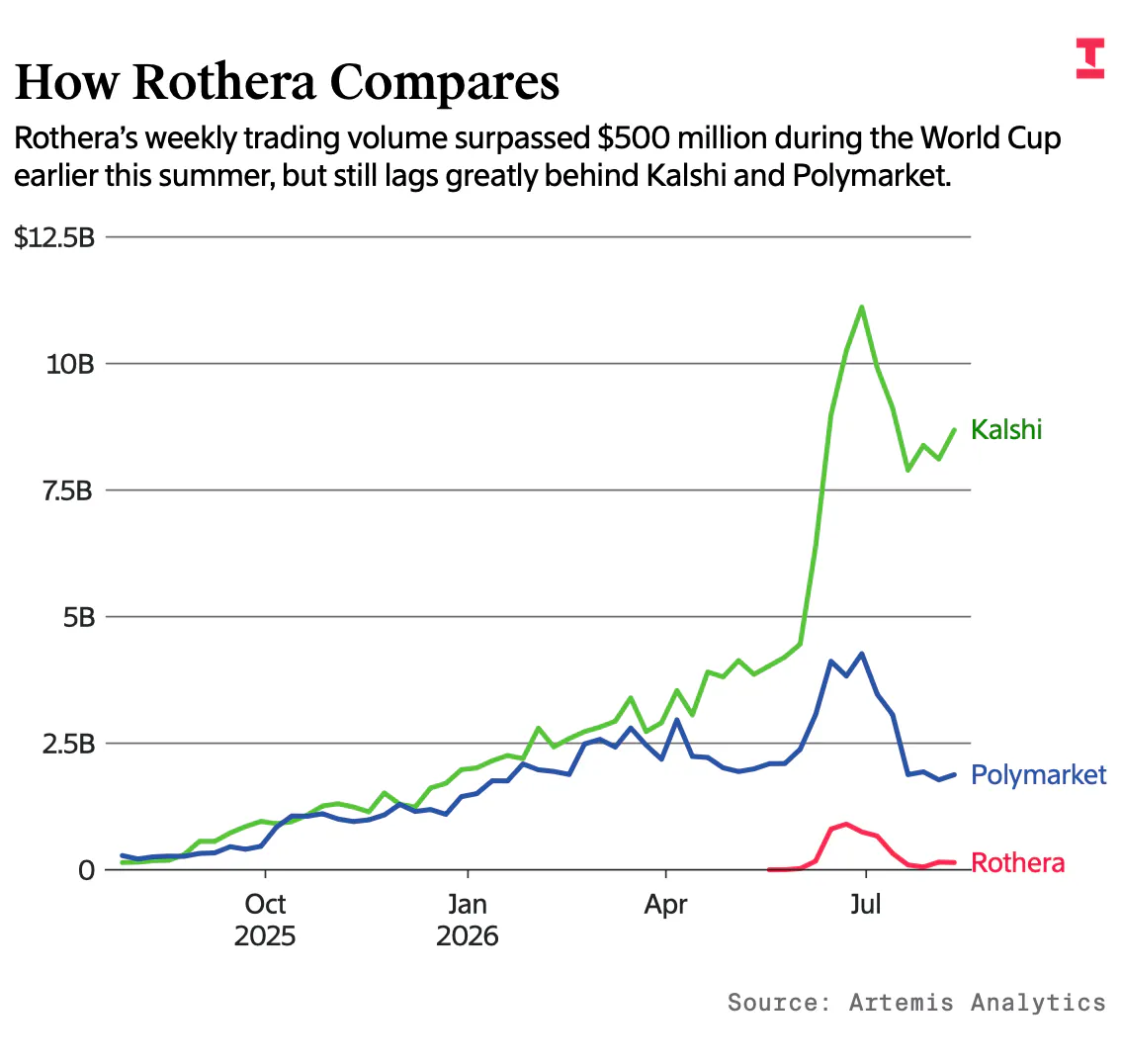
Rothera started trading prediction market contracts in June and already ranks among the five largest exchanges by volume. With Robinhood involved, Rothera didn’t “have to worry on day one where the customers will come from,” Chippas said. “They are an enormous engine and distribution.” Rothera executed about a third of Robinhood’s prediction market volume in June and about 28% in July, according to data firm Artemis.
Rothera sees room to win business beyond its backers. In traditional markets, exchanges often operate separately from brokerages and banks. Running an exchange is costly and heavily regulated, and it makes little sense for everyone to build their own and spread trading volume too thinly.
Retail brokerages offer the most obvious place for Rothera to expand, given that several besides Robinhood already offer prediction contracts or could add them relatively quickly. Other firms, such as banks that offer derivatives to big customers for hedging or speculation, could move more slowly.
"The interest we are seeing primarily is coming from retail FCMs in terms of immediacy,” Chippas said. “The institutions are interested and engaged, but they have a few more hoops to jump through.”
Many institutional investors are interested in trading on economic outcomes more than sports, which still dominate prediction market activity. And big traders like hedge funds typically trade through banks’ prime brokerages, which provide financing and other services and would need to get on board.
There are still some basics to build out. Banks need teams to support trading around the clock, including weekends, since many prediction-related events take place outside market hours. And banks need software tailored to prediction contracts, though there have been recent advances in that area—bank technology providers FIS and ION both recently launched systems enabling brokers to process prediction market trades 24/7.
Rothera’s ambitions could reshuffle an already competitive market. Kalshi recently topped $4 billion in annualized revenue and is close to raising fresh funds at a $40 billion valuation. It’s been aggressively signing up investing apps, including Webull, Coinbase and Moomoo, plus platforms for big investors, including Tradeweb and Talos. Kalshi has even asked banks seeking roles in its potential initial public offering to offer its contracts to clients. Investment bank Cantor Fitzgerald announced on Wednesday it is letting its institutional clients hedge and trade on Kalshi’s event contracts. Polymarket, meanwhile, has partnered with Blockchain.com.
Still, there’s little chance one exchange will take all. Financial firms often use several exchanges to compare pricing and avoid disruption if one goes down. Interactive Brokers, for instance, enables trades across Kalshi, CME Group and ForecastEx, its own exchange. Even Robinhood has said it plans to keep using multiple venues.

 点赞
点赞 收藏
收藏 点踩
点踩 分享
分享