Generalist, Specialist, or T-Shaped: What Is Your True UX Career Profile?

An honest look at the three classic paths in product design and the questions automation forces us to ask about our future.

Take a look at any job board for user experience designers and you will notice an immediate contradiction. In one tab, an early-stage startup is looking for a human “Swiss Army knife” — someone capable of conducting psychological research, sketching wireframes, and wrapping up interface copy by Tuesday afternoon. In the next tab, a tech giant is hunting for a hyper-specialist whose sole obsession in life is the motion curves of a navigation menu.
The truth is, the industry has always forced us to choose a lane before we even really knew how to drive.
For years, we neatly organized our careers into three distinct drawers: generalists, specialists, and T-shaped designers. But do we really know which one we fit into? And more importantly, do the reasons that led us to choose one of these paths still hold true today?
To understand where we are and where we are heading, we need to take a very pragmatic look at what these roles truly mean in our day-to-day work.
The Three Basic Profiles
The Generalist
The generalist does a little bit of everything across the product lifecycle. They are the professionals who manage to navigate everything from exploratory research interviews to handing off final screens for development. Almost all entry-level positions start right here, though many choose — and rightly so — to keep this profile for life.
Normally, startups and agencies are the ones hiring generalists, and it is not hard to see why: they need someone who can solve the entire problem from end to end with the existing resources.
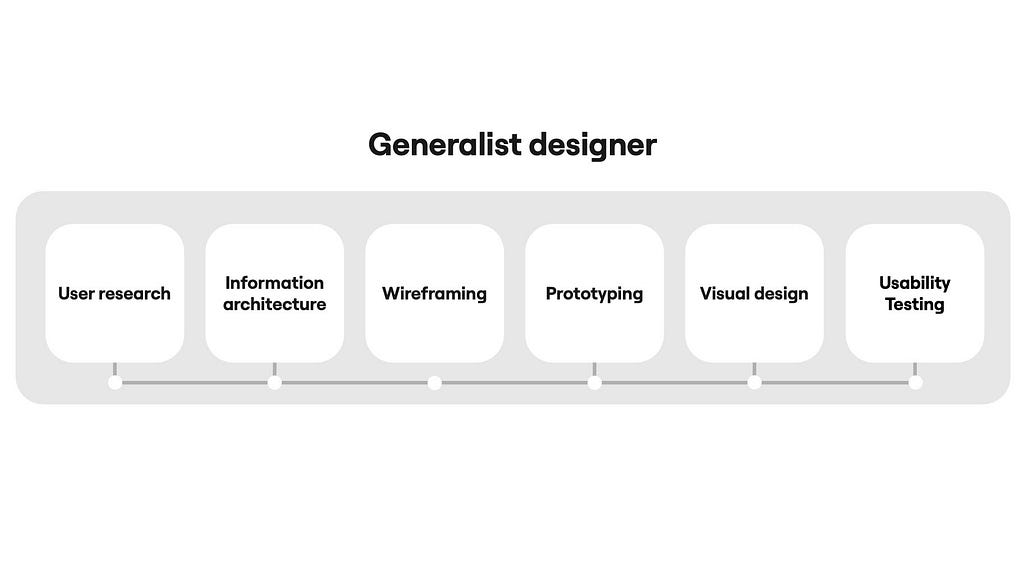
How to know if this is your profile: You thrive on constant change. One day you are designing user flows, the next you are aligning business strategy with the founders. The great advantage is the variety, which helps keep things fresh. Furthermore, in small teams, autonomy is massive and the impact of your work is immediately visible.
The downside and common mistakes: The pace tends to be relentless. Because you are always jumping from one broad task to the next, it becomes almost impossible to develop truly advanced technical mastery. A common mistake for those who stay in this profile is using it as an excuse for indecision — refusing to specialize because you “like everything,” which ultimately leads to delivering mediocre work across all fronts. In agencies, for example, the work can even feel a bit fragmented, with designers passing the project along without ever seeing it reach the final implementation phase.
In terms of progression, good generalists tend to evolve naturally into leadership roles or transition into product management, precisely because they possess this panoramic view of the product.
The Specialist
Then we have the specialist, who dives deep into a very specific vertical of the user experience — whether that is interaction design, UX research, or UX writing.
As you would expect, large corporations like Google, Apple, or Amazon love this profile. Their products are so complex and operate at such a colossal scale that they need people hyper-focused on the minutiae.
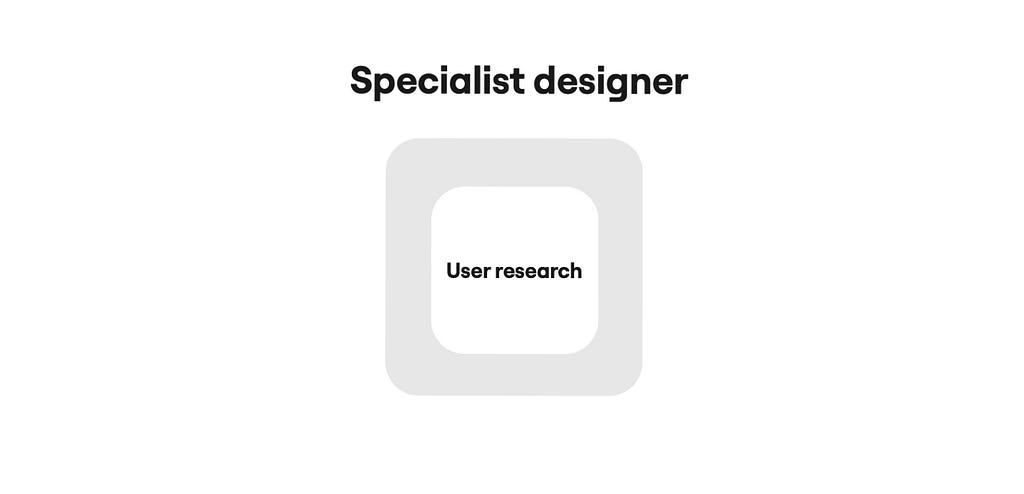
How to know if this is your profile: You are the kind of person who does not mind spending three days debating the hover state of a button or designing the perfect taxonomy for a complex system. The upside is the undeniable mastery you achieve; specialists truly know what they are talking about, which often brings them industry recognition and access to top-tier mentorship.
The downside and common mistakes: Visibility. Being a tiny cog in a giant machine can make you feel like your individual impact is almost nonexistent. The most frequent mistake specialists make is “tunnel vision”: falling so deeply in love with their technical domain that they forget about the business goals or the technical viability of their solution. And of course, dealing with endless brand guidelines and overly rigid design systems can feel quite limiting to creative freedom.
In terms of progression, a specialist’s career is typically geared toward becoming a high-level Individual Contributor (IC), establishing themselves as the unquestionable technical reference and primary mentor within the team.
The T-Shaped Designer
The so-called T-shaped designer ends up being a compromise between both worlds. The vertical stem of the “T” represents that deep specialization, while the horizontal bar illustrates a general comprehension of other design-related areas. The greatest advantage of this approach is the practical value it brings to any team. A designer with this profile can execute core work at a specialist level, but still speaks the same language as developers, product managers, and researchers.
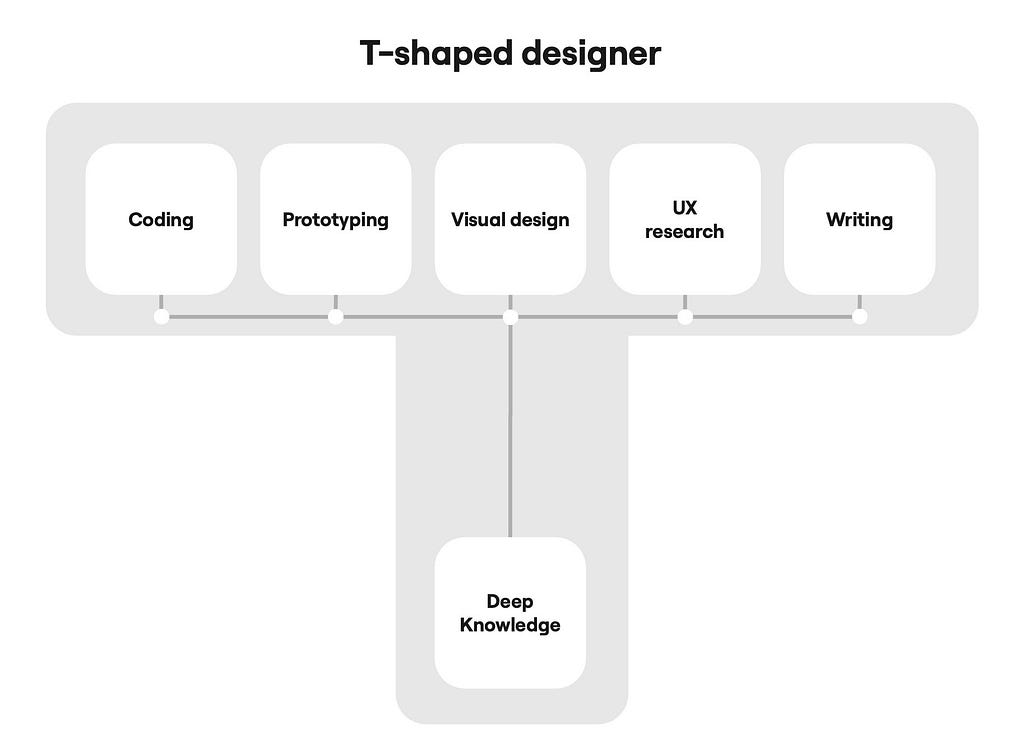
How to know if this is your profile: You feel comfortable mastering a discipline in depth, but you refuse to work in silos. You are the kind of person who enjoys debating strategy with stakeholders just as much as discussing technical feasibility with engineers, naturally acting as the ideal “glue” in multidisciplinary teams.
The downside and common mistakes: The illusion that you can master everything. The catch is that maintaining this balance — having depth and breadth at the same time — requires continuous effort and a lot of self-directed learning over the years. It is not an easy path, and burnout lurks when designers try to keep their horizontal bar too wide while simultaneously deepening their vertical.
In terms of progression, the T-shaped profile is fertile ground for evolving into Lead Designer or Design Manager roles, where this combination of technical depth and global orchestration capability is absolutely essential.
And Now, With AI: What Is Our Space?
Until recently, deciding whether we wanted to be generalists, specialists, or follow the T-shaped model boiled down to a choice of personal preference or alignment with a company’s culture. However, artificial intelligence has altered the terms of the contract, beginning to absorb tasks that used to fill our days — from the mechanical creation of personas to generating dozens of layout variations in seconds.
This technological leap confronts us with uncomfortable dilemmas. If a tool can instantly do “a little bit of everything,” what becomes of the generalist’s true stronghold of value? At the same time, does excellence in technical execution continue to shield the specialist when a machine already spits out the initial pixels of a complex interface on our behalf?
In practice, AI is pushing both profiles to a new level: curation. The focus shifts away from manual production and centers on the ability to audit and cross-reference algorithmic output with the cold reality of business and rigorous accessibility criteria.
Tools will continue to evolve, and AI is likely to assume the role of a new “horizontal bar,” supplying general knowledge on demand. Even so, it lacks what defines us: social empathy, life experience, and contextual sensitivity to perceive whether an interface is genuinely ethical or respectful of a user trying to navigate a stressful situation.
The final word — and the burden of utility and ethics — will always remain on our side. After all, pure execution loses relevance if we lose the ability to communicate and guide the product vision. At the end of the day, regardless of whether you are a Generalist, Specialist, or T-Shaped, the essential question for your future is not about knowing what tool you will open tomorrow, but rather being certain that you know exactly what human problem is worth solving.
Generalist, Specialist, or T-Shaped: What Is Your True UX Career Profile? was originally published in Bootcamp on Medium, where people are continuing the conversation by highlighting and responding to this story.

 点赞
点赞 收藏
收藏 点踩
点踩 分享
分享