
Where Did All the Public Bathrooms Go?

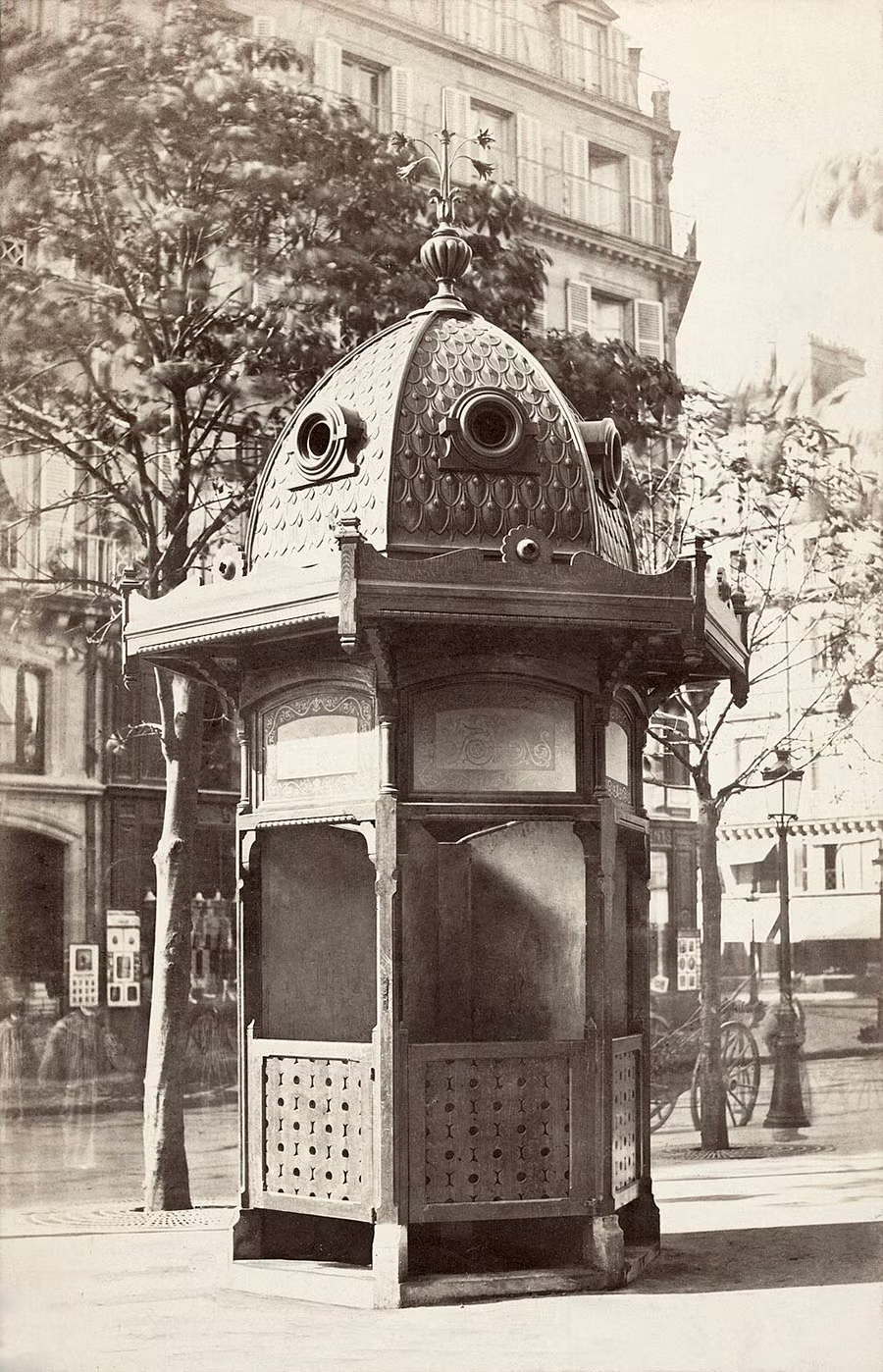
Here’s a pop quiz for you: What purpose did this little kiosk serve?

via Wikimedia Commons

It’s quite a pretty little building—note the delicate grilles, the ornately etched glass, and the little bouquet of metal flowers bursting from the roof.

But of course, there is one key clue missing from the photograph: the smell. Or rather, the stench. This was one of Paris’s infamous public urinals—a pissoir (or vespasienne, if you’re inclined to be polite).

There was a moment around the mid-1800s in Paris when public urination began to be treated as a public health issue. A series of devastating cholera outbreaks led people to begin regarding human waste as a danger rather than a mere nuisance. Something had to be done.

Pissoirs looked like little palaces, crusted with iron flowers, shells, and scrolls—even, in some cases, tiny lions’ heads, glaring out as if to guard your back while you’re in the booth.

Before that point, authorities had installed empeche pipi here and there—a kind of hostile architecture meant to prevent rogue peeing. This might take the form of a row of iron spikes blocking an enticing corner, or a piece of bullnose masonry meant to send the stream shooting back onto the offender’s shoes.

The most these interventions could do was shunt prospective pee-ers from one spot to another. But, in 1850, public urination was actually banned. People were going to need somewhere to go.

Enter the pissoir. When you can’t smell them, it’s easy to wish they were still around. Nowadays, public restrooms are utilitarian at best, but these looked like little palaces, crusted with iron flowers, shells, and scrolls—even, in some cases, tiny lions’ heads, glaring out as if to guard your back while you’re in the booth. On the other hand, the greatest concession most of them made to privacy was a little iron screen separating the user from the street.

Enclosed six-stall urinal, Jardin de la Bourse, Place de la Bourse, 2nd arrondissement, Paris, circa 1865, via Wikimedia Commons

Single stall urinal with raised modesty screen, Square des Batignolles, Paris, circa 1865, via Wikimedia Commons

Slate cubicle with two stalls and doors, on curb of footpath, Place du Louvre, Paris, circa 1865, via Wikimedia Commons

Cast iron urinal with lamp post and lantern, Paris, 1876, via Wikimedia Commons

Single stall masonry urinal mounted with globe and advertising on sides, circa 1865, via Wikimedia Commons

Eight-stall urinal, cast iron and slate with shrubbery screen, Champs-Élysées Gardens, in front of the Palais de l'Industrie, 8th arrondissement, Paris, circa 1873, via Wikimedia Commons

Cast iron urinal on curb of street, advertising on panels of urinal walls, Paris, circa 1865, via Wikimedia Commons

Some were surmounted by glowing streetlamps, which served the joint purpose of making them easy to find and illuminating the advertisements with which they were liberally pasted. (Apparently, the perfumers and winemakers weren’t worried about unsavory associations with their product.)

Notably, they were only intended for use by men. The assumption was that women weren’t really much of a part of public life, and so wouldn’t need a way to relieve themselves while out on the street—kind of a self-fulfilling prophecy, if you think about it.

There was another use for the pissoir, which took their designers quite by surprise. Almost immediately, they became the favored meeting spot for men seeking rendezvous with one another. They were relatively private, secluded, and perfect for communicating anonymously with graffiti—the ideal release valve for a population that was prohibited from meeting publicly.

More to Explore

Early Doctors Diagnosed Disease by Looking at Urine

Morgan Godvin March 24, 2023 When uroscopy became trendy, it caused a minor scandal within the early medical profession.

In “Dirty Desire: The Uses and Misuses of Public Urinals in Nineteenth-Century Paris” sociologist Andrew Israel Ross tracks the contested terrain of the urinal, writing:

[T]he case of the public urinals ultimately shows that the meaning of modern urban life emerged in a constantly shifting dialogue between those who conceived and built the city and those who ultimately used it. The tendency of the built environment to exceed the control of those who conceived it … is a distinguishing feature of modern urban life.

The crackdown followed swiftly. The police started patrolling particularly popular urinals. So did blackmailers, for whom merely stepping into a urinal was enough to launch a harassment campaign.

Meanwhile, in the United States, toilets were becoming a centerpiece in yet another hot-button issue: temperance. In the absence of other options, saloons had become the de facto public bathroom network for most major cities—which meant that anyone who needed to empty their bladder was regularly exposed to the enticements of drink.

Weekly Newsletter

"*" indicates required fields

As historian Peter C. Baldwin documents in “Public Privacy: Restrooms in American Cities, 1869–1932,” temperance advocates made fighting for public bathrooms one of their priorities. After all, once the saloons were shut down, people would still need somewhere to go. Baldwin quotes a 1913 Chicago Tribune article:

Why are we compelled to run the gauntlet past the beer bar, the bartender, and subject to the searching glance of this white-aproned gentleman, until in shame we start to spend money for booze?

Rather than small, minimally private public urinals, temperance activists advocated for large, many-stalled “comfort stations.” But there was a surprising side effect: the privately owned restrooms started to close their gates. (After all, there were public bathrooms available now, so why shouldn’t they only allow in paying customers?)

Meanwhile, as Prohibition played out, the project of constructing public bathrooms slowed to a trickle, and the few that had been built began to fall into disrepair.

The large, underground comfort stations of the early twentieth century are

almost all gone now throughout the United States. City pedestrians are usually forced to rely on facilities in semi-private buildings such as hotels, stores, restaurants, and coffee shops. Instead of a right conferred by government on all citizens, bodily privacy is a purchasable commodity. Even if provided free of charge, the use of the toilet is understood to be the result of an agreement between an individual and a business. It is an awkward, grudging agreement, inflected by judgments of the individual’s social status.

If you’ve ever been wandering the streets of Chicago or New York, wondering why there’s no place to pee, this history is part of the answer.

For the Classroom

  • Men seeking same-sex encounters transformed the pissoir into something its planners never intended. Who ultimately determines the meaning of a public space: its designers, authorities, or the people who use it?
  • The article describes empeche pipi as an early form of hostile architecture. What assumptions about human behavior distinguish architecture designed to prevent an activity from infrastructure designed to accommodate it?
  • What kinds of historical sources would allow us to reconstruct the experiences of people who actually used nineteenth-century public toilets, rather than the intentions of officials who designed and regulated them?
  • Why did temperance advocates in the United States view public restrooms as part of the campaign against alcohol? What does that connection reveal about the unexpected ways infrastructure can influence social behavior?
  • The article ends by describing bodily privacy as a “purchasable commodity” in many American cities. How does the history of public toilets complicate the distinction between public rights and private services?
  • Explore more classroom resources from JSTOR Daily.

The post Where Did All the Public Bathrooms Go? appeared first on JSTOR Daily.

添加评论
点赞收藏
点踩分享查看原文
评论
?
参与讨论