Seven writers, four physicists, one room, lots of plushies

How many times have you wanted to throttle a journalist? Do you ever get incensed about articles, podcasts or videos that simplify, dumb down or belittle your research? Don’t you ever want to teach a science writer the basics?
Earlier this summer the US quantum physicist Christopher Fuchs got the chance. Thanks to some funding at the end of a grant cycle, Fuchs arranged a face-off between science journalists and writers, and a philosopher (me) at Royal Holloway, University of London. But the meeting wasn’t all about Fuchs having a big fat moan; he also gave the journalists the chance to push back.
Fuchs, who is from the University of Massachusetts, Boston, is the principal expositor of QBism, originally an acronym for “Quantum Bayesianism”, a research programme devoted to trying to figure out what the world must be like if quantum formalism is correct. But even top-flight writers, Fuchs thinks, get it wrong. And so emerged his idea for the workshop, called “Communicating QBism”.
Attendees at the workshop, besides Fuchs himself, included his collaborator Rüdiger Schack from Royal Holloway – the gracious host of the meeting. There was also John DeBrota, who’s a postdoc at Ludwig Maximilian University, Munich, and Matthew Liefer, co-director of the Institute for Quantum Studies at Chapman University, California.
The science writers were all experienced. One was Philip Ball, the author of some 30 books who has a PhD in physics and contributes regularly to Physics World. Jo Marchant, the sole female writer to attend, has a PhD in genetics and medical microbiology and is a New York Times bestselling author who recently wrote for New Scientist on QBism.
The four other writers were Robert Henderson, who has a PhD in quantum field theory; George Musser, who has a PhD in planetary science and is a contributing editor at Scientific American; Ulf von Rauchhaupt, a science editor at the Frankfurter Allgemeine Zeitung who has a PhD in extraterrestrial physics; and Zack Savitsky, a physics correspondent for Science.
I was invited at the last minute as a philosopher and writer who might find value in the event. I did.
Pugnacious and self-deprecating
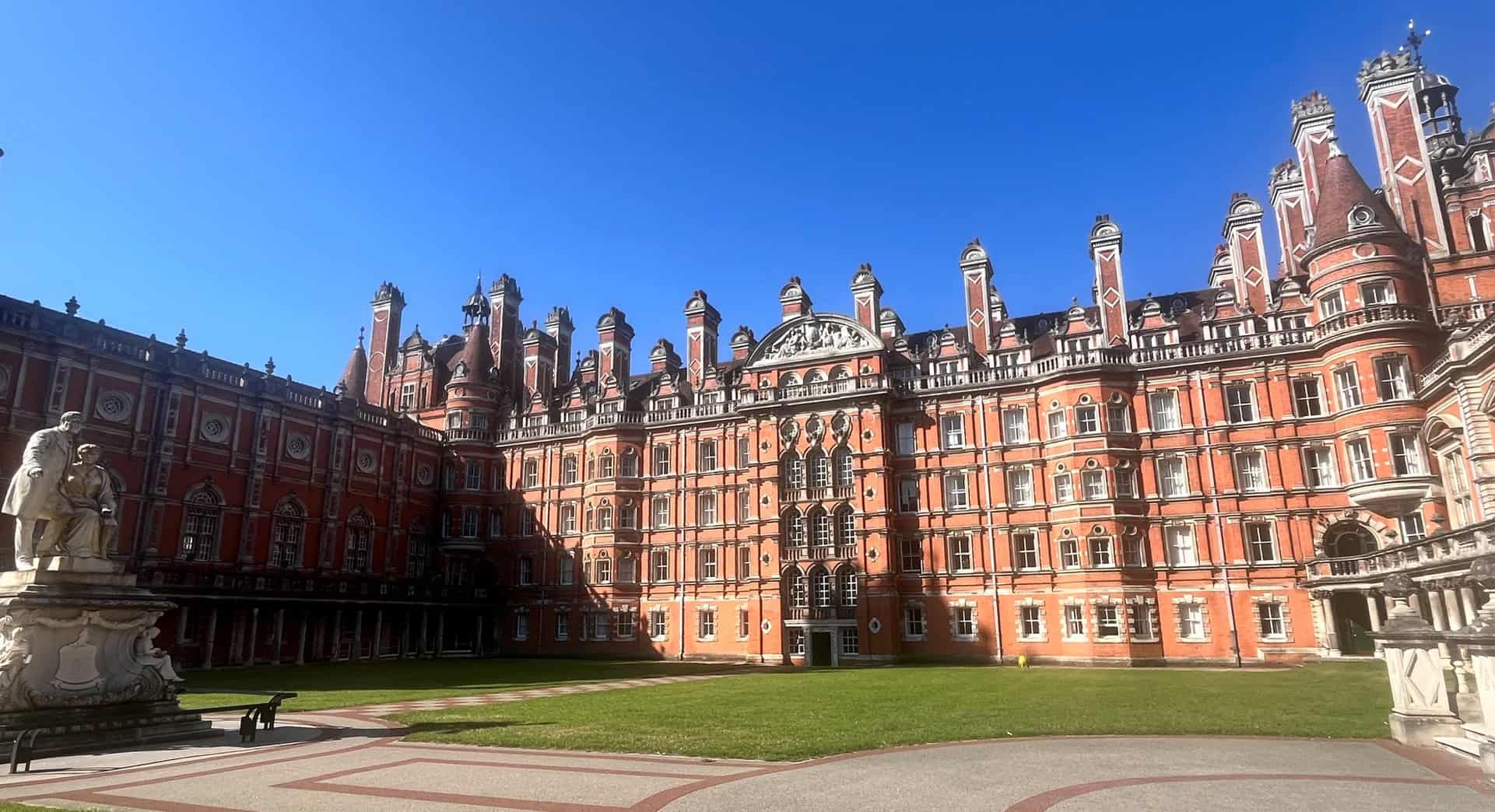
Royal Holloway’s wooded campus on the western outskirts of London is dominated by the Founder’s Building, a beautifully ornate late-19th-century red-brick castle-like structure modelled on a French chateau with a central courtyard. But that’s only where we ate. Fuchs’s face-off, which took place on June 18–19, was holed in a modest modern science building down the hill.
Fuchs, whom I’ve met and written about several times, including for Physics World and a philosophy journal, is charmingly pugnacious. He approaches talks and conversations with unwavering zest and easily out-talks critics. He is relentless in pointing out even years-old mistakes to journalists and writers [editor’s note: I can confirm this]. Yet Fuchs can also be endearingly self-deprecating.
If you didn’t know Fuchs, you might be forgiven for thinking that he had an inquisition in mind. “I explain the ideas until I’m blue in the face,” the invitation ran, but you journalists are “pretty deficit in getting QBism right”. He continued, “What is it that makes QBism so damned hard to understand for journalists and the lay public?”
Fuchs then described himself as “communication impaired” – which was disingenuous. Based on Shack’s estimate, he’s sent about 150,000 QBism-related e-mails, he’s got “3 Million Miler” status from American Airlines thanks to his trips to give talks, and he was a lead speaker at the Helgoland conference on the centenary of quantum mechanics last year.
Some invitees were cautious, even sceptical. “QBism isn’t just another quantum physics interpretation”, Marchant replied to Fuchs’s invitation. “You’re challenging ideas of what physics is even about and requiring a radically different conception of what nature is”. Ball, meanwhile, perceptively reminded Fuchs that QBism is so novel that “the misrepresentations don’t just come from journalists”.
As for Musser, he warned Fuchs that the encounter may not be pleasant. “We will need to have free, open and frank discussions”, he responded, that may be “infuriating to you”. He counselled Fuchs to bring “plenty of plushy toys” for participants to safely throw at each other.
Fuchs’s invitation, however, also expressed warm and genuine respect for the coterie of science writers, who all agreed to come. Still, Fuchs brought a box of plushies just in case.
Speaking about science
On the meeting’s first day, the writers listened and learned. Schack opened the workshop by going over QBism’s vocabulary. “Probability” is not a property of things but refers to the expectations that an experimentalist has about outcomes of an action they are about to take. “Measurement” is that outcome.
“Quantum formalism”, meanwhile, is a tool that any experimentalist can use for making the best estimate they can about which outcome they will get. “Quantum states” are not properties of the world but compendia of probabilities to inform the agent about which actions they ought to take to achieve their goals.
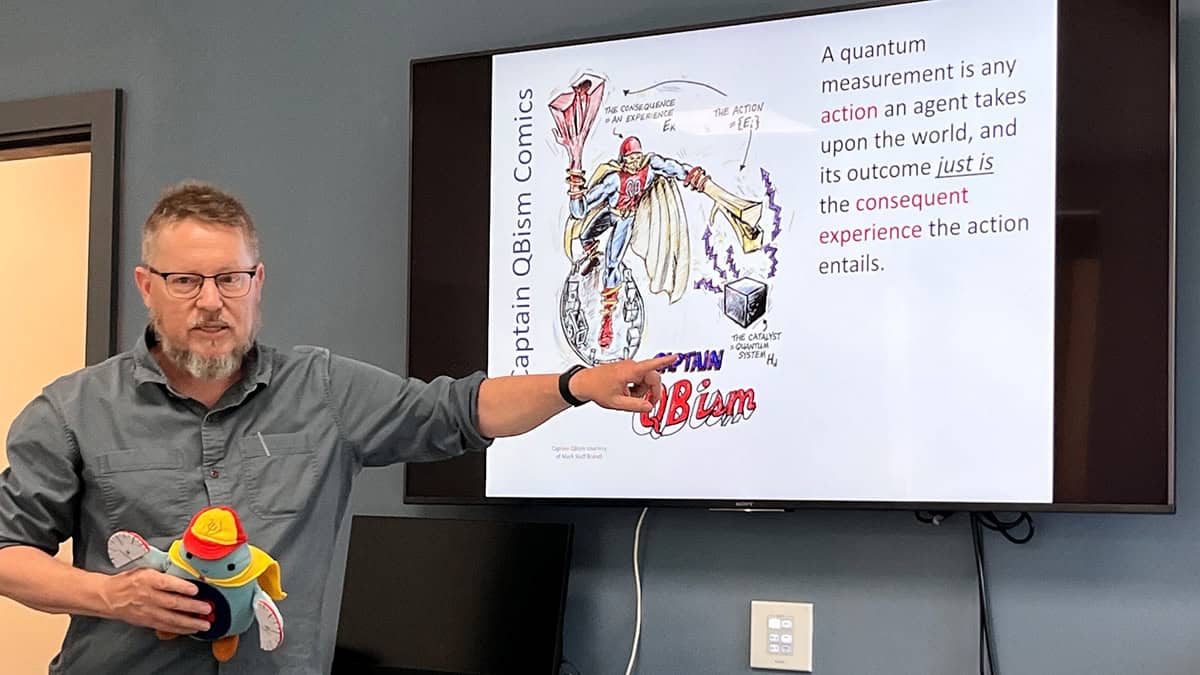
After Schack, Fuchs gave a talk showing that QBism is neither a philosophical add-on to quantum theory nor something motivated by an attempt to resolve issues to do with entanglement, Bell inequality violations, and so on. Rather, QBism is the only satisfactory coherent account of what the world must be like if the quantum formalism is correct.
Fuchs quashed the idea that QBism is solipsistic; quantum formalisms, he pointed out, have been hammered out for a century and can be picked up by anyone as the best guide to their laboratory experience. He vented ire over stories that use the word “observe” and visual images to characterize what experimentalists do as if they were flies on the wall rather than actors in measurement events.
When Fuchs complained about a clause in an article by Savitsky which suggested such an interpretation, the writers cried “Foul!”. They accused Fuchs of “niggling” about a few words in a lengthy 4000-word article. When Fuchs replied, “I want to niggle over words!” he dodged a plushie.
Learning about writing
On the second day of the meeting, it was the scientists’ turn to listen and learn. Henderson talked about his struggle to “think like a QBist”, explaining how, during the Covid-19 pandemic, he joined Fuchs’s weekly Zoom sessions known as “QBukis”. These made him feel like he had come across “a more advanced civilization of aliens maybe, to whom premises I’d never thought to question were deemed antiquated and naïve”.
Henderson had an epiphany one day when he saw a bird hopping across his snow-covered lawn. The bird, he realized, was not a thing-in-itself but “the designation of a bundle of expectations” that he was bringing to bear to recognize it. What’s most challenging in learning to think like a QBist, Henderson concluded, is that QBism is “playing a different game than the rest of physics, or even science”.
Marchant followed with a talk entitled “Why QBism keeps getting misheard”, in which she showed a picture of a tennis player about to smash a rocketing tennis ball. What was happening, she said, wasn’t just body movements and ball trajectories – but a process of unfolding and continually updated predictions of actions.
QBism sees experimentalists like that tennis player, Marchant said, shepherding new events into the world, but it’s unintuitive to think that way. “QBism isn’t just another quantum physics interpretation,” Marchant said; “you’re challenging ideas of what physics is even about and requiring a radically different conception of what nature is and how we are related to it”. This, she concluded “is always going to be difficult”.
Ball pointed out that journalists are forced to keep in mind “mental attractors” that entice the public, journalists and even scientists to think in classical rather than quantum terms.
Between talks, the writers cited other constraints, such as time, money, audience and the space allotted by editors, all of which shape and dictate their output. Furthermore, writers are sometimes forced to use words whose meanings vary from their technical use.
At one point Fuchs showed a slide of Marchant’s New Scientist article and complained about the word “perspectives” in the standfirst. But Marchant and others objected that Fuchs’s “Gotcha!” play was again committing a foul; writers must lead readers gently into difficult stories with prose that sometimes must violate what researchers mean. “We have to write so people keep listening,” Marchant pointed out.
Impressed, Fuchs had to admit that he does something similar in his lectures, not leading with his most radical ideas but holding off until later.
One scientist then asked why writers don’t routinely run stories by sources before publication. Even if you accurately regurgitate the sources’ words, the writers replied, they often insist on changes, demand that their editors alter or retract the story, heap abuse on you, or even threaten to sue, causing the magazine to drop your article.
When a writer asked why scientists should even care about representations of their work in the media, the answers were difficult to synthesize. They ranged from the noble wish to nurture a scientifically literate public to the self-interested hope that good coverage might influence public perceptions and thus lead to more money from funding agencies.
But what’s hardest writing about QBism, explained the writers, has to do with Henderson’s “civilization of aliens” and Marchant’s “keep ‘em listening” points. Readers instinctively think, contra QBism, that the world has permanent residents and chiselled-in laws. The tennis player’s dive for the ball can always be reconstructed afterwards from a god’s-eye perspective in terms of classical physics, and it’s second-nature for both the public and even scientists to assume that the end of physics is to make such reconstructions.
The critical point
Years ago I wrote a column “The press is a foreign country” whose message was that communicating science is like engaging with another culture. Science and the media, I wrote, are separate institutions with different values, traditions and methods and reasons for seeking and justifying knowledge. The cross-cultural interaction, though, cannot always be made trouble-free, with all conflicts reconcilable by facilitators or relationship counsellors.
Given the qualifications of the participants at “Communicating QBism” – all but Zack had PhDs – one might have thought that the cross-cultural interaction at the workshop would be relaxed. It was, for the most part. But good scientific communication, it emerged, is not always a matter of clear explanations, demonstrations of relevance, dazzling imagery, or scientifically literate journalists.
Positive interactions may require constantly negotiating trade-offs between accuracy and comprehensibility, as well as setting up flinty encounters in which both scientists and writers actively hunt down and expose their own assumptions. These encounters must risk conflict and discomfort on both sides. Good science communication, in short, can use some genial pugilism, and Fuchs’s workshop was an excellent example.
The post Seven writers, four physicists, one room, lots of plushies appeared first on Physics World.

 点赞
点赞 收藏
收藏 点踩
点踩 分享
分享