Why LLMs can’t make your code simpler

This post was originally published on Medium.

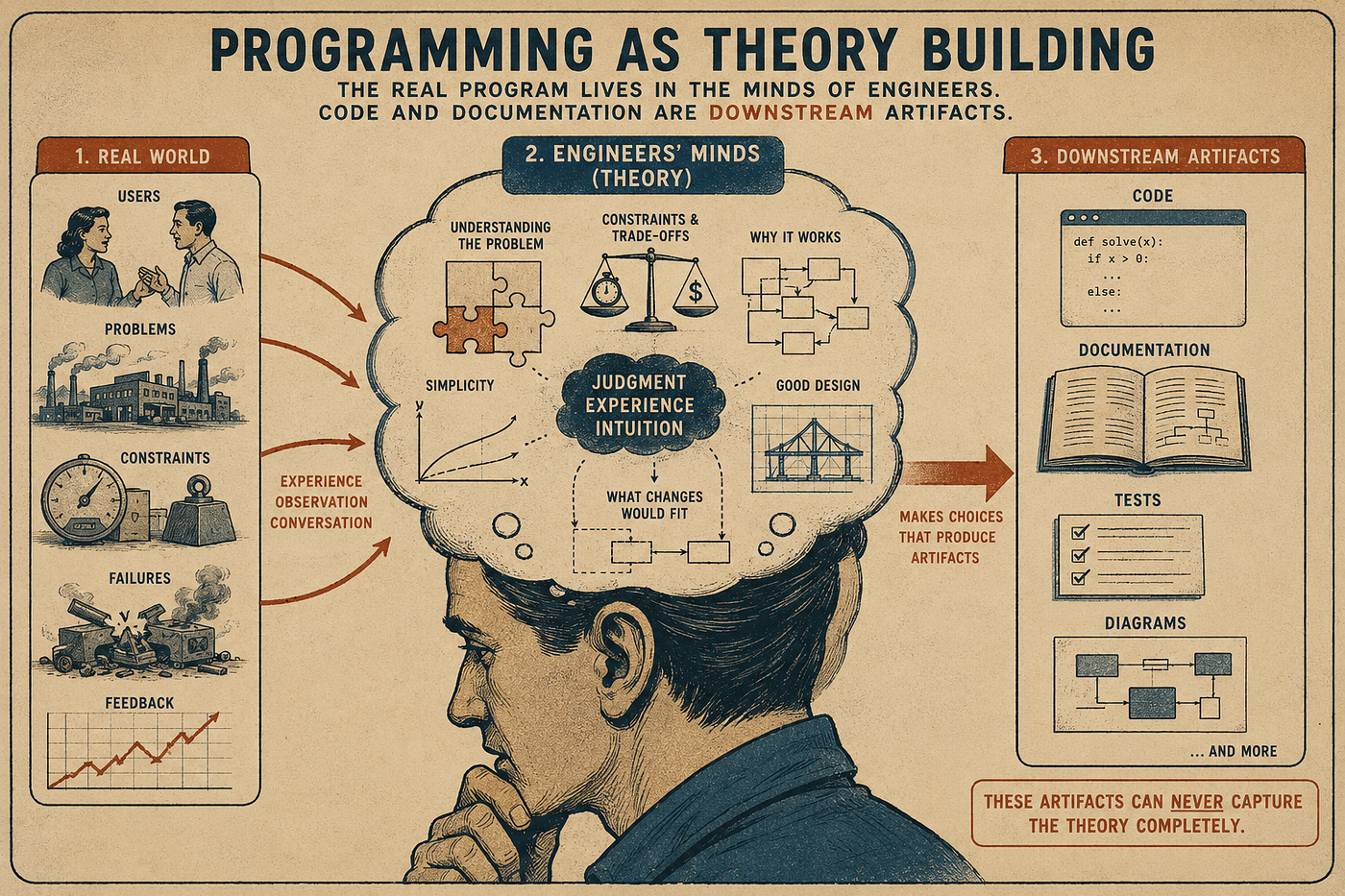
tl;dr Peter Naur’s “Programming as Theory building” states that the real programs, what he calls Theory, with capital T, are in the mind of the engineers. The code & documentation are just downstream (and thus incomplete) artifacts. One of my main complaints about LLMs is how verbose the code is and how complexity creeps in everywhere. I always had some faith that we might improve that using metrics like LoC or the number of independent code paths to constrain them. However, after reading Naur I realized that the complexity we are trying to reduce is the Theory one, not the code, and there are no relevant measures for that because it’s very subjective.

I recently read the fantastic paper “Programming as Theory building” by Peter Naur. It has changed quite substantially my views on what current LLMs can or can’t do, how to prompt them, what are the main limits to current agentic systems or why pair programming is so effective.

Today I will focus on its relation to code complexity.

If you haven’t read the paper, I really suggest that you do. In fact, my main goal in writing this post is to get some of you to read the original paper. It is worth the effort. It is also the perfect chance to practice (or learn!) to do close reading in Solveit because it’s much easier: you can ask any questions throughout the text, go down any rabbit holes you like, or just ask Solveit to make the language clearer to you. More information on close reading in this blogpost and you can quickly get started by forking my own dialog.

With that in mind, if you still decide not to read it, here’s the paper’s tl;dr:

A program is the Theory held by the people who build and maintain it: an understanding of how the program relates to the real-world problem, which constraints and trade-offs shaped it, why it works, and which changes would fit its design. Code and documentation are downstream artifacts of that Theory, and can never capture it completely. Engineers develop this understanding through experience: talking to users, observing failures, learning the domain, and seeing how the system behaves in the real world. This understanding guides judgments of relevance, similarity, simplicity, and good design.

LLMs aren’t great at continual learning, talking to users, or experiencing things in the real world. But why is this relevant to complexity?

I think we can all agree that LLMs in general tend to increase the complexity of codebases if left unchecked. The reasons are many: they fail to realize a method already existed and duplicate it, they write overdefensive code like protecting against edge cases that can’t happen, or overoptimizing things too early. Tangentially, most frontier labs make a hefty sum the more tokens you consume, so they are kind of incentivized to promote tokenmaxxing. All in all, LLMs rarely follow the KISS principle. This issue is at its worst when vibe-coding w/o checking the output. But even when you review code, if you want to keep a program concise it requires an active effort to cut down complexity as much as possible.

In my naive days (about two weeks ago), I used to think we would get out of this complexity pit at some point. Frontier labs would just add some complexity penalization to their RL training. They could use total LoC as a metric to minimize, but we can all agree that sometimes a one-liner can be more complex than 2–3 lines. Another option would be cyclomatic complexity which measures the total number of independent code paths. After reading Peter Naur I realized that those things can’t really solve the problem (maybe they can alleviate it a bit though). Let’s see why.

Why Code Complexity is the wrong metric

In the (invented) example below we want to support calling OpenAI & Anthropic. Imagine all the message preparation and retries are handled identically, but the request body params are slightly different so we have 2 different methods call_openai and call_anthropic.

In the first naive version we have 2 different classes with duplicated boilerplate code (ie prepare and with_retries).

# Separate — duplication a metric would flag

class OpenAIClient:
    def complete(self, prompt):
        msgs = prepare(prompt)         # shared boilerplate
        y = call_openai(msgs)          # the only line that differs
        return with_retries(y)         # shared boilerplate

class AnthropicClient:
    def complete(self, prompt):
        msgs = prepare(prompt)
        y = call_anthropic(msgs)
        return with_retries(y)

A straightforward refactor would be to create a single class so we DRY. By many metrics this is a better implementation: it has fewer lines of code, better Halstead volume — calculated as V=N×log2(n) for program length (N) and vocabulary (n) — and better Maintainability Index.

# Merged — genuinely better by the metrics: DRY, fewer lines

class LLMClient:
    def __init__(self, provider): self.provider = provider
    def complete(self, prompt):
        msgs = prepare(prompt)
        y = call_openai(msgs) if self.provider == "openai" else call_anthropic(msgs)
        return with_retries(y)

In general, the second version (or similar versions that reduce LoC and duplication) are less complex. However, what if I told you that it is very likely that next month we will stop supporting Anthropic. In that situation I find it preferable to keep them separated so when the time comes I can simply remove the file containing the AnthropicClient.

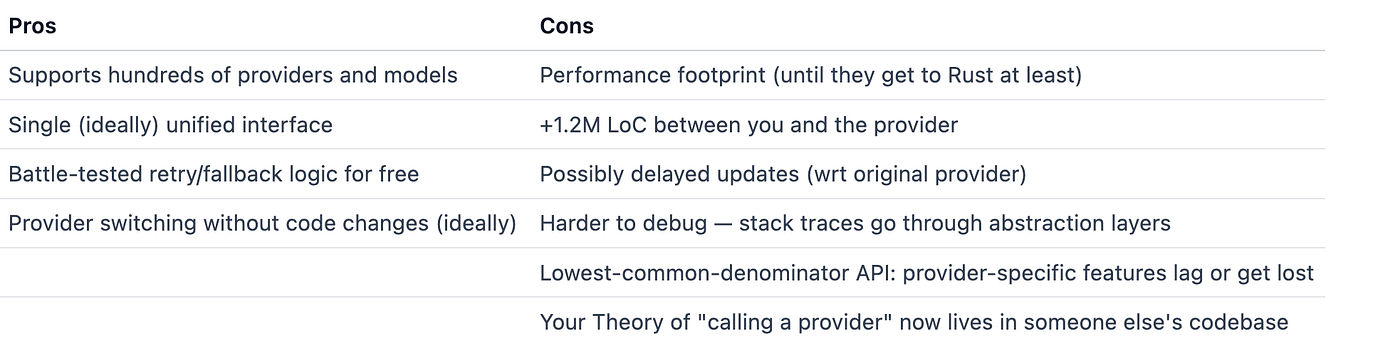
Of course a simple example like this is easy to solve, especially now that LLMs can code for you. But what if instead of 2 providers you want to support 165+ providers like LiteLLM does? Well in that case just use LiteLLM. But then you will be putting over +1.2M python LoC between you and the final provider. Is it worth it?

Well-designed APIs are a great way to abstract complexity. You have a clear contract and you don’t need to understand what happens behind. Even if the LiteLLM is a huge package, it might not count towards your total Theory complexity. The early days of LLM inference endpoints were like this: “you send text in, you get text out”. However, this breaks down when the contract is not reliable anymore. This can happen because it’s buggy, or because there’s a lot of state hidden behind the API which you can’t get, or simply because you’re not sure if a new provider feature is supported.

Whenever you are forced to peer into the abyss beyond the API abstraction layer, that complexity becomes your problem. This problem is becoming more common. Providers like OpenAI and Anthropic increasingly hide data server-side like encrypted compaction data or reasoning tokens (more on this). Anyone aiming to offer an abstraction layer on top of them is forced to either expose provider-specific details, reimplement increasingly brittle compatibility logic, or accept that the abstraction cannot faithfully represent the systems beneath it.

If you are moving fast, using basic features and want to try many providers then LiteLLM or similar libs might be worth it for you. If on the other hand you value control, debugging and in understanding your stack, then probably not. There’s no right “complexity” (although I very much prefer the second option).

Enter the Theory

The information to decide which path to take does not live in the code. This information is part of what Naur calls the Theory of the program. LLMs so far have little to no access to this information because it lives in people’s minds. They can get hints about it in IM, email, or other kind of written docs but all of those will always be partial (best case).

Some of this information can be supplied to an LLM as context like business priorities, expected product changes, operational constraints, and the reasons behind earlier decisions. Doing so might improve its choices, but these are still artifacts of the Theory. They cannot completely transfer the experience and judgment through which the team developed that Theory.

This is all good, but what if I am all-in with vibe-coding & tokenmaxxing, what if I don’t care at all about the code. Well in that situation the rest of the blog post won’t convince you otherwise. If on the other hand you’re in-between I will describe a real situation we went through at Answer.AI with our billing system for Solveit.

Spoiler alert, at Answer.AI we are heavily invested in minimizing complexity at all costs. This investment actually tends to result in simpler code that is easier to hold in your mind.

The initial billing system

Solveit is a platform where you can use AI to work in a notebook-like environment. The environment is persistent so we charge for LLM usage, cpu, disk, memory and bandwidth.

The initial plan was to charge users a monthly subscription fee (e.g. $5). This monthly subscription amount would then become credits to be consumed during the month, if you consume them all then you’d have to top up your balance before next month. We tested this approach in a smaller scale project first to validate it.

This approach turned out to be more complex than we wanted. First, the credit + subscription mechanism would make some people (like myself) confused. Second, it made the code more complex at multiple levels. You have to deal with all the logic of consuming “monthly subscription credits” first, and then normal credits or what to do with leftover credits. On the Stripe side of things it had 2 distinct code paths: manual top up and the subscription service.

For those of you not familiar with it, Stripe subscriptions is a fully managed service. Stripe manages the lifecycle (recurrence, invoicing, retries all happen on their side).

You just create the subscription roughly like:

stripe.Subscription.create(customer=cust_id, items=[{"price": "price_5usd_monthly"}])

and listen to their webhooks to update your DB when subscription status changes or when payments arrive (or many other options you can decide on).

The direct charge requires you to start a checkout session so users land in Stripe’s domain and fill in their card. It requires you to provide a customer ID. Where should you create the stripe customer? when your user signs up? when they try to pay, something else? all are valid options.

stripe.checkout.Session.create(mode="payment", customer=cust_id,
    line_items=[{"price": "price_5usd", "quantity": 1}],
    success_url="https://yoursite.com/done")

Good so far? If you don’t have a lot of experience with Stripe or payments, chances are you will be already struggling to hold it all in your head. Maybe you have managed to simplify it into your mind like:

  • Subscriptions -> managed by stripe subscriptions
  • Top up -> stripe checkout

A problem that is not obvious is that using Stripe managed service means that you have duplicated data. Half of the data lives in Stripe’s backend and you have to make sure your local DB is synchronized with it. Another problem is that while debugging, you have to both query Stripe services AND check your own DB. For example, if a payment does not show up is it because Stripe did not send the webhook (“their fault”), or because we failed to store it in our DB (“our fault”)?

Stripe subscription service is great and easy to set up, but it is designed to support a huge number of use cases. That means that, even if well designed (which it certainly is), the API abstraction ends up being quite complex. In this case you are trading the complexity of rolling up your sleeves and writing that code yourself, for the complexity of learning the Stripe API.

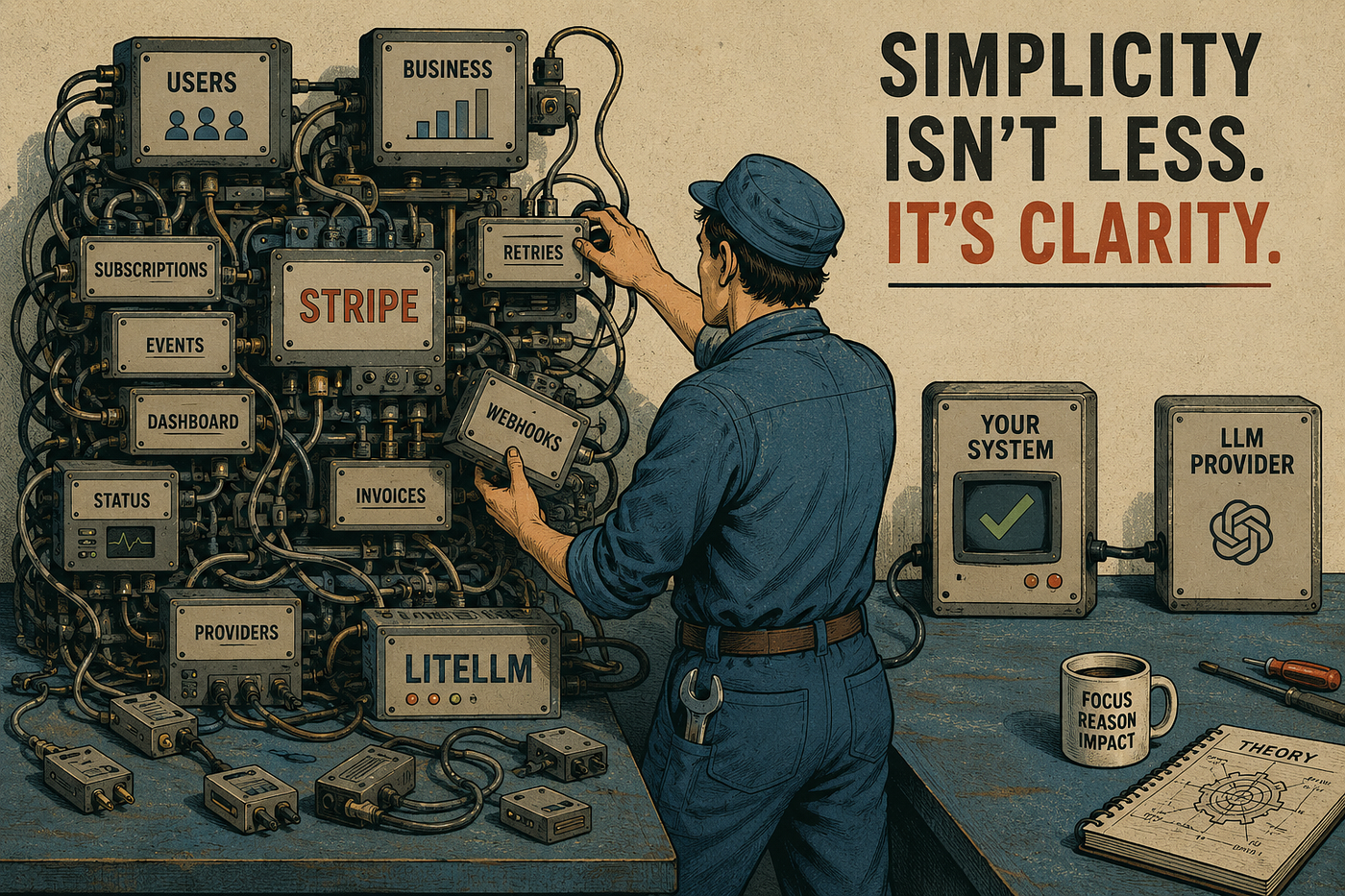
LiteLLM and Stripe illustrate the same trade-off at different scales: an external abstraction can greatly simplify your Theory while its contract holds, but its hidden complexity becomes yours whenever you must debug, modify, or reason beyond that contract.

The AAI way

At Answer.AI we try to own all the stack. The reason why merits a full article (or multiple ones) so I won’t delve into it. So we were not pleased with the state of affairs discussed above.

After many days of exploration and discussion we settled on a much simpler system.

First of all, we would do credits only and charge based on usage. This is a super simple model (and Theory!): you pay for what you use by adding credits.

Once subscriptions were out of the way, we could remove a big chunk of code related to keeping them in sync. Only 2 payment paths remained, manual top up and auto topup. To do auto topup you need to be able to save the customer CC so you can charge it at will. In the case of Stripe checkouts, you don’t save the CC, you just ask Stripe to process the payment in their UI.

Long story short, we eventually figured out that the simplest way would be to save users’ credit card as soon as they sign up. Once they have a card on file, they can either use it to manually top up their account, or they can set it to auto topup. Because we handle it all manually the sync problems are almost nil. We only listen to payment success events (no subscriptions!).

The result is that the Theory of our payment system can be summarized in a single sentence:

Customers add their CC when they sign up and then we charge that card either manually (topup) or automatically when the credit goes low

Both manual and automatic top up now use the same payment path. Our entire payment stack — split between Solveit & faststripe — is roughly 300 lines of code.

The result is very low complexity but it was the result of multiple hours of exploration, attempts, and discussions. My explanations here scratch the surface at best.

Enter India

So what happened on launch day? Did everything go smoothly? No. After launching we realized that Indian cards do not support charging a card off-session whenever you choose. The manual top up, which is on-session, would still work because they would be shown a 3DS-like approval flow in our UI but not the automatic top up.

When exploring for solutions, we discovered that Stripe managed subscriptions actually work in India. Why? Well Stripe works around all that complexity for you. They create & hold the off-session payment intent the day before, so the banks can send a pre-debit notification or authentication request to the users before the actual charge.

When migrating away from managed subscriptions we lost that feature. I asked a frontier LLM — I think it was GPT 5.5 — how could we handle this. Do you care to guess at the proposed solution?

Use Stripe subscriptions to handle it

The LLM was proposing to use again the solution we just migrated away from. If you have read this far, what would you say, what’s your opinion? Should we migrate back?

The LLM outlined two options, either to support both systems (ready to code, just say the word!) or to fully migrate back into the old one. What did we do? Nothing. We greatly value the Theory complexity so we decided that requiring Indian users to manually top up was ok (sorry guys!) in exchange for a simpler and more robust platform.

If you don’t agree with our choice, reflect on why not. Like, seriously, stop right now and think about it.

There is no right answer and one of the points of this post is to help you realize where your answer comes from. What are your arguments and, more specifically, where do they come from?

There are many situations where Stripe managed services are a superior choice. Here are some examples:

  • Company revenue is the most important, so the extra friction of manual top up might make us lose some India sales, we should migrate back (or support both)
  • The sales team uses the Stripe Dashboard UI, having all the payment system information in our DB is not ideal because they can’t manage it.

My point is that the complexity of your code really depends on a lot of factors that have NOTHING to do with code and that information is NOT in the code.

The hidden advantage

So why not let LLMs fully manage these things for you? The beautiful answer in my opinion is that our way of working uncovered a possible business opportunity. India does not support debit mandates in the same way the rest of the world does. Stripe tries to solve this, but it is far from a complete solution.

In the process of understanding and simplifying the process and the Theory we learned something valuable beyond the product we built. These, in my opinion, are the kind of insights that can turn into competitive advantages.

Striving to understand is essentially a process of Theory-simplification. If you let your LLM free rein in complexity you can churn out a lot of code quickly. Choosing the simplification route is longer and takes more effort, but in the long run I think it pays off, and you might find hidden gems along the way.

添加评论
点赞收藏
点踩分享查看原文
评论
?
参与讨论