Nebius and CoreWeave Tout Short-Term Cloud Deals, While AWS Goes Long

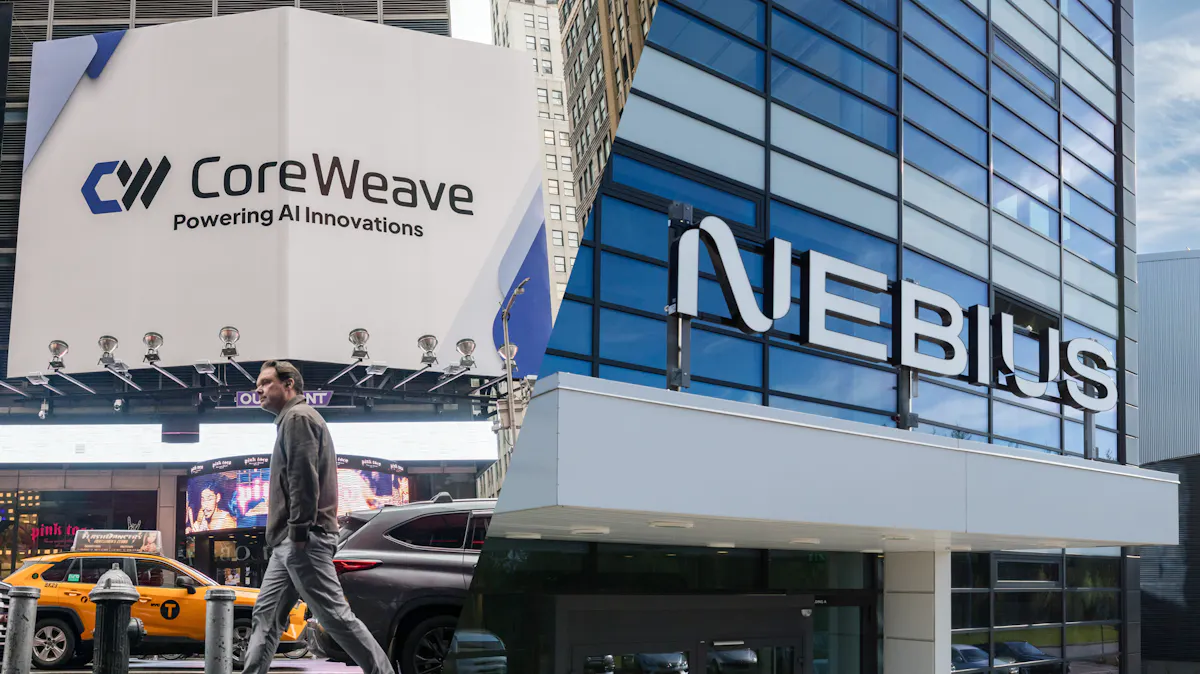
This week, Nebius and CoreWeave both pitched investors on a new business opportunity—shorter-term contracts. The neoclouds said these deals would allow them to cash in on surging prices for AI compute capacity amid a crunch for GPUs, and investors seemed to agree, with shares in both companies moving sharply higher.
While the neoclouds are selling investors on fat margins on quick deals, cloud giant Amazon Web Services had used its earnings call to highlight that it was selling most of its AI capacity via five-year deals. Amazon CEO Andy Jassy said these long deals ensure AWS will generate enough revenue to make money on its data center build-out. Investors seemed to like this narrative too—Amazon’s stock is up over 11% from its July 30 call.
But which investor story translates into better business results remains an open question. Devoting more capacity to short-term deals could allow the neocloud firms to step in quickly and capitalize on customer needs for immediate compute. But ramping up in that area at the expense of longer-term deals introduces more uncertainty about future revenue. At the same time, AWS could lose the opportunity to earn higher margins and to court fast-moving startups if it leans too far into long contracts.
“You want to balance your book between long-term, secure, highly rated, dependable customer contracts …. and the on-demand [market],” where you can get opportunistic pricing, said Paul Meeks, managing director and head of technology research at Freedom Capital Markets. “You got a little bit of the hare, and you got a little bit of the tortoise.”
A significant portion of both neocloud companies’ existing revenue pipeline comes from contracts of at least five years signed with customers that have investment-grade credit ratings, including Meta Platforms and Microsoft. Those contracts have been critical for the neoclouds to secure financing to buy GPUs and build data centers, since lenders want to see predictable revenue streams.
One way to measure cloud businesses’ future contracted revenue is by remaining performance obligations, or RPO. That figure measures revenue that has been committed to under contracts but that hasn’t yet been recognized by the cloud companies, which disclose roughly when they expect that revenue to come in. Both Nebius and CoreWeave’s RPO shifted slightly toward the nearer-term in the second quarter, likely in part as existing deals aged.
A continued shift could signal a broader move toward shorter-term contracts. Whether that is a positive or negative for the overall business depends on what new contracts look like—shorter contracts can command higher pricing, but with less long-term revenue visibility for investors and lenders.
Nebius reported $37.5 billion of RPO at the end of June. Of that, 36% is due within two years, up from 29% three months earlier, while 24% is more than four years out, down from 32%. CoreWeave showed a similar shift, reporting $103.7 billion of RPO with 41% due within two years, up from 36% the prior quarter, while 20% is due more than four years out, down from 25%.
And the two companies in recent months launched new offerings with very short or no contractual commitments. Both said the moves have positioned them to capture surging compute demand. Nebius executives said this week that new contracts of three to six months can command prices of $40 million to $50 million per megawatt on an annualized basis, more than double what the annual rate has been for the one- to three-year deals Nebius offers.
“We are building an agile [go-to-market] process that allows us to have the flexibility to respond to customer requirements we see emerging,” Nebius Chief Revenue Officer Marc Boroditsky said in an emailed statement. “Short-term scale training clusters are a need that model builders are willing to pay a premium for.”
CoreWeave, meanwhile, highlighted rapid growth in its managed inference business, which allows customers to pay to run models as needed without having to commit to longer-term contracts. The company also touted strong pricing for contracts on both new and old generations of Nvidia chips.
AWS started from the opposite end of the spectrum, with an established on-demand cloud business that in recent years introduced ways to secure AI compute in advance. It added capacity blocks in 2023, allowing customers to reserve a fixed amount of GPU capacity in advance, while its largest AI customers have increasingly signed multiyear cloud commitments.
The weighted average for the remaining length of Amazon’s long-term contracts rose to 6.4 years in the second quarter, up almost a year from 5.5 years in the prior period and well above the roughly four-year average of recent years.
That jump reflects megadeals like the $100 billion commitments the company announced for both OpenAI and Anthropic earlier this year for eight and 10 years, respectively. Still, Amazon says it is contracting most of its AI capacity these days for at least five-year terms.
Amazon has blamed its large, long-term contracts for putting a drag on its cloud revenue growth in recent years, with customers committing to longer terms in exchange for lower prices. Even so, at a time when Amazon is spending heavily on AI expansion, those contracts are a positive signal for investors, because they mean AWS will have committed revenue even if a hypothetical AI bubble pops.
“[AWS is] trying to convince investors that if you want to know who to make a bet on in the AI space, you want somebody with the biggest backlog,” said Dave McCarthy, group vice president for cloud and data center infrastructure at intelligence firm IDC. “It shows [there is] customer confidence in what they’re doing.”
On Demand?
For now, the neocloud companies are making only a modest shift toward shorter deals. CoreWeave Chief Financial Officer Nitin Agrawal told analysts “a very limited part” of CoreWeave’s capacity is up for renewal, which limits how much the company can take advantage of high prices right now.
Nebius says it is allocating just a small portion of its available capacity to the shortest contracts of several months. It believes that part of the market will allow it to command strong prices from customers that need immediate compute. However, the company plans to maintain its focus primarily on landing new AI cloud deals of one to three years, which it considers midterm contracts.
Nebius executives said this week that demand is strong for those deals too, pointing to the company’s first ever auction of unallocated capacity as evidence that it can move pricing higher more broadly. The winning bidder paid 15% more for Nvidia Blackwell chip capacity than Nebius had ever charged previously, the company said.
CoreWeave, meanwhile, considers short-term contracts to be anything with a contract length of less than three years, including its managed inference offering and other on-demand services, according to a source familiar with the business.
Shorter-term deals currently make up just a small percentage of CoreWeave’s overall revenue, in part because most of its capacity is already rented out, the person familiar with the business said, but the company expects such deals will make up a larger share of revenue over time.
“As we continue to expand our customer base to an increasing mix of AI application builders in enterprises, we find customers are looking for more flexibility in how they plan their service needs and growth,” CoreWeave Chief Revenue Officer Jon Jones said in an emailed statement.
Earlier this month, CoreWeave raised a five-year $2.6 billion term loan backed by customer contracts of around three years, which the company said showed lenders’ appetite for debt backed by shorter deals that command higher prices and better margins.
To be sure, when those short-term deals come up for renewal, it’s not clear if the neoclouds will still be able to extract high margins from them. With cloud companies across the industry racing to build out capacity, there’s a scenario where a company like Amazon could still have plenty of long-term deals in place while neoclouds have to sign or renew deals at softer prices.

 点赞
点赞 收藏
收藏 点踩
点踩 分享
分享