
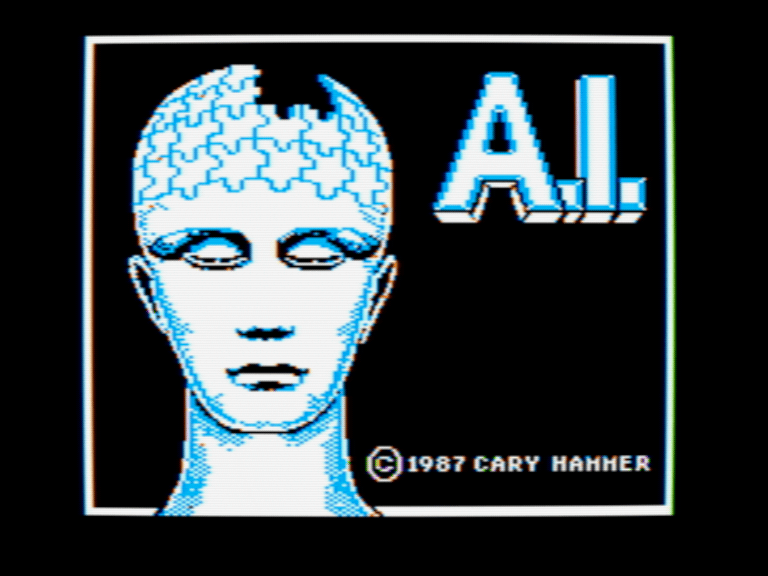
Vintage Artificial Intelligence: Before It Got Awkward

Long before the current kerfuffle about LLMs, Generative AI Artwork, and asking your tax preparation chatbot for a cookie recipe, the concept of artificial intelligence and synthetic life was a pervasive theme in creative and engineering works. We have the ground-breaking appearance of Rossum’s Universal Robots (or Tik-Tok, the Royal Army of Oz), through countless science-fiction properties and incredibly positive futurist home-making advertisements, and into the inevitable portrayal of dark and dystopian empires providing humans with nothing but a clear and present ending to their story arc. Artificial Intelligence has been riding along with humanity’s storytelling and expressiveness for many generations – and, one might argue, it is this ever-present influence and inspiration that has driven a lot of the modern phrasing and design in our most contemporary toys and tools wearing the vestements of consciousness.

The motivations are clear: our endless curiosity of the nature of our minds and humanity, the twists and turns that come when the synthetic mirror-images of people betray unintended consequences, and the fact that human beings look amazing when rendered in chrome.

But before we get swept up too much into the echoes of the past and see patterns of AI-like entities into the distant generations (golems, anyone?) let us instead zoom into a very specific family of projects and products that are presented at the Internet Archive for the research, education, and enjoyment of all:

The newly-minted Vintage Artificial Intelligence collection.

Dating roughly from the 1970s through the 1990s, these emulated software packages have come from many sources, and with many motivations, but have been curated together for a very subtle and occasionally imperceptible theme: the adventure of experiencing a machine that thinks.

To be clear, and without taking too much time for a press conference announcing so or claiming such for a future IPO, none of the programs in this collection come within a solar system of thinking in any actual sense. They are, instead, portrayals on microcomputers and game consoles of the idea of thinking machines, the experience of creating autonomous or semi-autonomous virtual entities, and playing games with the illusion of a contemplative and improvisational opponent.

“Delve” is a very popular word with machines, Jason said ironically, as well as em-dash. Let’s delve into some of the odd ways artificial intellgence begin appearing with these programs in the early days of home computers. Em-dash.

The most obvious and pervasive example for Artificial Intelligence is Joseph
Wizenbaum’s ELIZA, named after Eliza Doolittle in Pygmalion, and which began its artificial life as a program that would run various conversational scripts, of which its main first one, DOCTOR, was so popular in putting on the appearance of an interested psychologist that users famously opened up to the question and answer process it provided as if talking to a real person. While Wizenbaum wrote throughout his life of the over-abundant assumptions of the program, it was still enough of a successful gimmick that the program was ported and re-written dozens of times, many examples of which are at the archive: Eliza, Eliza, Eliza, Eliza, Eliza, Eliza, Eliza, Eliza, Eliza, Eliza, Eliza, Eliza, Ms. Eliza, Eliza, Eliza, German Eliza, German Eliza, Eliza, Eliza, and, finally, Psycho Eliza.

Eliza is the gold standard of the promise of artificial intelligence and the program was simple enough to encourage easy porting to various platforms, which is why you can click on many of the links to find yourself inside Apple II, Radio Shack Color Computer, Palmpilot, Atari 800, and many more home computer machines of the 1980s.

Naturally, the idea of “talk to something that sort of responds to you like a person, preferably like Eliza did” had innovation, parody and experimentation, leading to some of these other programs in the collection: Dr. Z (Eliza, but it ignores what you are saying) Talking Sam (which is more or less a demo for a speech synthesizer) Hyper Psych (A Therapist in Hypercard Format) DR. SPOC (another therapist) Abuse (which answers in a hostile way to your conversation) Pisko (which is a parody, and also requires you to talk to it in Serbian).

A program in this vein deserves special attention. Racter (short for Raconteur) (MS-DOS version here) is a very early commercial version of a chatbot – it was written to literally write sentences and stories that sounded authentically created, and even wrote some published short works. They sound exactly like you might think they would sound: “Bill sings to Sarah. Sarah sings to Bill. Perhaps they will do other dangerous things together. They may eat lamb or stroke each other. They may chant of their difficulties and their happiness. They have love but they also have typewriters. That is interesting.” This work eventually led to this commercial program, Racter, which you could hold conversations with and which could do a relatively eerie experience of conversations. At the time this program was released (1985), a small trickle of reviews and articles speculated on the ramifications of such a program existing, which look and sound, frankly, like someone bringing a bucket to catch what ultimately is a 100 foot tidal wave coming in from the 21st Century’s shore.

With the lens of the modern era to look back, and billions of dollars spent on the project and maintenance of the current systems, it’s easy to dismiss these older programs as toys or forgettable jaunts, but they carried with them the weight of a machine imbued with at least a fuzzy sense of character and thought. At a time when functioning spreadsheets were revolutionary to business and desktop publishing was looming over the audience and potential costs of printed communication, it seemed only natural these machines might become some possible type of being, and that being could be had for a price. The profits could, with some luck and opportunity, raise a fortune.

Activision of the 1980s, essentially a completely different company than the contemporary concern of today, did two major experiments in artificial intelligence-like products, seeking to find oddball variants of simple video games or productivity software.

Alter Ego (male and female versions) was developed by a psychologist as an exporation of decisions and consequences in life, allowing the player to take over a persona (an “alter ego”) and guide them through stages of childhood, teenage years, adulthood, and so on. Premature death was not off the table, nor were examples of the dark and light aspects of life, portrayed in interactive steps. Along the way, you would gain points towards various attributes of the personality (providing a game-like function) and ultimately, help to craft a more accomplished and successful life. It is, in other words, a classic RPG (Role-Playing Game) with a hint of a sense of an actual life being somewhere down there inside your home computer.

The other Activision creation, Little Computer People, is both an interesting choice and experience of the time. The conceit was simple – that people were discovered living inside computers, and this program gave the user a chance to see them living their otherwise hidden lives. Think The Sims, but Much, Much Smaller. Through clever programming (thanks to the work of programmer David Crane, of Pitfall! fame), the game had a lot of flexibilty and variance for the “inhabitants”: hundreds of names, variance in moods and willingness to listen, and other bits of illusion of life.

That illusion, that something living and functioning is buried somewhere among the code, that a program has created life from the darkness of ones and zeroes, is the most frequent aspect of all these programs, but was an actual selling point for some of the items in this collection.

The games Murder on the Zinderneuf, Suspended, Deadline, and The Hobbit all leaned heavily into scripted movements and off-screen antics of the characters inside them. At the time of its release, Deadline was reported on in general news articles about the possibility of literary characters who were quietly living their own lives, only mildly engaged with the game player, and who only interacted with narration and story when happenstance provided it. The Hobbit was legendary for the fact that the programmer of the non-player characters, Veronika Megler, held to the belief of the autonomy of the world outside the player so strongly that sometimes world-changing events (characters fighting, resulting in the loss of one) could happen entirely out of control and context, only revealing the game was unwinnable later. Suspended, in which the player is a cryogenically frozen mind restored to action to help handle an emergency, split consciousness and awareness to six different functioning robots, meaning only one could access information, another pick up items, and so on. The perception that reality is maleable, that work can happen in the background outside your awareness and return the results to you, finds itself referenced in the structure of modern AI agents and how they are sold to public and industry.

But avoiding rabbit holes of arguing humanity and mind inside code, let’s pull back to one of the other genres curated in this collection: autonomous agent programming.

There have been an entire family of games that consist of pre-programming the skills and processes of some manner of automaton (in the form of robots, worms, and so on), setting your programmed warrior into the arena, and seeing if they win. Examples of this include Robot War, Worms and Fortress. These humble-by-comparison programs make obvious what is not always expressed – that a number of simple rules, presented quickly and without intervention, can give incredibly powerful illusions of autonomy and intelligence, as long as you don’t look so closely.

And onward we go. For a solid amount of the late 20th century, the very computers we had created and made part of our lives could be used to tell stories that the computers themselves were alive.

And maybe a few of us believed it!

The collection ranges into other tangents of this arena, well worth exploring, but left as something for you, the intelligent agent at the keyboard, to browse around and play with. From programming languages based around logic rules to groundbreaking examples of what were called “expert systems” before they got renamed to “your new manager”, Vintage Artificial Intelligence has something for everyone, machine and person alike.

Try it out.

添加评论
点赞收藏
点踩分享查看原文
评论
?
参与讨论