Grief for Sale: AI Resurrects the Russian Dead Nobody Counts

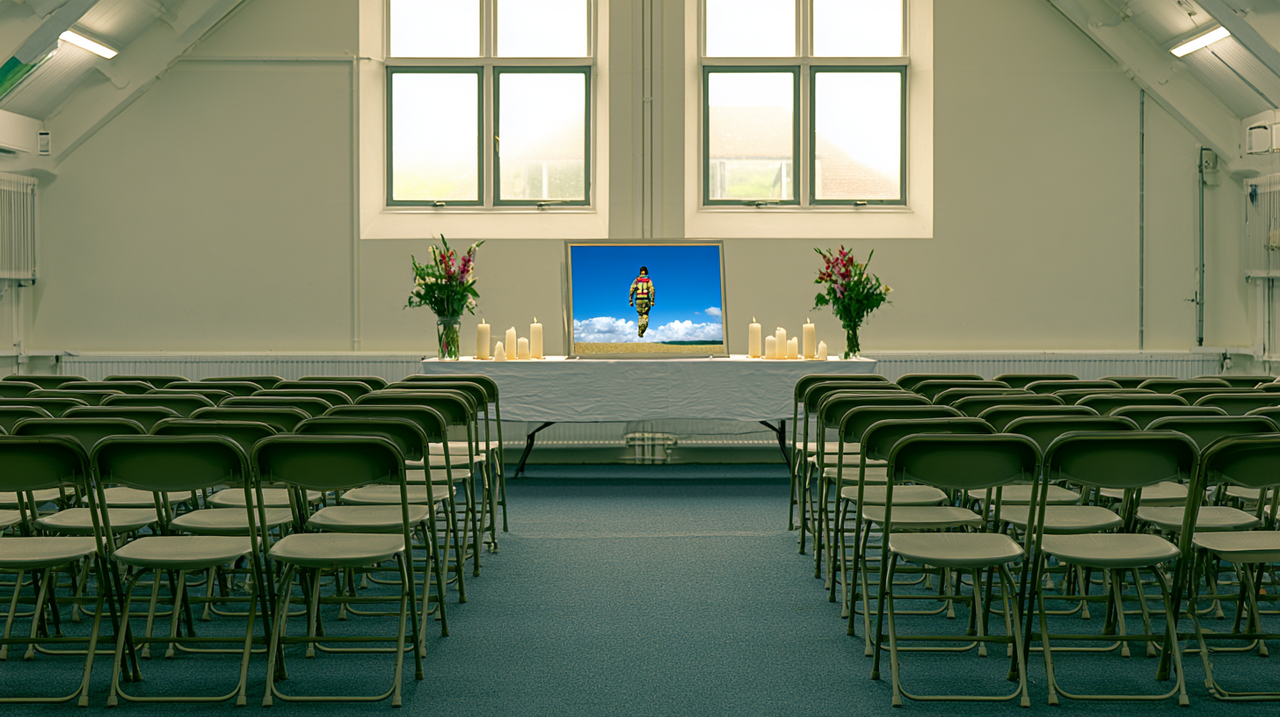
The clip lasts fifteen seconds. A woman pushes a pram along a sunlit street, then turns, and a man in military uniform steps into the frame to fold her into his arms. The light is warm. The faces are familiar. For the length of a held breath, a family is whole again. Then the man releases the embrace, turns, and begins to climb. A staircase resolves out of the air beneath his boots, rising into a blue sky thick with cloud, and as he ascends he is met by figures with wings. He pauses near the top, looks back once, and is gone into the light.
None of it happened. The man, in reality, vanished at the front in Ukraine, one of tens of thousands of Russian soldiers whose families have never received a body, a grave, or an official word confirming what they already suspect. The street, the embrace, the staircase, the angels: all of it was assembled by a generative artificial intelligence model, prompted by a paying customer and produced, in many cases, in a matter of minutes by a creator who may never have met the dead man or the grieving woman holding the pram.
This is one of the strangest and most quietly devastating cultural phenomena of the fourth year of Russia's full-scale invasion of Ukraine. It is a cottage industry of digital resurrection, and it has grown up in the gap between a state that will not acknowledge its dead and a population that cannot stop grieving them. A BBC investigation published on 14 June 2026 documented the practice in detail: the AI-generated farewell videos, the deepfake photographs, the visual grammar of religious ascent, the creators earning real money from manufactured reunions. The investigation gave the phenomenon a name that captures its peculiar emotional logic. It called it the unfinished goodbye.
What follows is an attempt to take that phenomenon seriously, not as a curiosity or a parade of the grotesque, but as a live experiment in how human beings might grieve in an age when the dead can be made to move and smile and ascend to heaven on demand. Because that is precisely what one of the few credentialed experts on the subject has called it. “We are all in the midst of a technological and cultural experiment,” Katarzyna Nowaczyk-Basińska, a researcher at the Leverhulme Centre for the Future of Intelligence at the University of Cambridge, told the BBC. The ethical assessment, she added, is “extremely complex.” She is right on both counts, and the second point is the harder one.
A Death Toll the State Will Not Name
To understand why so many Russian families have turned to a fifteen-second fantasy, you have to understand the scale of the loss and the silence that surrounds it.
Russia does not publish meaningful casualty figures. It has not done so in any honest or sustained way since the invasion began in February 2022. Into that vacuum stepped two independent newsrooms, the exiled Russian outlet Mediazona and the BBC Russian service, which have spent years assembling a verified count of the dead from open sources: obituaries, social media posts by relatives, regional newspaper reports, photographs of fresh graves, statements from local officials who let slip what the Kremlin will not. That painstaking work had confirmed, by early June 2026, more than 225,000 Russian military personnel killed in Ukraine; by the end of that month the tally had passed 227,000. On 3 August 2026 the two newsrooms put it at 236,066 named dead, 2,867 of them added since the previous update a fortnight earlier: more than 86,600 volunteers, 26,200 men recruited from penal colonies, 19,600 mobilised soldiers, 7,465 officers. The count does not pause while it is being read.
These are not estimates. They are named, documented, individually corroborated deaths, and the journalists who compile them are emphatic that the true figure is considerably higher. A separate modelling exercise by Mediazona and the outlet Meduza, drawing on inheritance records, put the probable number of Russian military fatalities at around 352,000 over four years. The confirmed count is a floor, not a ceiling. Behind every verified name there are families, and behind an unknown but vast number of the missing there are families who have been given nothing at all: no confirmation, no remains, no closure, only an absence where a son or a husband or a father used to be.
This is the soil in which the AI resurrection industry has grown. A state that conscripts and then disappears its young men, that recruits from prisons and remote regions and then declines to count the cost, leaves an enormous population of mourners with no officially sanctioned object for their grief. There is no telegram from the front. Often there is no funeral. The bureaucratic machinery that, in most societies, exists to convert a death into a recognised social fact has been deliberately switched off. And grief, denied its ordinary channels, will find others.
The Grammar of Ascent
The videos and images follow a remarkably consistent visual liturgy, and the consistency is itself revealing.
The typical clip, as documented across multiple accounts of the BBC investigation and earlier reporting by Meduza, runs to a few seconds. A man in uniform appears, often reconstructed from a single photograph supplied by the family. He embraces a wife, a mother, a child. Sometimes he speaks a few prewritten words of farewell. Then he turns and walks away from the camera, and as he walks he begins to climb, mounting an invisible staircase that materialises into a sky of blue and gold. Angels gather around him. He becomes one of them, or is received by them, and disappears upward into the light.
It is worth pausing on how legible this iconography is. Nothing about it is accidental. The ascending staircase, the cloud, the winged figures, the backward glance: these are the inherited images of Christian and folk-Orthodox eschatology, the visual vocabulary of icons and funerary art, repurposed and animated by a diffusion model. The technology is brand new. The symbolism is a thousand years old. What the AI does is collapse the distance between them, taking the abstract consolations of religious imagery (your loved one is at peace, he has gone to a better place, he is watching over you) and rendering them as a literal, moving, photorealistic event starring the actual face of the actual dead man.
The images do not stay on screens. The BBC documented their migration into the physical infrastructure of mourning. AI-generated portraits have been displayed at funerals. They have been etched onto headstones, fixing a synthetic image of the deceased as the permanent public marker of a real grave. One woman, the investigation reported, hung two AI-generated images of her late husband in her bedroom, turning the most intimate space in her home into a small private shrine to a man rendered by software. The dead, in this telling, are not merely remembered. They are reissued, in a flattering and consoling edition, and installed in the places where the living sleep and pray and say goodbye.
There is one more feature of these videos that cannot go unmentioned, because it changes their meaning entirely. They are not neutral. The man is always a hero. The war that killed him is never shown. There are no ruined Ukrainian cities in these clips, no civilian dead, no acknowledgement of the cause for which the soldier was sent to die. The angelic ascent sanctifies not only the man but the manner of his death. To Ukrainians who encounter this content online, and many do, the effect is grotesque: the aggressor's foot soldiers, beatified by algorithm, floating heavenward while the country they invaded burns out of frame. Grief and propaganda are braided together here so tightly that it is not always possible to say where one ends and the other begins.
The People Who Make the Dead Walk
The most uncomfortable fact about the unfinished goodbye is that it is a business, and a reasonably good one.
The BBC investigation identified real creators earning real money. One, who works under the name Ulyana Lebed and is herself married to a serviceman, was reported to earn between 150,000 and 200,000 roubles a month, roughly the equivalent of one and a half to two thousand pounds, by producing this content at volume; she told the BBC she works through between forty and fifty photographs a day. That is approximately double the average monthly wage in Russia. She charges, like many in the field, somewhere between a few hundred and ten thousand roubles per piece. The margins are extraordinary, because the marginal cost of generating an image with a commercial AI tool is close to nothing; the BBC's Russian service estimated that the production cost of some of these videos can be thirty roubles or less. Other creators in the reporting, including a young woman known online as Katya Jin (whose own husband is among the missing) and another named Anna Korableva, have built substantial audiences around the work.
It would be easy, and lazy, to cast these creators as simple ghouls cashing in on a nation's bereavement. The reality the reporting describes is more tangled. Korableva, who frames her work explicitly around helping people address “unfinished farewells,” told reporters that “in the first months of working on these videos, I cried almost every day.” Lebed is herself the wife of a soldier and so sits inside the very community she sells to. These are not detached operators in some distant content farm. Many are themselves embedded in the grief economy of wartime Russia, simultaneously its merchants and its members.
But the commercial frame is exactly what makes the phenomenon so difficult, and it is where the absence of any regulatory or clinical scaffolding becomes most glaring. Consider what is missing from every one of these transactions. The deceased person's consent was never sought; he cannot give it, and in the chaos of a disappearance at the front he was never asked how he might wish to be remembered, let alone whether he would consent to being animated into an angel for a fee. No grief counsellor reviewed the purchase. No clinician assessed whether the bereaved customer was in a psychological state where a photorealistic simulation of her dead son would help or harm her. There is no aftercare. The creator delivers the file and the relationship ends. What the buyer does with a moving image of a loved one ascending to heaven, how she integrates it into a grieving process that may already be going badly, is nobody's professional responsibility. It is a pure market transaction conducted over one of the most psychologically fraught events a human being can experience.
This is not a uniquely Russian problem, though the Russian case is uniquely stark. The phenomenon sits at the leading edge of what researchers have begun to call the digital afterlife industry, a global market for products that simulate, preserve, or reanimate the dead. Analysts project that the broader digital legacy and afterlife sector, valued in the low tens of billions of dollars in the mid-2020s, could grow several-fold within a decade. Western firms have already begun probing the commercial logic of grief. The founder of one American service that builds simulations of deceased relatives has openly discussed integrating advertising into the conversations users have with the dead, including the prospect of making non-paying users watch an advert before speaking to a simulation of a lost loved one, or having the simulation itself deliver targeted marketing mid-conversation. The Russian farewell videos are a wartime, downmarket, hyper-accelerated version of a temptation that the entire industry faces: once you can manufacture the presence of the dead, you can sell it, and once you can sell it, the incentives of the marketplace begin to shape how an entire culture mourns.
What We Actually Know About Grieving With Machines, Which Is Very Little
Here is the central, vertiginous problem. We are deploying these tools at scale, in a population traumatised by war, with essentially no evidence about what they do to the people who use them.
The clinical literature on grief is not silent, and it is worth bringing to bear because it cuts in two directions at once. For most of the twentieth century, the dominant Western model of healthy mourning was one of detachment: the bereaved person was meant to “let go,” to sever the bond, to relocate their emotional energy onto the living and thereby “move on.” That model was overturned in the 1990s by the continuing bonds theory, set out in the influential 1996 volume edited by the psychologists Dennis Klass, Phyllis Silverman, and Steven Nickman. Their argument, drawn from close study of how people actually grieve, was that maintaining an ongoing relationship with the dead is not pathological at all. It is normal, often healthy, and a feature of grieving across most human cultures. The widow who talks to her husband's photograph, the parent who keeps a child's room intact, the family that sets a place at the table: these are not failures of mourning but a natural reconfiguration of a bond that does not so much end as change form.
On the face of it, continuing bonds theory might seem to vindicate the AI farewell video. If maintaining a connection to the dead is healthy, what could be wrong with a tool that vividly sustains that connection? But the theory contains a crucial proviso that the technology threatens to violate. A healthy continuing bond is built on the truth of the loss. The widow knows her husband is dead even as she talks to his photograph. The bond continues, but it continues as a relationship with someone who is gone. The danger of a photorealistic, animated, speaking simulation is that it can blur exactly the boundary that healthy grieving depends on, the boundary between presence and absence, between memory and hallucination.
This is the boundary that one bereaved mother put her finger on with brutal clarity. Asked whether the technology had helped her, she told the BBC: “Could technology help me accept that I will never hug my son again? No. It's an illusion.” It is hard to imagine a more precise lay diagnosis. The work of grief, in almost every clinical model, requires the acceptance of an irreversible reality. An illusion of reunion does not perform that work. At best it postpones it. At worst it substitutes for it, offering the feeling of contact without the fact of it, and in doing so risks holding the griever in a permanent present tense where the loved one is always about to walk back through the door.
The risk has a clinical name. Since the publication of the DSM-5-TR in March 2022, the American Psychiatric Association has formally recognised prolonged grief disorder, a condition in which acute grief remains intensely distressing and disabling beyond twelve months after a death, marked by persistent yearning, preoccupation with the deceased, and an inability to reintegrate into ordinary life. Studies suggest it affects somewhere in the region of five to seven per cent of bereaved people. No one yet knows whether immersive AI simulations of the dead increase that risk, but the mechanism by which they might is not hard to sketch. A technology whose entire emotional appeal is the suspension of the fact of death is, almost by definition, in tension with a recovery process whose first requirement is the acceptance of that fact.
And then there is the opposite possibility, which the honest commentator has to hold in mind at the same time. For some users, the videos may genuinely help. One Russian widow described how AI gave her “an opportunity to feel close to her husband again, nearly two years after his death,” a way of carrying a continuing bond rather than dissolving in unresolved loss. For a mother who has been denied a body, a grave, and any official word that her son is dead, an image of him ascending peacefully to heaven may supply something the state has cruelly withheld: a ritual, a marker, a place to put the grief. The point is not that the technology is uniformly harmful. The point is that we do not know, that it almost certainly helps some and harms others, and that at present there is no way to tell which is which, and no one whose job it is to find out.
The Academic Frontier, Such As It Is
The research community has begun, belatedly, to map this territory, and what is striking is how candidly its leading voices admit how much remains dark.
A paper published in Frontiers in Psychology on 10 December 2025 offers one of the more rigorous recent attempts. Authored by a team of researchers (Mengxi Fu, Hanyu Xiao, Haoyi Ruan, Yuran Lin, and Xiangyu Dong), it examined grief in virtual environments by staging avatar-based memorial ceremonies on the social platform VRChat and interviewing sixteen participants aged between eighteen and sixty-five. The study is not about war videos, but its findings are directly relevant. The researchers proposed what they call a Hybrid Grief Model of Virtual Mourning, describing digital grief not as a tidy linear progression through stages but as a restless oscillation between emotional states, mediated throughout by technology and shot through with the impulse to maintain continuing bonds.
Two of the paper's conclusions matter especially here. The first is a clear generational fault line. Younger participants tended to approach loss in virtual settings with humour, narrative play, and a flexible, experimental attitude toward identity, while older participants engaged with more solemnity, more ritual structure, and a stronger pull toward symbolic continuity. If that pattern generalises, it implies that the same AI memorial artefact may land in radically different ways depending on who is grieving, which makes any one-size-fits-all judgement about the technology's effects almost meaningless. The second conclusion is an admission. The authors state plainly that avatar loss “remains an underexplored form of grief,” that “little is known” about how people experience these new modes of mourning, and that the emotional processes involved are not well characterised. This is the considered verdict of specialists actively working in the field: we are flying nearly blind.
The same humility runs through the work of Nowaczyk-Basińska, the Cambridge researcher whose phrase about a “technological and cultural experiment” has become the most quoted line in the coverage. Together with her colleague Tomasz Hollanek at the Leverhulme Centre for the Future of Intelligence, she published a paper in the journal Philosophy and Technology in 2024 with the title “Griefbots, Deadbots, Postmortem Avatars: on Responsible Applications of Generative AI in the Digital Afterlife Industry.” It is among the most serious attempts yet to think through the ethics of simulating the dead, and its central image is haunting in both senses of the word. The researchers warn of the possibility of unwanted digital “hauntings,” in which a simulation of a dead loved one keeps reappearing, sending notifications, or delivering marketing messages dressed up as words from beyond the grave, in ways the bereaved never asked for and cannot easily switch off.
Their recommendations read, in light of the Russian farewell videos, like a catalogue of everything that industry lacks. They argue that re-creation services should secure the mutual consent of both the data donor, the dead person whose likeness is used, and the recipient who interacts with the result. They call for meaningful transparency, so that no one is misled about what they are dealing with. They argue these services should be restricted to adult users. And they insist on the need for dignified ways to retire a simulation, even gesturing toward the idea of “digital funerals” or rituals that would allow a griever to bring the relationship with a deadbot to a close that offers emotional resolution rather than abandonment. Almost none of this exists in the Russian market. The consent of the dead soldier is structurally impossible to obtain. There is no transparency requirement, no age gate, no retirement protocol, no aftercare. The artefact is generated, sold, and abandoned to whatever role the buyer assigns it.
When the Simulated Dead Enter the Public Square
The Russian phenomenon may feel remote, a product of a specific and terrible war. It is not. The capacity to animate the dead is becoming a general feature of the technological landscape, and it is already crossing from the private grief of the bedroom into the shared institutions that depend on a clear distinction between the living and the dead.
The most arresting Western example to date unfolded in an Arizona courtroom in May 2025. Christopher Pelkey, a thirty-seven-year-old army veteran, had been shot and killed in a road rage incident in Chandler, Arizona, in 2021. At the sentencing of the man convicted of killing him, the court permitted something unprecedented in an American courtroom: a victim impact statement delivered by Pelkey himself, four years after his death, in the form of an AI-generated video. His sister, Stacey Wales, and her husband, who work in technology, had trained the simulation on photographs and old footage. On screen, the reconstructed Pelkey addressed his killer directly. “To Gabriel Horcasitas, the man who shot me,” the simulation said, “it is a shame we encountered each other that day in those circumstances.” The presiding judge, Todd Lang of Maricopa County Superior Court, sentenced the defendant to ten and a half years and remarked from the bench that he “loved that AI.” The defence appealed, its attorney Jason Lamm arguing that the trial court erred in allowing the AI-generated video to be played at sentencing at all. The case has now been briefed and argued before the Arizona Court of Appeals, which has yet to rule.
Set the courtroom beside the Russian bedroom and a common thread emerges. In both cases, a grieving family used generative AI to make a dead person say and do things he never said or did, and in both cases the synthetic artefact was granted a kind of authority: emotional authority on the headstone, quasi-evidentiary authority in the court. The technology does not merely console the bereaved in private. It is beginning to insert simulations of the dead into the public processes by which societies establish facts, mark deaths, and render judgements. Each instance is sympathetic on its own terms. The aggregate is a slow erosion of the line between what a dead person actually said and what software can be made to have them say, at precisely the moment when that line matters most.
Who Is Responsible?
This brings us to the question the brief poses most sharply, and the one for which there is currently no satisfactory answer. When the commercial production of AI simulations of the dead becomes the primary available response to a loss the state will not acknowledge, who, if anyone, is responsible for the long-term psychological wellbeing of the people who use these tools?
Run through the candidates and watch each one fall away. The state that sent the soldiers to die and then refused to count them is, in the Russian case, the least plausible guardian imaginable; the entire phenomenon exists because that state abdicated its most basic duties to the dead and the bereaved. The AI creators are unregulated, often untrained, frequently grieving themselves, and bound to their customers by nothing more durable than a single transaction. The platforms on which the videos are made and shared have shown little appetite for policing content that, after all, drives engagement and breaks no obvious rule. The clinical profession that might offer aftercare is nowhere near the point of sale and, in many cases, would not know the artefact existed. And the bereaved themselves, the people least equipped in the rawest hours of loss to make a cool judgement about the psychological wisdom of buying an animated angel bearing their child's face, are left to carry the entire burden of caveat emptor.
The legal landscape offers no rescue either, though it is no longer quite the blank it recently was. On 18 June 2026, four days after the BBC published its investigation, the US Senate Judiciary Committee advanced the NO FAKES Act by unanimous voice vote, sending to the full Senate the first federal intellectual property right over AI-generated replicas of a person's voice and visual likeness: rights inheritable by heirs, executors and estates for at least seventy years after death, with platforms liable for up to $750,000 per offending work. Senators Mike Lee, Ted Cruz and Eric Schmitt registered First Amendment misgivings even so. But set that bill beside the Russian bedroom and it passes clean over the case. It is built to stop the commercial exploitation of a likeness, usually a famous one, and says little about a private recreation commissioned by the very heirs in whom the new right would vest. It is American law besides, of no consequence to a market operating in Russian for Russian families. The vacuum is filling at its commercial edges while its intimate centre stays open, governed by nothing better than a thin and inconsistent patchwork of publicity and personality laws, written long before the technology, that vary enormously in whether they survive a person's death at all, for how long, and with what exceptions. A simulation of the dead falls into the cracks between intellectual property, data protection, and the dignity of the deceased, claiming the protection of none of them with any reliability. In practice this means that the most intimate possible use of a human likeness, the reanimation of someone's dead child, is among the least regulated, governed by less than the law would demand of a company wanting to use that same face to sell soap.
The result is a closed loop of unaccountability. A bereaved person experiences a loss the state denies. The market offers, for a modest fee, a consoling illusion of reunion. The illusion may soothe or may entrench the very inability to accept the loss that grief recovery requires. And there is no one in the chain whose responsibility it is to know the difference or to act on it. The researchers who have studied the field most closely are reduced to calling it an experiment, which is an accurate description and also an indictment, because an experiment conducted on traumatised human subjects at population scale, without consent, without oversight, without aftercare, and without any mechanism for learning from its results, would not pass the ethics board of any university in the world. Yet that is precisely what is being conducted, in the open, on the families of a country's war dead.
The Goodbye That Cannot Be Finished
The deepest cruelty of the unfinished goodbye may be hidden in the phrase itself. The promise of the technology is completion: the farewell you never got to say, the embrace you were denied, the ascent to peace you can now witness. The reality, by the testimony of the very people who buy it, is the opposite. “It's an illusion,” the mother said, and an illusion is by definition something that cannot finish anything, because it never began. The goodbye remains unfinished precisely because the thing performing it is not real, and some part of the griever, the part that hangs two images in the bedroom and visits the headstone, knows this even as another part of her longs to believe.
What the AI farewell videos expose, more than anything, is how much of the human apparatus of mourning was load-bearing all along. The body to be buried, the grave to be visited, the rite performed by a community that gathers and witnesses, the official word that converts a private suspicion into a shared fact: these were never mere formalities. They were the technology, in the oldest sense, by which a society helped its members metabolise loss and rejoin the living. When a state switches off that apparatus, and a market rushes in to replace it with a thirty-rouble fantasy of angels and staircases, something is lost that is harder to name than a soldier. It is the cultural scaffolding of grief itself, the accumulated wisdom of how to say goodbye, dismantled and sold back to the bereaved one heart-rending clip at a time.
We are, as the Cambridge researcher said, all in the midst of a technological and cultural experiment. The Russian families of the missing are simply its first mass cohort, the involuntary subjects of a trial whose results no one is gathering and whose ethics no one cleared. Whether the machines that animate the dead can help us complete our grief or whether they merely sell us the illusion of a goodbye that, by their very nature, can never be finished, is a question the available evidence cannot yet answer. What is clear is that the question is being settled in practice, at scale, in real time, in the bedrooms and graveyards of a country at war, and that no one has been left in charge of the answer.
Sources and References
- BBC News, “Russian families use AI to 'resurrect' loved ones killed in Ukraine,” 14 June 2026 (republished by The Star, Kenya): https://www.the-star.co.ke/news/world/2026-06-14-russian-families-use-ai-to-resurrect-loved-ones
- Kyiv Independent, “Over 236,000 Russian soldiers killed in Ukraine identified by media investigation,” 3 August 2026: https://kyivindependent.com/over-236-000-russian-soldiers-killed-in-ukraine-identified-by-media-investigation/
- IBTimes UK, “Russian Families Use AI To 'Bring Back' Loved Ones Killed in Ukraine, but Critics Call It a 'Disturbing Illusion',” 18 June 2026: https://www.ibtimes.co.uk/ai-videos-russian-families-digital-reunions-1803565
- Meduza, “Widows of Russian soldiers killed in Ukraine are using AI to 'resurrect' their husbands,” 14 April 2026: https://meduza.io/en/feature/2026/04/14/widows-of-russian-soldiers-killed-in-ukraine-are-using-ai-to-resurrect-their-husbands
- ThePrint, “Russia's disturbing AI video trend today is about dead soldiers”: https://theprint.in/feature/russia-ai-videos-dead-soldiers/2964420/
- BreezyScroll, “AI-Generated Videos of Fallen Russian Soldiers Spark Ethical Debate as Digital Afterlife Industry Grows”: https://www.breezyscroll.com/world/russia/ai-generated-videos-of-fallen-russian-soldiers-spark-ethical-debate-as-digital-afterlife-industry-grows
- Kyiv Independent, “Over 225,000 Russian soldiers killed in Ukraine identified by media investigation”: https://kyivindependent.com/over-225-000-russian-soldiers-killed-in-ukraine-identified-by-media-investigation/
- Kyiv Independent, “Over 227,600 Russian soldiers killed in Ukraine identified by media investigation”: https://kyivindependent.com/over-227-600-russian-soldiers-killed-in-ukraine-identified-by-media-investigation/
- Mediazona (zona.media), “Russian losses in the war with Ukraine. Mediazona count, updated,” 5 June 2026: https://en.zona.media/article/2026/06/05/casualties_eng-trl
- Mediazona and Meduza, “352,000 deaths in four years. Mediazona and Meduza's new estimate of Russian losses in Ukraine,” 9 May 2026: https://en.zona.media/article/2026/05/09/losses
- Meduza, “Four years, 200,000 confirmed dead… Mediazona and BBC Russian analyze Russia's military losses,” 24 February 2026: https://meduza.io/en/feature/2026/02/24/four-years-200-000-confirmed-dead-yet-major-cities-remain-largely-untouched-mediazona-and-bbc-russian-analyze-russia-s-military-losses-on-the-full-scale-invasion-anniversary
- University of Cambridge, “Call for safeguards to prevent unwanted 'hauntings' by AI chatbots of dead loved ones,” 9 May 2024: https://www.cam.ac.uk/research/news/call-for-safeguards-to-prevent-unwanted-hauntings-by-ai-chatbots-of-dead-loved-ones
- Tomasz Hollanek and Katarzyna Nowaczyk-Basińska, “Griefbots, Deadbots, Postmortem Avatars: on Responsible Applications of Generative AI in the Digital Afterlife Industry,” Philosophy and Technology, 2024: https://link.springer.com/article/10.1007/s13347-024-00744-w
- Dr Katarzyna Nowaczyk-Basińska, personal academic profile: https://katarzynanowaczykbasinska.pl/en/about/
- Leverhulme Centre for the Future of Intelligence, “Deathbots, griefbots and the digital afterlife”: https://www.lcfi.ac.uk/news-events/news/deathbots-griefbots-and-the-digital-afterlife
- Mengxi Fu, Hanyu Xiao, Haoyi Ruan, Yuran Lin and Xiangyu Dong, “Grieving in virtual worlds: emotional processes and generational differences in avatar-based memorials on VRChat,” Frontiers in Psychology, 10 December 2025: https://www.frontiersin.org/journals/psychology/articles/10.3389/fpsyg.2025.1669020/full
- Frontiers in Psychology paper (NCBI/PMC mirror): https://www.ncbi.nlm.nih.gov/pmc/articles/PMC12727626/
- Dennis Klass, Phyllis R. Silverman and Steven L. Nickman, “Continuing Bonds: New Understandings of Grief” (1996), overview via The Loss Foundation: https://thelossfoundation.org/stages-of-grief/continuing-bonds-theory-klass-silverman-nickman-overview/
- Continuing bonds theory, systematic review, Death Studies (Taylor & Francis): https://www.tandfonline.com/doi/full/10.1080/07481187.2023.2223593
- “Prolonged grief disorder in DSM-5-TR: Early predictors and longitudinal measurement invariance,” PMC: https://pmc.ncbi.nlm.nih.gov/articles/PMC9131400/
- “Prolonged grief disorder in ICD-11 and DSM-5-TR: differences in prevalence and diagnostic criteria,” Frontiers in Psychiatry: https://www.frontiersin.org/journals/psychiatry/articles/10.3389/fpsyt.2024.1266132/full
- CBS News, “Man murdered in 2021 'speaks' at killer's sentencing hearing thanks to AI video”: https://www.cbsnews.com/news/chris-pelkey-murder-victim-ai-statement-sentencing/
- CNN Business, “He was killed in a road rage incident. His family used AI to bring him to the courtroom to address his killer”: https://www.cnn.com/2025/05/09/tech/ai-courtroom-victim-impact-statement-arizona
- Holland & Knight, “Senate Judiciary Committee Advances Legislation to Protect Name, Image, Likeness and Voice Against Unauthorized AI Use,” June 2026: https://www.hklaw.com/en/insights/publications/2026/06/senate-judiciary-committee-advances-legislation-to-protect-name
- NPR, “AI 'deadbots' are persuasive — and researchers say they're primed for monetization,” 26 August 2025: https://www.npr.org/2025/08/26/nx-s1-5508355/ai-dead-people-chatbots-videos-parkland-court

Tim Green UK-based Systems Theorist & Independent Technology Writer
Tim explores the intersections of artificial intelligence, decentralised cognition, and posthuman ethics. His work, published at smarterarticles.co.uk, challenges dominant narratives of technological progress while proposing interdisciplinary frameworks for collective intelligence and digital stewardship.
His writing has been featured on Ground News and shared by independent researchers across both academic and technological communities.
ORCID: 0009-0002-0156-9795 Email: tim@smarterarticles.co.uk
Listen to the free weekly SmarterArticles Podcast