Same researcher, four outcomes

A BCG matrix for reading your product teams and predicting which insights will be ignored
I strongly believe that asking the right question as a UX researcher is one of the most important, fun and creative parts of our job. But what if you know the right question, but it doesn’t work anyway?
We’ve all been there. You did your best doing rigorous research, and it wasn’t used, or the decision was delayed, or only part of this research was used.
But what if it’s not a matter of communication or research skills, but just the wrong time and place?
Once I asked myself this question, I jumped into the ‘right question void’. On my way back, I decided to settle on 3 questions instead of one in my work.
First one – for myself: how can I help this particular team as UXR? What is their core question now?
Second – for the PM: what are the PM’s hopes and fears, real goals in this team?
And only the third one is about research.
Answering the first two questions at least will help to estimate the genuine need for research, degree of usage and reasons for that.
As a person who worked simultaneously with 4–5 teams, it’s hard to be deeply involved in team dynamics on an everyday basis. So I borrowed and adapted a principle of the BCG matrix for understanding the high-level situation and current needs in my teams.
Dividing teams and looking at them in terms of 4 categories (question marks, stars, cash cows, dogs) helped me get an approximate sense of the atmosphere and the right approach.
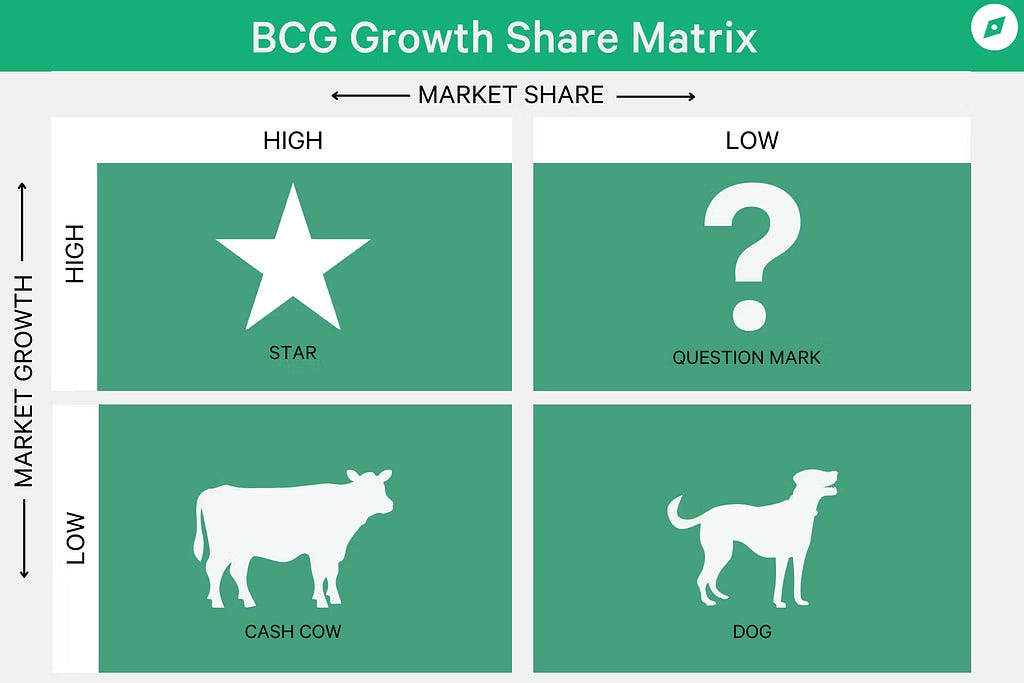
Of course, I had some mixes: question marks who were funded as stars, stars with dog-like parts of the product.
Let me give you some examples.
Dogs — low growth in feature/product area, weak position in the product in general
Inconsistent tempo: sometimes slow, sometimes everything is on fire. Everybody is looking at research as ammunition in a survival argument.
The atmosphere in such teams is usually ‘we gave up before you came and achieved eastern philosophy level of zen’ or ‘let’s go to our last fight’. Anyway, prepare to have requests for a lot of research. On each bit of new design, minor variations and random ideas. Usage of research is unpredictable, bold experiments are welcomed, but then frequently stuck.
Being on such a team is good for testing your own initiative, learning how to stand behind hard-to-swallow answers, and building a knowledge base that helps to resist requests of new research (they don’t need that much). The best learning for me was here — learning how to support and go through hard times with a team. Can’t underestimate these skills.
Question mark — high growth, weak position
If you have such a team in your portfolio, well, congrats, it’s your lucky day. The energy is crazy, no big tail of history. Big hunger for real data, real experiments. So, attention is yours, but responsibility too. You’re all in uncharted waters together. It’s hard to avoid the temptation to just follow the PM, but totally worth it.
Everything is changing fast. Being one step ahead of research requests, proactively proposing directions and generating risky hypotheses wins you team trust. What I did with this trust: postponed one of the launches, influenced how the metric was calculated and how the segment was seen. So expect high speed and need for research. It was one of the most fulfilling experiences for me: results of one study led to new stronger hypotheses and if that isn’t the beauty of research, I don’t know what is.
Cash cows — low growth, strong position
Slow pace, the most cautious team. Where everybody is afraid to break something.
Most concerns, hypotheses and evaluations of research arise from that. Know the history of research, how it became what it is now. Build a comfortable and usable research base, make sure that everybody is on the same page.
In my case, we worked on improvement very carefully, so a lot of triangulation. You’re working like a sapper. We defended the decision, but the launch was still delayed.
The cash cow team won’t ask you for extra research, can wait and look at results through the lens of risk cost. If insights are too unexpected, be ready for a second round.
Stars — high growth, strong position
Looks like the place you’d want to retire to. Where everybody is calm and you go with the flow. Help with small tweaks on execution, teach the team Cash cows — low growth, strong positionto do unmoderated tests. They are the only ones who aren’t stalking you for research. But that can be a trap. For me at least it was. Research felt decorative, because users didn’t have much choice about using these features.
So when a rare piece of exploratory research turned up a new segment, it went to production without any drama. Nice — though it shipped easily because it didn’t threaten anything.
What this changed for me:
- Understanding the type of team doesn’t only help you prioritise requests. It tells you which findings will bounce off. Dogs ignore anything that requires a move bigger than a sprint. Question marks ignore anything that would slow them down. Cash cows — big changes. And stars ignore (in my case) anything implying the metric doesn’t mean what they think — users had little choice about the feature, so high usage was measuring compliance, not satisfaction.
- For a long time I wondered how the same effort and the same standards could produce opposite results — and got quietly irritated about it. Here’s the answer: it was a research question meeting a team that can’t act on it. Knowing the type won’t make the work land, but it will stop you blaming yourself.
Originally published at https://convenientusers.substack.com on August 12, 2026.
Same researcher, four outcomes was originally published in Bootcamp on Medium, where people are continuing the conversation by highlighting and responding to this story.

 点赞
点赞 收藏
收藏 点踩
点踩 分享
分享