Anthropic’s ‘First Lady’ Took a Winding Road to the Top

Eric Schmidt had plenty of reasons to toast the success of Dario Amodei and Anthropic at a private event the former Google CEO hosted recently. But Schmidt, who is also an early Anthropic investor, made a point to celebrate “Cami and Dario,” the couple seated together at the event.

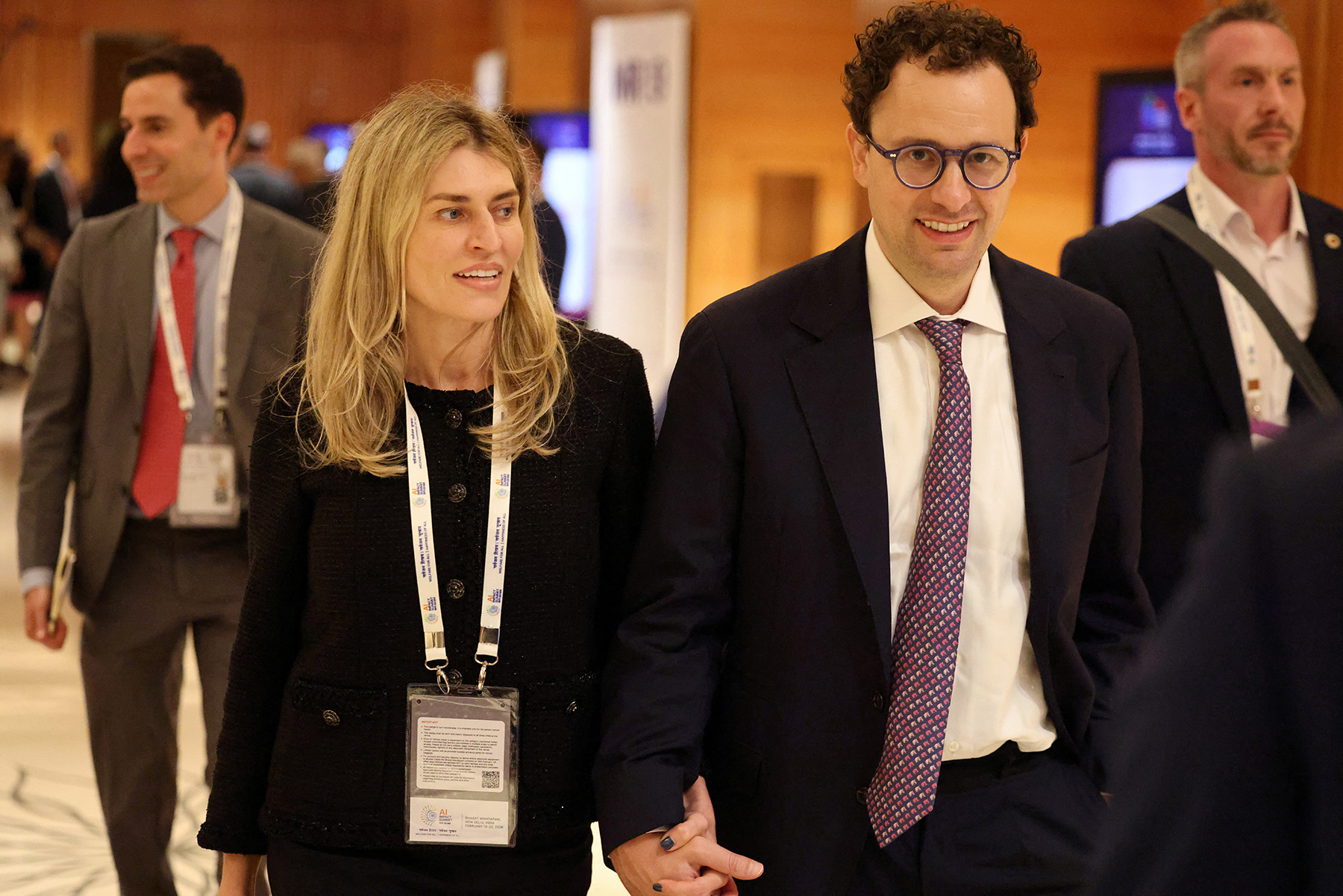
The Cami in question was Amodei’s wife, Camilla Clark, who has become a key behind-the-scenes player at Anthropic as the company has shot to prominence over the past year. As Amodei has hopscotched the globe to preach about the potential and risks of AI—from New Delhi to Davos to Sun Valley—Clark has almost always been near his side. Several people who know the couple describe Clark as Amodei’s emotional ballast, someone he has sought counsel from during the turbulence of Anthropic’s growth and clashes with Washington over the future of AI.

Clark may well be the most consequential person within Anthropic’s orbit who doesn’t have a formal role at the startup. You might even call her the first lady of Anthropic.

Clark, who declined through an Anthropic spokesperson to be interviewed for this story, was instrumental in Anthropic’s early founding: She was the one to introduce Amodei to Schmidt, whose investment lent Anthropic important clout at its start. (Before Clark and Amodei got together, she and Schmidt used to date casually.) Today the support she provides to Amodei is varied. She has gotten involved with organizing Amodei’s personal security and discussions about shaping his public persona, according to people familiar with the couple. And Amodei has also told people Clark manages their family’s personal investment strategy and helps vet the startup investment pitches they receive, according to a person who spoke with Amodei.

Unlike the more introverted Amodei, Clark is a consummate networker. She has struck up a friendship lately with President Donald Trump’s daughter, Ivanka, even as Amodei and Anthropic have at times faced an existential struggle with her father’s administration. Clark is also a member of a WhatsApp group called Real Housewives of AI, which includes other prominent women in the tech industry.

Before Clark married Amodei in 2022, she herself made several bids at entrepreneurship and labored within the ranks of a tech startup.

For a time, she was head of revenue for Leap Motion, a once-buzzy startup that made hand sensors for virtual reality headsets before it needed to sell itself in 2019. Her time at Leap Motion came after an attempt to to start a clinic company focused on women’s health, Female Algorithm Technologies, that counted Schmidt as an investor and Amodei as an adviser, a fundraising document shows.

Cami Clark walks with husband Dario Amodei after Amodei’s meeting with President Emmanuel Macron in February. (Getty Images)

And before Female Algorithm Technologies, Clark tried her hand at building a pornographic film company, Eddice, that planned to make movies with high-production values and female protagonists. She also hoped it would have online shopping capabilities. In 2011, she tried to raise money for Eddice from Jeffrey Epstein, who’d pleaded guilty to charges of soliciting a minor for prostitution three years earlier, according to emails made public as part of the Epstein files released by the Department of Justice earlier this year. She emailed Epstein the script for the first of a series of films they hoped to make (title: “American Girl in Paris”).

“We thought you and the ladies might enjoy,” Clark wrote. She then appended a winking warning: “A little nsfw,” an acronym for “not safe for work.” Epstein didn’t invest.

While enormous attention has fallen on AI and the people behind the companies developing it, Clark has largely flown under the radar. That is in stark contrast to some other prominent couples that bask in the social media limelight, such as OpenAI President Greg Brockman and his wife, Anna. As she got closer to the center of AI through her decadelong relationship with Amodei, Clark’s online presence largely went dark. Her professional websites were taken down. Her LinkedIn profile vanished. She stopped posting on Instagram.

Cindy Gallop, a former advertising executive who later launched the sex video website MakeLoveNotPorn, remembers counseling Clark on her early startup efforts. They lost touch around 2015, she said. In recent years, Gallop has tried searching for Clark on Google and has found nothing.

“Over the years, she’s come to mind,” Gallop said. “I wonder: What happened to Cami Clark?”

Clark comes from blue-collar roots in Reno, Nev., where she grew up in the late 1980s and 1990s. At 14, Clark started working for a pipe fitters union where her grandma and great-aunt also worked, a person who knows her said. She later graduated from one of the city’s public high schools.

She moved to the Bay Area to study architecture at the California College of the Arts, a private design school. She later spent several years working in business development at Herman Miller, a high-end office furnishing company, in San Francisco. The job offered her a window into the tech industry as it tried to rebuild after the dot-com bust: She told a friend about her bewilderment at a young startup founder rollerblading into the company’s store to buy office furniture.

Clark, however, wanted to build something of her own. And she wanted to fix a problem that the adult film industry wasn’t tackling: creating porn that addressed women’s interests, with top-notch production. “The only thing that was available at the time was Pornhub and YouPorn,” recalled that friend. “That was a pretty horrible hellscape.”

So in 2009, Clark started Eddice with a co-founder, Michelle Capocefalo. Neither had deep connections in Silicon Valley, and with many investors reluctant to invest in companies associated with adult content, they had to search high and low for funding.

In March 2011, Clark and Capocefalo were introduced to Epstein over email by their mutual friend, John Brockman, a literary agent who often connected prominent academics and book authors to Epstein, his longtime friend. (Brockman and Clark had recently met at DLD, a media and tech conference in Munich, Germany.)

“You should connect for dinner with my girls—Cami and Michele—who I met last month in Munich. They’re in LA raising money for porn movie aimed at women’s market,” Brockman wrote. According to the friend who knew Clark at the time, Brockman introduced Clark and Capocefalo to Epstein with “no context” about Epstein’s background. Clark and Capocefalo met briefly with Epstein in person after a TED conference in March 2011, the friend said.

Cami Clark (right) and a friend attend a New York City gallery opening in 2010. (Getty Images)

A year later, Clark emailed Epstein again asking to catch up over lunch in New York. She told him they were still “moving full steam ahead” with Eddice and asked if he might be interested in participating in another fundraising round. Epstein declined. A few months later, she and Capocefalo invited Epstein to their housewarming party in the Lower East Side of Manhattan. He didn’t show up.

By the spring of 2013, the Eddice website appeared to be inactive, according to the Wayback Machine. The idea had sputtered after Eddice raised just roughly hundreds of thousands of dollars rather than the millions Clark and Capocefalo had wanted. Clark then took inspiration from what she saw other people doing all the time in Silicon Valley—she jumped quickly to a new project. She had seen how “people would keep moving onto the next thing,” said the friend.


Clark’s next thing was starting Female Algorithm Technologies, which aimed to open a chain of female-focused health clinics, in 2013. To get going, she raised a modest amount of money from Schmidt and brought on an adviser she described in a fundraising deck as “Dr. Dario Amodei.” (Amodei has a Princeton University doctorate in biophysics.) She and Amodei met in 2013 when he was a postdoc at Stanford. They started dating the next year. Amodei—who around that time started working on AI research for Baidu and then Google—bonded with Clark over a mutual interest in how AI might be used in healthcare, said a person who knows them.

Clark struck a note of high optimism as she fundraised for her startup, describing the health and wellness market in a fundraising deck as a “TRILLION Dollar Industry.” The deck went on: “Wellness, the ‘new black,’ is now a status symbol among consumers.…Fashion and Vanity are driving interest in health.”

Female Algorithm Technologies hoped to open high-tech, hospitality-focused health clinics in Los Angeles and New York’s Soho neighborhood by 2017, with their design coming from David Adjaye, the star architect behind the then recently opened National Museum of African American History and Culture in Washington. The starting membership cost would have been $9,000 annually, running as high as $20,000 a year, according to the deck.

In 2016, Clark discussed the startup at a talk at the Arc Fusion, a biotechnology-focused organization, which is now defunct, that hosted entrepreneurs for tech-centric talks in San Francisco. In the presentation, Clark said her startup would use AI to analyze a patient’s traditional medical data as well as their selfies and their online presence, examining their health and wellness habits through a “wide lens.” The pitch deck listed other potential data sources including credit card transactions, GPS location points and phone call records.

“The right kind of data does have the potential to transform biomedical monitoring,” Clark said at the event. A video of her presentation is still online—one of the only remaining digital traces of Clark.

It’s not clear how far Clark got with Female Algorithm Technologies, but by 2016, she had given up on the concept and taken a job at Leap Motion. The startup was co-founded six years earlier by David Holz, who would later found his own AI startup, Midjourney.

As Leap Motion’s head of revenue, Clark was one of the more commercially minded people at the startup. She focused on trying to find new applications for the company’s tech, which controlled computers with hand gestures, said a person who worked with her. In that role, she struck up a friendship with Mira Murati, then vice president of product and engineering, before leaving in 2017, according to the person who worked with her. Murati went on to become a senior OpenAI executive before leaving to lead AI startup Thinking Machines Lab.

Peter Bell, a venture capitalist who was on Leap Motion’s board of directors, recalled meeting Clark while she interviewed for the job. Her energy impressed him, but he noticed her lack of experience compared to other candidates. Still, Leap Motion’s founders were enthusiastic about hiring Clark, as were other people who interviewed her, Bell said. After she got the job, Bell found that Clark was “fun to be around” and did a “really nice job for the company.” She didn’t stay long at Leap Motion, though, leaving in 2017—two years later, rival Ultrahaptics bought Leap Motion for $30 million, a tenth of the valuation it had received six years earlier.

While Clark was trying to help Leap Motion gain serious momentum, Amodei’s career was taking off with his jump from Google to OpenAI, which he joined as an early employee in 2017. The then-nonprofit AI lab was just then beginning to make big advances in AI with its very first large language models.

Amodei, who was OpenAI’s head of safety, was creating internal alliances with other smart, cautious researchers. Clark meanwhile sent her then-boyfriend’s research papers to wealthy tech insiders who would be well positioned to invest in his eventual company, a person close to them said.

When Amodei and Clark wanted a break from their tech jobs, they enjoyed attending Burning Man festivals, once camping there with Dustin Moskovitz, the Facebook billionaire, and his wife, Cari Tuna, who were frequent Burners. (Moskovitz later became an early Anthropic investor.) In 2018, Clark posted a picture of her and Amodei enjoying Christmas in Cabo San Lucas, Mexico—he in high white socks and a white T-shirt, she in aviator-style sunglasses and a black dress, a drink in hand.

Billionaire Eric Schmidt, an early Anthropic investor, has known Cami Clark and Dario Amodei for years. (Getty Images)

Two years later, after his now well-publicized split with OpenAI CEO Sam Altman, Amodei departed to start Anthropic, taking along six other OpenAI employees, including his sister, Daniela. After Amodei began work on Anthropic, Clark quietly sought money from Schmidt and others for a fund to invest in Anthropic and other new AI companies, according to a person familiar with the matter. She called it “the Mother of AGI” and eventually hoped to raise billions of dollars.

Amodei’s co-founders, including his sister, opposed Clark’s plan because of her personal relationship with Amodei, the person said. Schmidt instead directly invested in Anthropic.

Today, Clark has remained a private source of counsel for her husband as Anthropic has ridden one of the largest waves of business success ever seen, prepared to go public and battled with the Pentagon over AI policy. One person close to Amodei called her a “stabilizing force” for him. While Amodei and Clark have been together for over a decade, one person who met them at an event recently said they appeared as tightly bound to each other as newlyweds.

Cory Weinberg is a senior reporter covering AI and business, with a focus on Anthropic, for The Information. He is based in Los Angeles and has an MBA from Columbia Business School. He can be found on X @coryweinberg. You can reach him on Signal at +1 (561) 818 3915.

Jemima McEvoy is a reporter for The Information's Weekend section. She is based in San Francisco and can be reached at [email protected].

Jessica Lessin founded The Information in 2013 after reporting on Silicon Valley for the Wall Street Journal. As The Information’s editor-in-chief and CEO, Jessica leads the company in its quest to deliver the most valuable technology and business journalism in the world. She regularly writes about all things tech and media. She can be found on X at @jessicalessin.

Stephanie Palazzolo is a reporter at The Information covering artificial intelligence. She previously worked at Business Insider covering AI and at Morgan Stanley as an investment banker. Based in New York, she can be reached at [email protected] or on Twitter at @steph_palazzolo.

添加评论
点赞收藏
点踩分享查看原文
评论
?
参与讨论