User Experience: Is It Really Just About Making Things Easier?

How fascinating is the term User Experience. We use it almost every day as designers, but what does it actually mean?
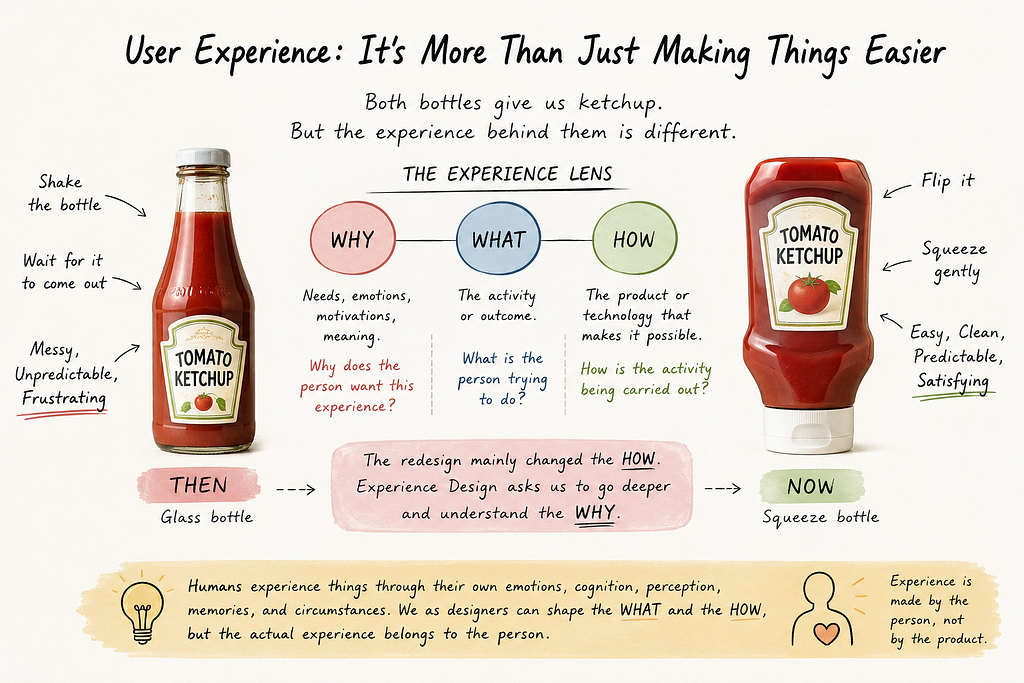
Most of us started learning UX with examples like the ketchup bottle. Years ago, ketchup came in glass bottles. You had to shake the bottle, wait for the ketchup to come out, and sometimes worry about getting too much of it at once. Then the packaging changed. Squeezable bottles made the interaction much easier. No more endless shaking.
And we called that a better user experience.
But I recently started thinking about this example differently. Both bottles are giving us the same outcome: ketchup. So what exactly changed, and is making something easier enough to call it a better experience?
This is where Marc Hassenzahl’s idea of Why, What, and How changed the way I understood User Experience.
The What is what we are trying to do. In this case, getting ketchup out of the bottle.
The How is how the product allows us to do it. We can shake a glass bottle or squeeze a flexible one.
But then comes the Why.
Why does a person want to perform an activity in the first place? What need, motivation, emotion, or experience sits behind it?
And this is where UX becomes much bigger than an interface.
Human experiences are shaped by emotions, cognition, perception, memories, expectations, and the situation we are in. This also means that an experience cannot simply be designed and placed inside a product. As designers, we can shape the product, the interaction, and the possibilities it provides, but the actual experience belongs to the person experiencing it.
That made me rethink something about my own work as a Product Designer.
We often start with:
What should the user be able to do?
Then:
How should they do it?
What if we started one step earlier?
Why should this experience exist for them in the first place?
Perhaps that is where Experience Design really begins.
User Experience: Is It Really Just About Making Things Easier? was originally published in Bootcamp on Medium, where people are continuing the conversation by highlighting and responding to this story.

 点赞
点赞 收藏
收藏 点踩
点踩 分享
分享