No, AI did not start with ChatGPT

The search interface changed, not the intelligence underneath it. Increasingly, my own industry gets this wrong.
Artificial intelligence did not begin in November 2022. What changed is the thing we touch it through: a box with a magnifying glass became a chat window. That is an interface shift, not the birth of a technology, and naming it correctly matters, because product decisions and budgets follow the name.
Why I am writing this at all?
I keep running into the same LinkedIn post in a dozen variations: the search box with the magnifying glass icon is dead, the future is conversation, because we finally have AI. It is usually written by someone in the industry, a designer a few years into their career. It collects a full house of reactions and almost no questions.
I started writing a comment several times. I deleted it every time, because it kept coming out snide, and that is not the point. I do not want to be the buzzkill in someone else’s comment section. So I will say it here because the problem is real and it is not laypeople getting it wrong. It is us.
We confuse the interface with the technology. We say “AI” and we mean ChatGPT and its cousins, like Claude, Grok, Gemini. Since the first one shipped, everything is AI now, with an exclamation mark, ideally three. Sorry to disappoint: this is not new. Yes, there is a revolution. Yes, and it did not start the day OpenAI released a chat window. It started much, much earlier…
Who I am to say it?
I have spent more than fifteen years designing content search, across several industries. I do not write models but I work alongside the people who do, and I own what the user sees of it: how the search field behaves, how the filters work, what happens on zero results, how to explain to a human being and also why the system showed them this and not that.
Which means ranking, query understanding and personalisation are not phrases I picked up on LinkedIn last year. They are things I argued about in meetings before “AI” became the word that opens every board deck.
So when I read another post claiming that “the future of e-commerce is a conversational assistant, because search is just a rigid filter”, I want to reply: a filter shows how many results are left after each click, it lets you untick one thing and see what changed, and you can leave it open in a tab for a week. Chat answers in a sentence and never tells you what is missing from that sentence, unless you happen to ask, which requires already suspecting that something is missing.
What is the difference between AI and ChatGPT?
ChatGPT is one application of AI, not a synonym for it. The relationship is nested: each level sits inside the one above.
Term & Short definition
AI is the field of computer science concerned with systems doing things that used to require human intelligence. The term dates to the 1950s.
- Machine learning is a subfield of AI where the system derives its rules from data instead of getting them from a programmer.
- Deep learning is machine learning built on multi-layer neural networks.
- The Transformer is one deep learning architecture, described in a Google research paper in 2017.
- An LLM is a model trained on vast amounts of text to predict what text comes next. GPT, Claude and Gemini are examples.
- ChatGPT is a product: a conversational interface wrapped around a GPT-family model. An access layer, not the technology.
It is also worth remembering how far back this goes. Peter Mozelius of Mid Sweden University traces the field to Ramon Llull’s Ars generalis ultima, a system for generating new knowledge from predefined concepts, completed in 1308. Llull inspired Leibniz, who in 1666, aged twenty, described a theory of producing knowledge by combining symbols according to rules. The criticism is the interesting part: Jonathan Swift mocked Leibniz’s system in Gulliver’s Travels as a “knowledge engine”, on which a student could write books in any subject without the least assistance from genius or study. We now call the same thing a “stochastic parrot”. Same objection, seven hundred years and a few interface layers later.
Saying “AI” when you mean “chat” shrinks the whole field down to one dialogue box. It is a bit like calling every search engine “Google” and every spreadsheet “Excel”. I am not making this point from an academic chair. I am making it because in my projects that confusion has a price, and I will show you the price in a minute.
What does DOS have to do with AI search?
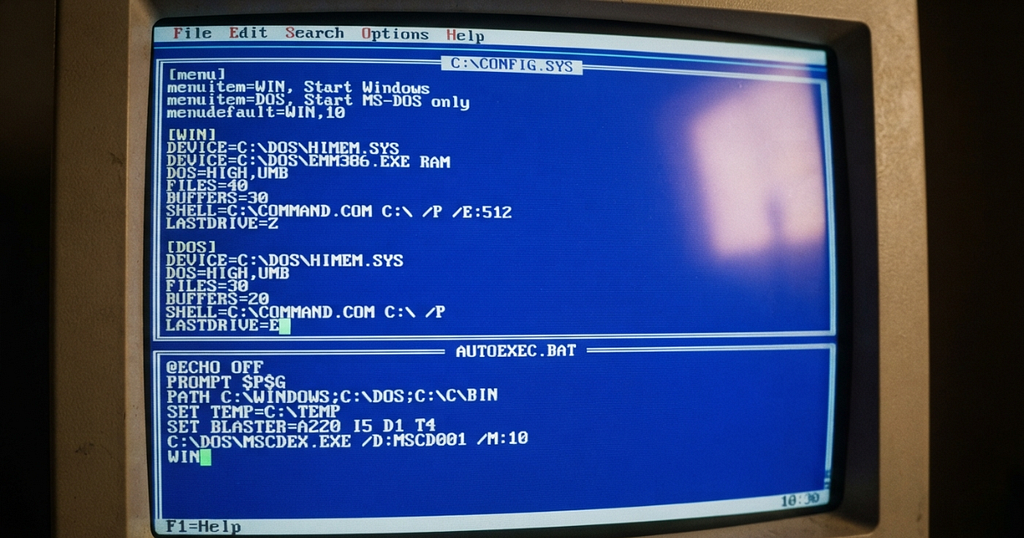
It shows how easily an interface change gets mistaken for a technology change. Same machine, same way of computing, a completely different experience.
There was a time when I switched on a computer and got a black screen with a blinking cursor: C:\>. To do anything, you typed a command. C:\>dir to see what was even on the disk. C:\>cd games to move into a directory. C:\>win to launch Windows, assuming somebody had installed it. And when something broke, you opened config.sys and autoexec.bat and hunted for the line eating too much memory.
Later you just opened a laptop. Not a PC, a laptop! The screen lit up, the icons were waiting, everything was ready to work. Did the machine underneath go through a revolution? The hardware, sure: processors, memory, drives. But the change the user actually felt was mostly in the interface layer. What stood between the human and the machine became unrecognisable. What the machine was actually doing underneath moved along far more quietly.
Exactly the same thing is happening with search and AI right now.
Which “AI breakthroughs” already existed?
Nearly everything being discussed today in the context of search: intent understanding, learned ranking and personalisation. Four mechanisms currently sold as fresh, with dates.
Query understanding
Systems that work out what a user actually wants from an ambiguous query were running long before 2022. The real step change was word embeddings: word2vec, published by Google researchers in 2013, let machines capture semantic similarity rather than string matching. “Running shoes” and “athletic footwear” stopped being two unrelated character strings.
I remember meetings where we sat over a spreadsheet of synonyms, manually typing in which words were supposed to mean the same thing. Then vectors arrived and that spreadsheet stopped being my problem. Nobody called it a revolution at the time. It was just the next item in the backlog.
Learning to rank
A method that sorts results on dozens of signals at once, not just keyword match, but user behaviour and query context too. It has been the backbone of large e-commerce search since the previous decade.
Personalisation and recommendations
“Customers also bought”, collaborative filtering, matching against purchase history. None of that arrived with conversational assistants. It was running Amazon and Netflix long before.
My role on those modules always came down to one question I asked on every single project: how is the user supposed to know why they are seeing this? The answer was usually “they do not need to know”. That same answer is back now, on chat, and I still do not like it.
Transformers, the engine inside today’s chat
The Transformer architecture comes from a Google research paper in 2017. A year later it produced BERT, the model Google rolled into its own search engine in 2019 to better read query context. That was already intent understanding built on the same family of technology powering chat today. Nobody was writing posts about “the end of search as we know it” back then.
What did language models actually change?
They lowered the cost of building a good dialogue. The shift is real, it just sits in the interaction layer rather than in whether a system can interpret a query at all.
An old NLU setup required somebody to define a closed list of possible intents up front and train a dedicated model on it. The chatbot asked you to “press A for X, press B for Y”, and the moment a user stepped outside the script, it looped back to a helpless “sorry, I did not understand, please choose from the menu”.
I drew those trees. Dozens of branches, a variant for every typo, a dedicated path for “I do not understand”, and there was always a user who typed something we had not thought of. Language models handle phrasings nobody anticipated, and that genuinely changed my work. Dialogue stopped being an expensive, brittle decision tree.
But query understanding was built up gradually over decades, mostly inside the research teams of large search engines, before OpenAI shipped a product. What changed is the packaging. A table of filters became a chat bubble. The engine underneath is largely the same engine, refined by years of practice.
Why does this distinction matter?
Because the name decides where the money goes. A team that thinks it is “building a new AI engine” invests in things it often already has: ranking, embeddings, personalisation. A team that understands it is adding an interaction layer to a proven foundation puts its effort where the value is: designing the dialogue and wiring it into the existing, well-tested engine.
I have inherited projects that started without me, where “we are building an AI search engine from scratch” was decided at board level before anyone asked what the current system could already do. I came in later, at the “something is broken, fix it” stage. And it usually turned out the ranking and personalisation had been sitting there for years, nobody had called them AI, and the problem was not the engine. The problem was that the user had no idea what was happening to their query. Fixing that cost a fraction of what the rewrite had already burned. Nobody added that number up out loud, because nobody enjoys counting money they have already spent.
What this means if you design these things?
You do need to know where a result comes from, what the system left out, and how to say that to a user in one line of interface copy. That has been enough, for fifteen years, to hold my own in rooms full of people who do write the models.
And it is worth being precise about what chat is good at, rather than treating it as a replacement. Chat wins on vague, exploratory questions, the ones where a user cannot name the criteria yet. Filters win when someone has to compare, narrow down deliberately, and see how many options they just ruled out. Two interfaces to one engine, not two generations of the same thing. Deciding which job you are solving is design work. Calling both of them “AI” and moving on is not.
What I would like us to keep straight?
- Using “AI” to mean “chat” shrinks seventy years of work into one dialogue box. Remember: AI is a field, ChatGPT is a product.
- Intent understanding, ranking and personalisation are not new: word2vec 2013, Transformer 2017, BERT in Google Search 2019.
- Language models changed the cost of building a good dialogue, not the machine’s ability to read a query.
- A filter shows criteria and counts; chat gives you one sentence and hides what it left out. Remember: filters and chat do different jobs.
- Building AI from scratch and adding an interaction layer are two different roadmaps and two different invoices. Precision in naming is a budget decision.
Because just as moving from C:\> to a clickable desktop did not mean the computer only then started computing, the arrival of ChatGPT does not mean machines only then started understanding what we are looking for. They just started talking to us more nicely about it.
About me: I have spent more than 15 years designing content search across several industries, from the UX side. Find me on LinkedIn if you disagree with any paragraph above.
Sources and further reading
- Cicero Institute, “Chatbots are not AI”, the history of the field from Turing and the Dartmouth conference onwards, and the risks of conflating terms.
- Milan Milanović, “ChatGPT is not AI”, the nesting of AI, deep learning, transformers, GPT and ChatGPT.
- Zhao et al., “A Survey of Large Language Models”, an academic survey of the research chain behind today’s models.
- “Dartmouth Summer Research Project: The Birth of Artificial Intelligence”, where the term was coined in 1956.
- Computer History Museum, “Shakey”, the first mobile robot to reason about its own actions, built between 1966 and 1972.
- Peter Mozelius, “A Discussion in the History of Artificial Intelligence: it did not Start with ChatGPT”, the field traced back to Ramon Llull and Leibniz, including Swift’s critique.
- Bender et al., “On the Dangers of Stochastic Parrots”, the origin of the “stochastic parrot” term.
No, AI did not start with ChatGPT was originally published in Bootcamp on Medium, where people are continuing the conversation by highlighting and responding to this story.

 点赞
点赞 收藏
收藏 点踩
点踩 分享
分享