New Single-Celled Species Discovered at the MBL Gives Insights into How Life Can Adapt to Marine Lifestyles

Both Honda and Cortes believe that studying a species that evolved from freshwater to saltwater will deepen our understanding of how organisms adapt to new environments.
“Studying single-celled organisms like stentors will help us better understand the biological principles of how living organisms adapt and how to address changing environments on Earth,” said Honda.
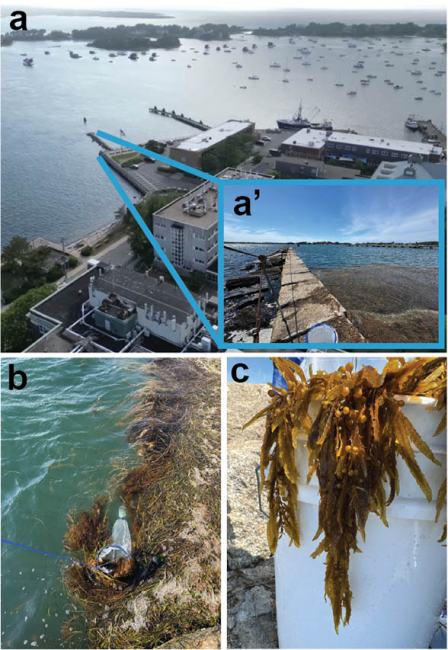
Field site on Waterfront Park where Stentor hondawara was first collected (a, b) and ‘Hondawara’ seaweeds (a larger group of sargassum) (c). Image credit: Takato Honda
The pair first discovered the new species by chance in 2023, while examining seawater they had collected from Waterfront Park under a microscope. “A few of the creatures in the seawater looked like stentors,” Honda recalled, “which triggered our curiosity, as stentors have been described for over 250 years as generally living in freshwater.”
Although some stentorspecies have been reported in brackish water—where freshwater and saltwater mix—Honda and Cortes have found the first clear evidence, using modern techniques, of a stentor species that lives in high-salinity seawater.
Wanting to be sure of their findings, Honda brought DNA from the marine stentors back to MIT to run whole-genome sequencing. By comparing its full genetic blueprint with those of the two currently available freshwater Stentor species whose genomes had already been sequenced, they confirmed it was a genetically distinct species. The genome they mapped is among the most complete genome ever assembled for a Stentor species, and it reveals genetic differences that explain how Stentor hondawara adapted to live in seawater.
One of the most important differences is that, unlike freshwater stentor, Stentor hondawara possesses a unique type of aquaporin, a protein that transports water and glycerol, which enables it to thrive in saltwater. The gene groups uniquely enriched in Stentor hondawara also encode a variety of proteins, including ion channels, pH-responsive proteins and osmoprotectants, which are small molecules that cells produce to survive harsh conditions like high salt or extreme temperatures. The genomic analysis also revealed that the new species may also host a unique bacterium inside its cell, an endosymbiont, that produces vitamin B12 and fixes nitrogen for the stentor.
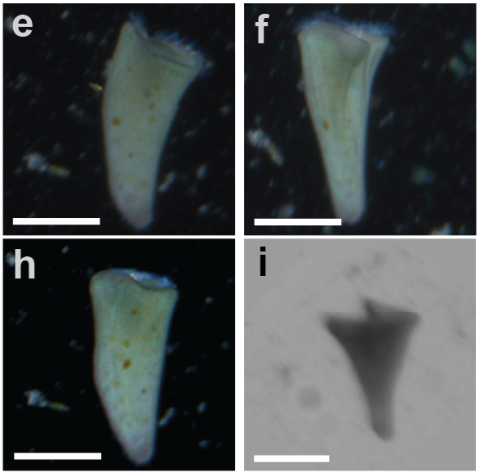
Microscopy images of Stentor hondawara. Image credit: Takato Honda
“My lab is specifically interested in researching cellular adaptation,” explains Cortes. “As climates change, adaptable organisms are going to have more advantages than organisms that can't adapt. Ciliates, in general, seem pretty adaptable, and because they're single-celled organisms, there are possibly molecular mechanisms we could learn from them that explain how they are as adaptable as they are.” This summer, the duo are working to culture Stentor hondawara on a large scaletomake the new speciesavailable to researchers around the globe. “Stentors have been studied for well over 200 years, yet there are few people that really work on them at any given moment,” explains Cortes. They plan to change that with Stentor hondawara, which they hope will become a new model system in the future to help study how single-celled organisms adapt to changing environments.
Their discovery may be only the beginning. “We believe this is the tip of the iceberg,” Honda said. “We are still actively collecting marine samples, and it would be wonderful if researchers identified new marine stentor species in the future from different locations."

 点赞
点赞 收藏
收藏 点踩
点踩 分享
分享