The End of an Era

We knew this day would come.
Some of us have known for decades, have been writing and pontificating about this since Ken Jennings lost at Jeopardy and Kasparov lost at chess. The writing was on the wall, and now the writing is everywhere. Literally. Artificial Intelligence is writing about as well as humans — at least well enough to cause confusion and speculation — and that’s creating an existential crisis among authors, confusion among readers, and legal action within the industry.
When talking about my success as a writer, I almost always bring up the lucky timing I experienced. I finished writing my first novel in 2009, just two years after Amazon released the Kindle. By the time I went to find an agent and publisher, the self-pubbing world of KDP, CreateSpace, and ACX were beginning their inevitable pull. That was dumb luck, and without it I would have written for love but likely never for a living.
This morning, an equally profound thought occurred to me: My lifelong dream of writing novels somehow overlapped with the 20 good years where stories could be published cheaply but not written cheaply. The writing was still hard. The publishing no longer was. I could sweat my way through a manuscript, and then use amazing tools like InDesign and Photoshop to create files, then upload those files FOR FREE to KDP and CreateSpace and hold a book.
Sales and marketing, of course, were always and will always be a different story.
But think about it: the misery most writers faced prior to 2007 (and really, prior to 2012 or 2013, when the stigma just started to fade) of writing query letters, researching agents, amassing rejection letters, avoiding scammy vanity publishers (and scammy review sites, and scammy conferences, and scammy writer-help resources), or even worse: spending their life-savings on boxes of terribly printed books that would sit in the garage for all of eternity, barely selling a dozen copies, and never making back a fraction of the print run.
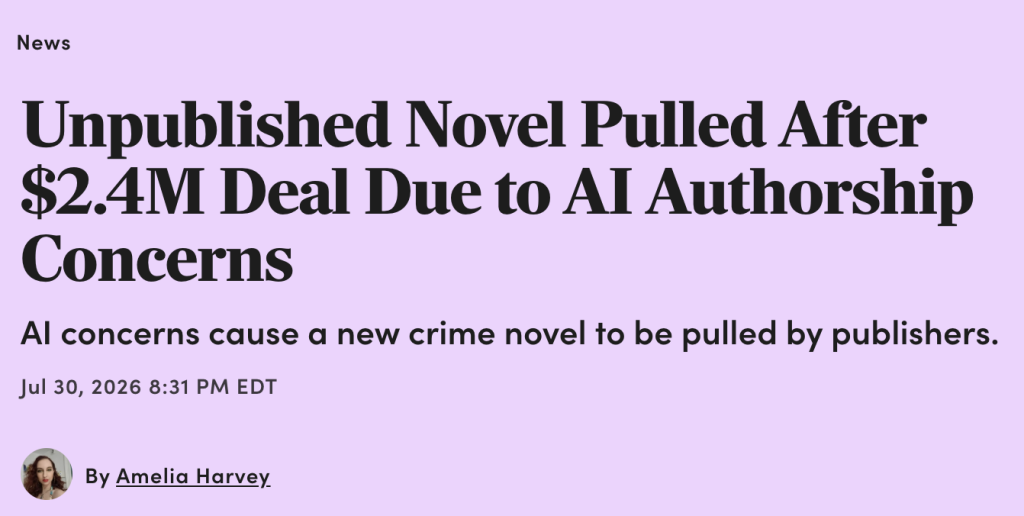
Fast forward to today, in 2026. You’ve got this story:
There’s a lot of insanity to unpack here. $2.4M advance! Holy shit. For a debut author, after what I hear was a bidding war among very excited publishers. That’s already crazy. But it gets crazier. Concerns were raised about the use of AI to write the book (not sure if this is a giveaway, but the book was about Nigerian cartels. You know the adage: write what you know). More questions were raised about style and some AI fingerprints, and the provenance of the book couldn’t be adequately proven. So the offer was rescinded. The deal fell apart.
Okay, there’s a chance this was a legit book from a legit writer, and the accusations are unfair (including my Nigerian cartel joke, but c’mon, this is like every college professor writing literary novels about college professors having affairs with their students. More imagination, people!). If this was a legitimate book, that might be the BIGGEST version of this story. Life-changing amounts of money, the start of a brilliant career, film or TV options, foreign deals, the works. It wasn’t just on the table, it was in writing. And then it fell apart for someone, all because it is now 2026. That’s one version of the insane new era we now find ourselves. Every book is suspect. No new author will ever be able to prove to anyone other than themselves that they can do it alone (hold this thought for later, because it’s not exactly true).
Let’s examine another crazy version. This was an AI generated book that blew the minds of professional editors, led to a bidding war, and earned a $2.4M advance. Holy shit. I’ve been predicting this day was a few years out, but it might already be here. AI books winning awards. AI books crowding up Amazon bestseller charts. AI books now getting big advances and whipping up bidding wars and excitement among publishers? As the blog title says, it’s the end of an era.
Which takes me back to my statement about lucky windows. We had less than 20 years of writing being hard and publishing being easy, and we will never get that window back. Ever.
I’ve always felt bad for authors who lived and worked before 2007. The choices unavailable to them made life harder than it needed to be. Getting their work out into the world was brutal. After KDP, that brutality became a choice, not a necessity.
I now feel awful for anyone who wants to tell a story post-2026. You will forever be doubted. If you love an em dash the way I do, or you like flowy run-on sentences like I do, if you grew up reading Proust to let the words flow over you in all their glory, if you memorized sonnets so the iambic pentameter would soak into your bones, you’re gonna sound like a fucking bot.
Less than 20 years. More like 10, honestly. You can argue that 2014-ish was when self-publishing became legit and 2024-ish was when the tools made AI writing viable. A decade where it was easy in the ways it should be and hard in the ways it should be. That’s insane. Ten years across the one-hundred-thousand years of language.
What comes next? I have some predictions, and they are pretty crazy. The first prediction is that publishers weather a few of these big AI scandals, but as years go by, publishers care more about profits and they let things slide. AI books from big houses get editing passes, and later they develop internal tools to roughen up the AI slop, and machine-books appear in bookstores alongside meat-books. This feels inevitable. Brace for this. (Feel free to rage about it as well, if you’re low on cortisol.)
Another prediction is that MOST readers will care about machine-vs-meat as much as they currently care about publishing imprints, which is to say almost none. Book series will go viral and readers will get wholly absorbed and where the story came from won’t matter. There will always be readers pushing beyond the fringe. That’s how fanfiction became viable. It’s why I had a career. There were readers who ignored the assholes saying, “Don’t read that, it’s self-published.” These readers asked instead, “Yeah, but is it any good?” Because of them, I got to write for a living. So I will always have a fondness for readers who search for story, ignoring the stories behind the stories.
Adding to the above, I think there will be a fringe of readers within this fringe of readers who SEEK OUT machine-books. I’ve seen this in the chess community, where fans of the game fall in love with a particular engine and become huge fans of the “way they think.” They pit their engine vs. other engines and pore over the games. They get excited when their engine gets an update, or beats every grandmaster, or discovers a new opening or gambit. This is a much bigger community than you may imagine, and I think it will be a great number of readers. Discount these readers at your own peril, because some of them will become readers this way and branch into meat-books. (Trad authors HATED the kinds of readers who made my career, calling them all kinds of hateful things. I’ve seen all this play out from the other side)
Another thing that will happen is established authors will turn to AI for assistance, not just for writing but for research, cover art, editing, returning emails, having an assistant, doing marketing, and thousands of other things that haven’t been invented yet. This will be ALL AUTHORS. This is me, already. I did a google search the other day for “tools a linguist uses to translate works” and another one for “what are the basic elements of every language” for a short story I was working on. The results I got back from these searches weren’t blogs or academic writings: they were AI summaries. And they gave me the answers I needed to get back to writing. At the same time, my agent sent me an email asking if a foreign cover could be approved. Gmail was right there with a suggestion based on my previous comments: “Looks great! Approved!” Two clicks, that email was off, and I was back to writing.
Yo, this blog post could’ve been a…

 点赞
点赞 收藏
收藏 点踩
点踩 分享
分享