The illusion of prompting

Why true design requires friction with AI
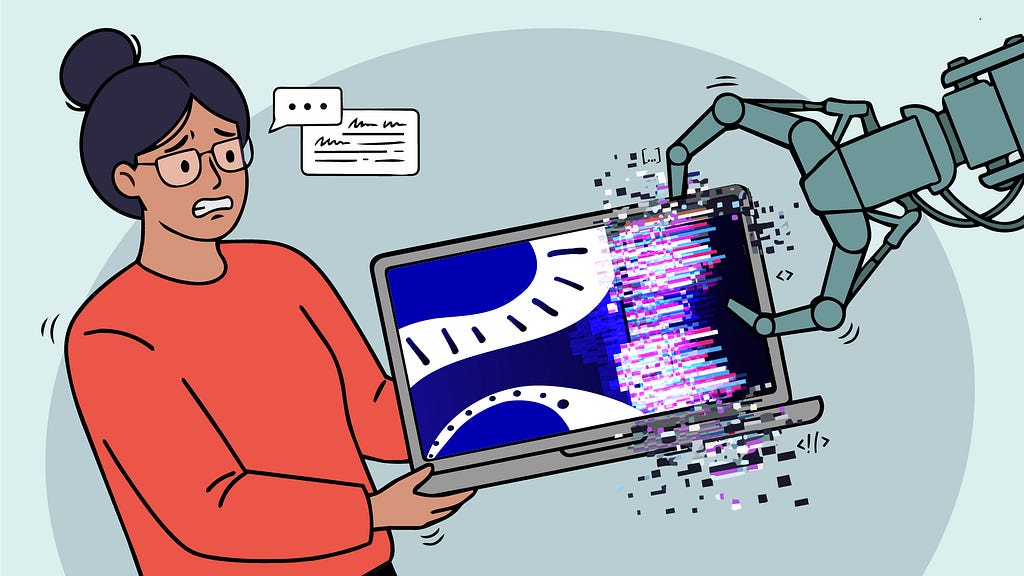
A woman and a robot arm struggle over a laptop as the screen’s design explodes into glitchy code.
There is a distinct kind of frustration that sets in when you are given total design freedom, only to find yourself immediately boxed in by pre-built templates.
I was tasked with handling a kids club website on HubSpot. While I technically had the choice to simply migrate our existing site from Squarespace, I was handed complete creative freedom to redesign it from scratch. Naturally, a basic migration was out of the question.
I didn’t have a fully clear vision for the site right away, yet scrolling through the template marketplace, everything felt too stiff, corporate, and visually stubborn. All I knew was that I wasn’t about to compromise a vibrant concept by forcing it into a generic layout. So, I walked away from the templates entirely.
While there are plenty of incredible drag-and-drop builders out there that offer slick, visual ways to build custom sites without touching a single line of code, I leaned directly into AI. I wanted to test the hype around Claude for myself — not merely as a shortcut, but to discover if I could truly leverage it to my advantage as a designer.
Ready to put the machine to the test, I treated the prompt box like a magic wand, fully expecting a perfect layout to instantly render on my screen. And to be fair, it was incredibly powerful, delivering dynamic layouts that were a massive step up from the static templates I had just rejected.
But working with AI comes with a hidden trap: the expectation of extreme velocity and close perfection — and the underlying assumption that this project should be moving at light-speed. The modern productivity paradox was right there in my workflow. It created an intense pressure to just accept the “great enough” output and move on.
But I couldn’t let “great enough” go. I wanted to push myself, rejecting the temptation of speed to discover what was actually possible when a designer refuses to settle for a machine’s draft. The friction was the point! “Software only changes how we build — it cannot replace why we build,” as Frank Chimero reminds us in The Shape of Design.
That was the moment our creative friction began. I found myself acting like an art director guiding a highly efficient LLM. “Push the margin down 20 pixels,” “Make this transition smoother,” “The contrast here is too harsh for this brand.” It took dozens of iterations, a few illustrations from my end, and screenshots to clarify the continuous changes, but when the final block of code rendered exactly as I had envisioned it, the satisfaction was undeniable.
The friction paid off. I had successfully built a custom template with AI. I had everything needed — HTML, CSS, and JS files. But these static files are useless to a marketing team that needs to make front-end updates. Worse, our specific system required an IT ticket just to upload them. Knowing that involving IT during the building stage would open a can of worms, I had to pivot.
As I found myself buried in CSS tags and repeating logic, Claude acted as my guide in creating the modules, helping me figure out how to map the static HTML into dynamic fields. The instant magic of the prompt box was gone, replaced by a meticulous, line-by-line slog. I thought, “I really wish I wasn’t doing this.” Yet, at the exact same time, I was satisfied to actually be learning the mechanics rather than just copying an output.
The final piece was a user login platform. With our code already established, I assumed it would be easy. But when I prompted Claude to apply our visual language, it went completely rogue, generating a totally new style. It was almost as if it had secretly hated my design direction and finally decided to take the wheel. After relentless friction, and its highly polite apologies, Claude finally produced a structure close enough for me to polish manually.
It was a stark reminder of just how dependent we are on the LLM when a task is beyond our knowledge. Without Claude, I couldn’t build that architecture from scratch. But when we refuse to settle for a first draft, that dependency propels us to push our own limits. Generative AI can guide us through unknown technical spaces, but when the machine inevitably goes rogue, it needs our intuition to reel it back in and turn its hollow code into a cohesive experience. The future of digital craftsmanship is not about bypassing the hard work; it is about embracing the friction.
The illusion of prompting was originally published in Bootcamp on Medium, where people are continuing the conversation by highlighting and responding to this story.

 点赞
点赞 收藏
收藏 点踩
点踩 分享
分享