Complex Systems and Quantitative Mereology
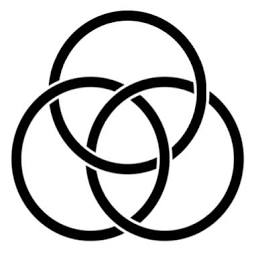
Have a look at these three rings:
Why are they connected? If you only consider two of the rings and ignore the third, then any pair can be smoothly separated. The triplet is connected and cannot be taken apart, but any description purely in terms of pairwise relationships would miss the fact that the three rings are connected.
While the three rings above—known as the Borromean rings—are especially simple and symmetric, similar links can be created for any number of rings. Here are links of four and six rings, for example, that fall apart if a single ring is removed:
I find this kind of magical. There seems to be a kind of ‘top-down’ causation: the behaviour of individual rings is restricted by the group as a whole, not by any individual.
Making sense of higher-order structure
The rings above are a simple example of a more general phenomenon known as ‘higher-order structure’ or ‘emergence’. These two terms are often used in an imprecise way. Imprecise use of ‘emergence’ does not bother me so much, because it seems to refer to something that is not very precise anyway (similar to ‘complexity’). But I believe that ‘higher-order structure’ can be made much more precise—it certainly sounds pretty mathematical. In fact, I recently wrote a paper about an idea that makes this precise, and that seems to explain many uses of the word ‘higher-order’. In particular, it answers the questions: higher than what? and which order? The paper is called A Mereological Approach to Higher-Order Structure in Complex Systems: from Macro to Micro with Möbius and is publicly available here. In this blog post1, I hope to give a more accessible and less technical overview of the main ideas in the paper.
Mereology
Mereology2 is the study of ‘parts’—specifically the relationship between parts and wholes. My central thesis is that incorporating mereology into scientific and mathematical thinking is a good idea. While a lot has been written about mereology—mostly by philosophers and logicians—it is not widely used as a practical set of ideas in the sciences. I suspect the aforementioned philosophers and logicians would find my approach simplistic, naive, or superficial, but I have found it to be very practical.
If we want to describe parts and wholes, let’s start with the whole. It is the biggest possible part of itself. The whole can then be divided into smaller parts. One example of this is from the 1886 “Handbook of Practical Cookery” by Matilda Dods:
The parts can be further divided into smaller parts, and so on. It is natural to assume some rules that parts should obey:
- If $a$ is a part of $b$, and $b$ is a part of $c$, then $a$ is also a part of $c$.
- Every part is a part of itself (namely, the ‘trivial’ biggest possible part).
- If $a$ is a part of $b$, then $b$ is not a part of $a$ (unless $a=b$).
These rules are well-known to mathematicians, who call them transitivity, reflexivity, and antisymmetry. Together, they define what is called a partial order. It gives a way to order a collection of things—in this case, wholes, parts, and parts of parts (and parts of parts of parts, etc.). When a part $a$ is smaller than (or equal to) part $b$, we write $a \leq b$. We say partial order, because not all parts can be put in order! A possible mereology on a bicycle is, for example, the following, where an arrow is drawn from a part $a$ to $b$ if $b$ is a part of $a$:
Clearly, all the components drawn in black are ‘parts’ of the full bicycle, and the ordering reflects that the tires and the spokes are both parts of the wheels. However, the tires are not part of the frame, and vice-versa, so there is no arrow between the two—they are ‘incomparable’.
Now let’s put on a more scientific hat. If we want to describe the mereology of a system, it makes sense to say that there is a unique part that is the biggest, namely the whole system. This is the top of the partial order of parts (for example, the fully assembled bicycle above). In addition, let’s assume that the system is only made up of a finite number of parts (a billion parts is fine, but infinitely many is not). If we call the system $S$, then I propose we call any (finite) partial order that has $S$ at the top a mereology3 on $S$. If we write the set of parts of $S$ as $\mathcal{D}(S)$ and the ordering as $\leq$, then the mereology can be summarised as the pair $(\mathcal{D}(S), \leq)$.
Decomposing Complex Systems
Fundamental to any description of Nature is the choice of parts. I imagine this like the cast of a theatre play: who are the characters that come together to tell the story. If you want to describe how an object behaves, you should decide whether you want to describe it in terms of the atoms, molecules, layers, structural elements, or something else. Once you make this choice, you can start writing down equations that describe how these parts interact. Say you want to predict some property of a system, let’s call it $Q$ for quantity. This could be the temperature of a material, or the height of a person—anything that can be described by a number is allowed here. If $Q$ is some macroscopic quantity that you could measure, then it makes sense to say: $Q(S)$ is the sum of microscopic contributions from all the parts that make up the system $S$. Since I’m imagining $Q$ to be an observable macroscopic quantity, built from microscopic contributions of the parts, I write them as a big $Q$ and little $q$ respectively. Each part can contribute something else, so I write $q(s)$ for the contribution of part $s$. Saying that the quantity $Q$ is the sum of the contributions of the parts can then be written mathematically as:
\[Q(S) = \sum_{s \in S} q(s)\]
Where I write $\sum\limits_{s \in S}$ to mean “sum all the parts $s$ that are in $S$”. Now the problem is that this can only really lead to very boring descriptions of the quantity $Q$. If the whole is just the sum of the parts, then your $Q$ is a pretty boring quantity. For example, say we want to describe the height of a person in terms of the genes they have. We could write this as $H(G)$: their height as a function of their genes. If then $H(G) = \sum\limits_{g \in G}h(g)$, then the height of a person is just determined independently by each gene. Biology is much more exciting than that: genes can individually contribute to your height, but they can also interact in complex ways and change each other’s effects. It therefore makes sense to extend our notion of parts to also include combinations of individual genes. For example, we could have contributions of three genes $g_1$, $g_2$, and $g_3$, but also of the pairs $(g_1, g_2)$, $(g_1, g_3)$, and $(g_2, g_3)$—and perhaps even the triplet $(g_1, g_2, g_3)$. Contributions from pairs are very common and usually called interactions. Less commonly considered is an interaction among three elements. Because interactions of more than two elements are less common, they are usually collectively referred to as higher-order interactions4.
Ok let’s therefore assume that in principle, all parts and all possible combinations might contribute to the overall observation of $Q$ (though not all have to contribute—some contributions could be zero in practice). This means that the quantity $Q$ is not just the sum of the contributions of the parts, but also of the contributions of the pairs, triplets, quadruplets, and so on. This can be written as:
\[Q(S) = \sum_{s \in S} q(s) + \sum_{\substack{s_1 \in S\\s_2 \in S}} q(s_1, s_2) + \sum_{\substack{s_1 \in S\\s_2 \in S\\s_3 \in S}} q(s_1, s_2, s_3) + \ldots\]
To write this down more efficiently, we define the set of all possible combinations of parts of $S$ as $\mathcal{P}(S)$. Mathematicians call $\mathcal{P}(S)$ the power set of $S$. The quantity $Q$ can then be written as:
\[Q(S) = \sum_{p \in \mathcal{P}(S)} q(p)\]
We are now at the point where we can connect this back to mereology. Note that $\mathcal{P}(S)$ has an “order” to it. Let’s say $S = (g_1, g_2, g_3)$, then…

 点赞
点赞 收藏
收藏 点踩
点踩 分享
分享