Apple MIE exploitation challenge


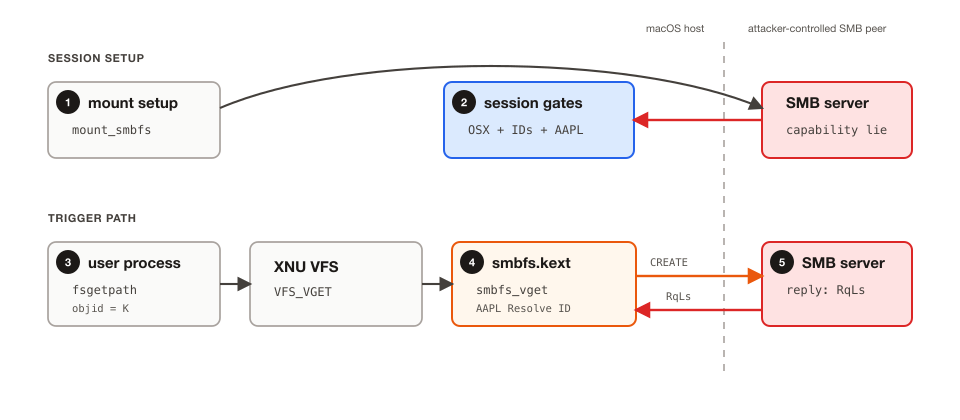
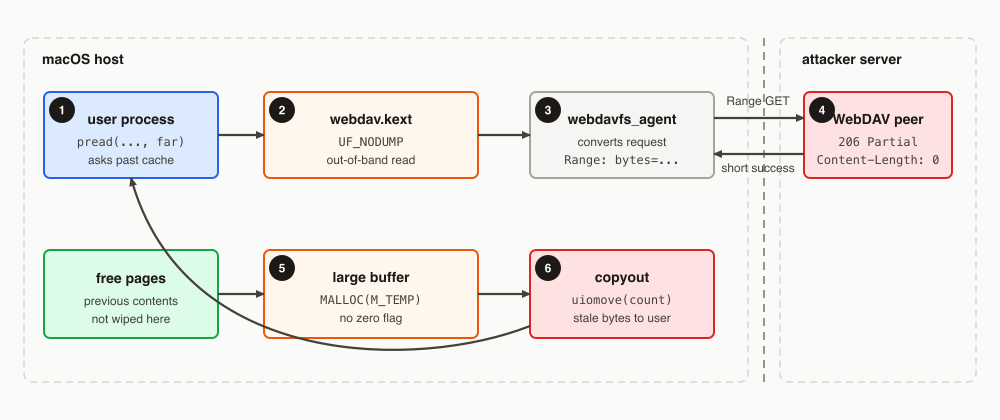

Two months ago, we demonstrated the first public bypass of Apple MIE on macOS 26.4.1. We withheld the technical details until Apple shipped fixes, which are now available in macOS 26.6. We'd like to thank Apple for their collaboration throughout this disclosure process. Since March, we've reported 38 vulnerabilities to Apple and counting.
In this blog, we'll share the details of the two vulnerabilities behind our exploit. We'll present the full exploit at Black Hat USA on August 5 and publish the complete technical report afterward.
Before then, we'd like to turn these bugs into a challenge. Apple MIE combines defenses across hardware, the hypervisor, the kernel, and userspace. Together, they form a mesh of overlapping filters that block many classes of vulnerabilities. Apple also continues to strengthen these mitigations over time. Given their complexity, rapid evolution, and the limited public discussion of exploitation techniques, we believe modern XNU kernel exploitation is one of the hardest and most interesting benchmarks for AI-assisted exploit development. We'd love to see how the community solves this challenge before we reveal our own approach at Black Hat. Humans, AI, and human-AI teams are all welcome.
We're looking forward to seeing different solutions and learning new techniques. It took us about five days to go from bug discovery to a polished exploit for this chain.
Background
The bugs we used were in WebDAV and SMBClient, both are open-source Apple components; you can find their source code here and here. The source code references here are from SMBClient-538.100.12 and webdavfs-403.0.0.0.1.
Both SMB and WebDAV on macOS are split designs. There is an in-kernel filesystem (smbfs and webdav_fs) that implements vnode operations, and a userspace helper that manages the session or the HTTP transport. When a program does something like reading a file or resolving a path on the mounted volume, the kernel side emits a request to the server and parses the reply.
B…

 点赞
点赞 收藏
收藏 点踩
点踩 分享
分享