AMIS 2026 at the National Music Museum

Greetings, Musicians, Scholars, Collectors and Nerds!
Once again, I managed to capture enough photos to share my personal experience at the American Musical Instrument Society meeting this May 2026 in Vermillion, SD. This will be only a snapshot (tho still almost a hundred pics) and of course skewed toward my own interests – which continue to expand.
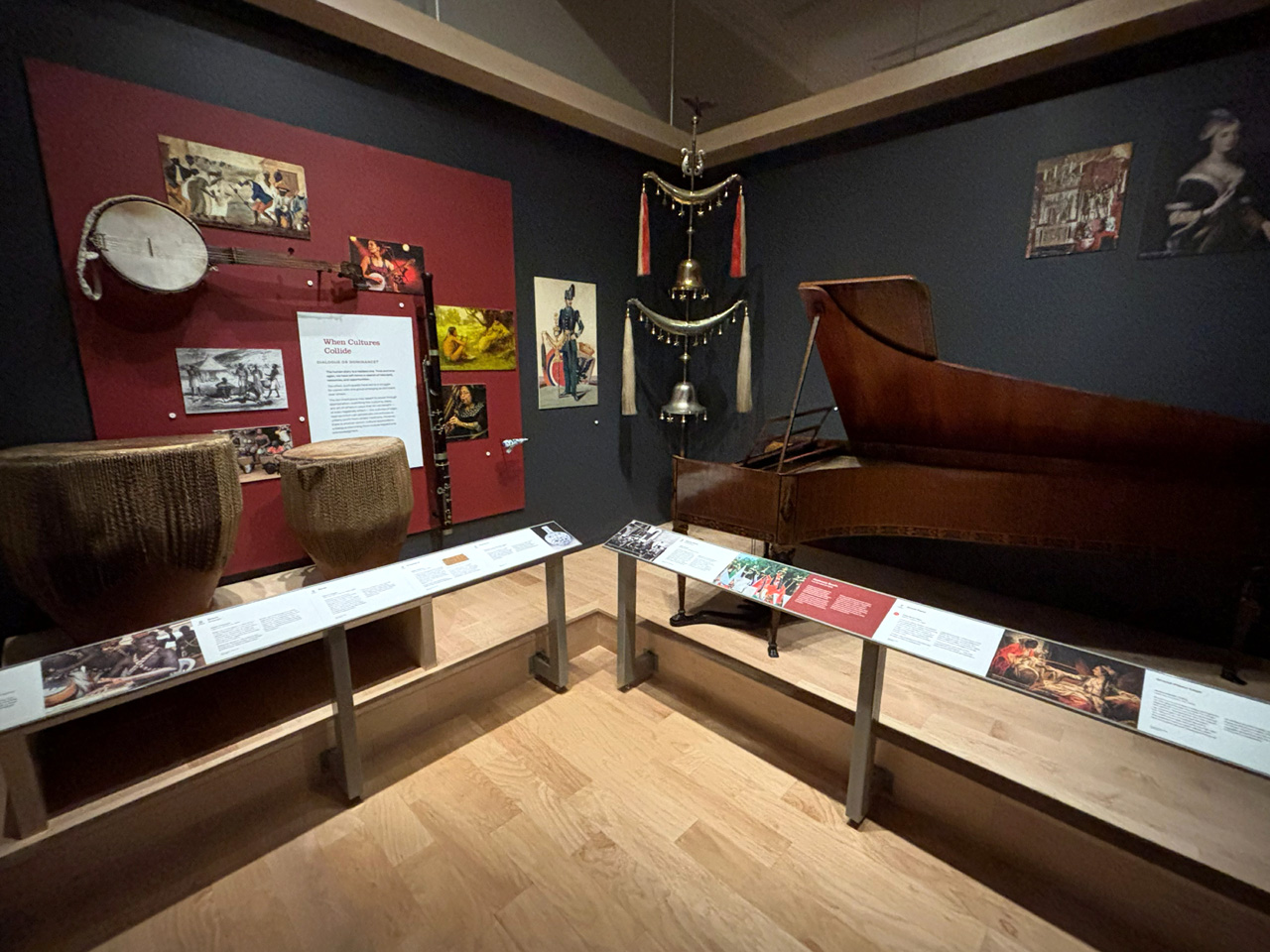
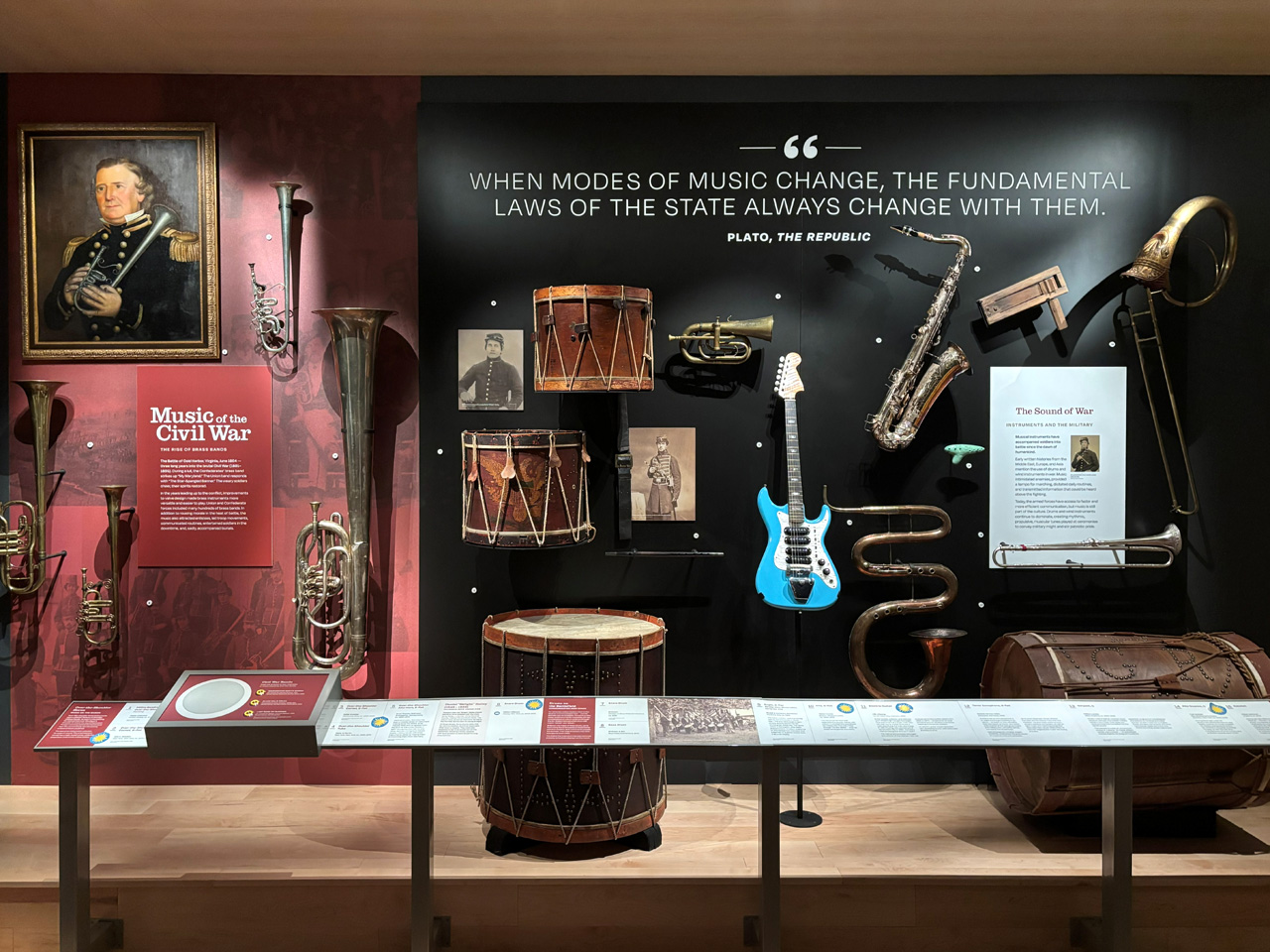
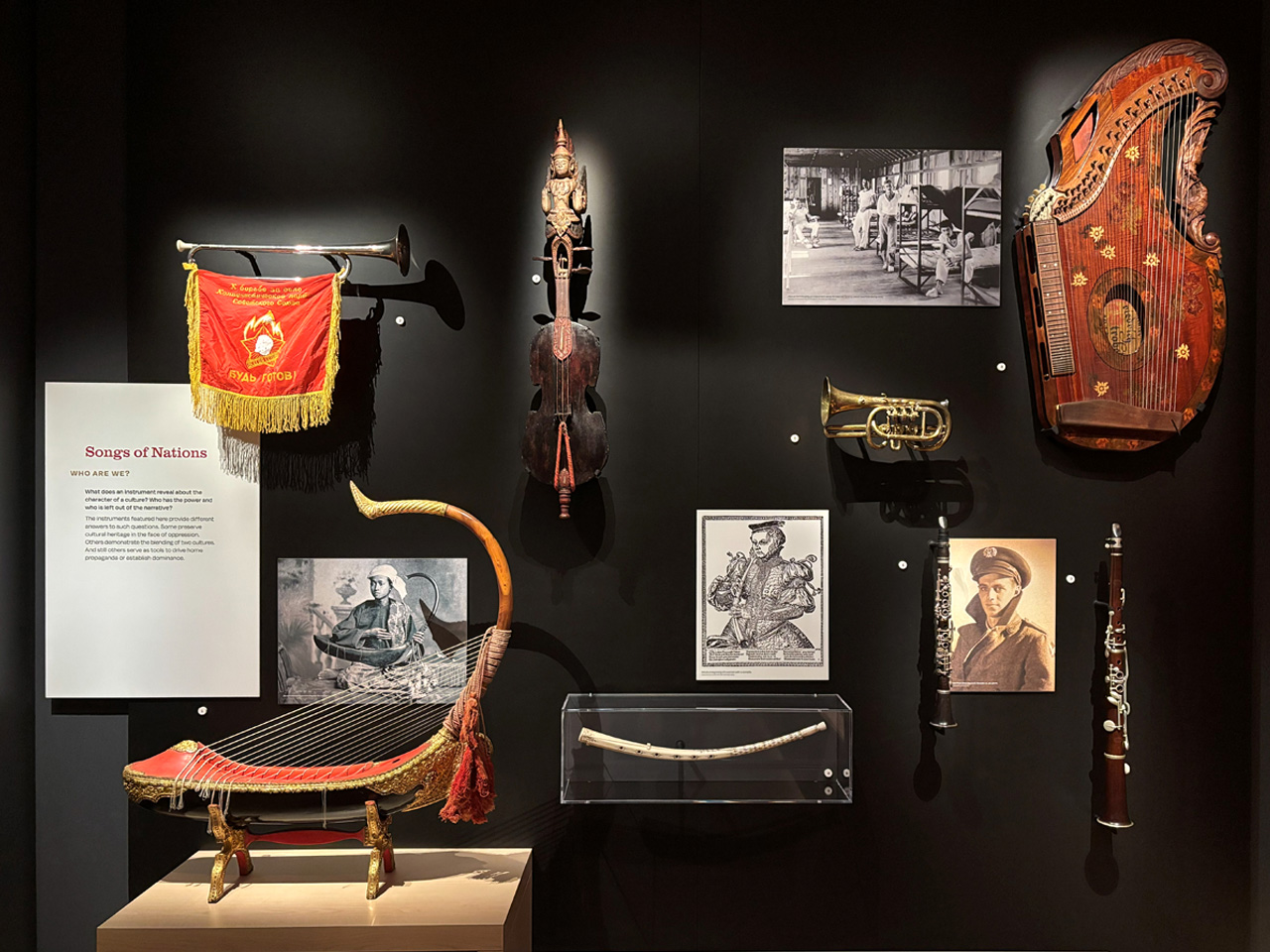
I’ll split the images and captions roughly into 3 sections: Friends (my peeps!), Papers, and Instruments (of the NMM). Actually, I think I’ll start with the latter, as the Museum is deep in the throes of its recent expansion. The research/conservator building and first floor of the public space is done; the latter space is very different from my last visit ten years ago (and truth be told, I miss so many instruments!). Here are overviews of the new first floor exhibits, in no particular order:
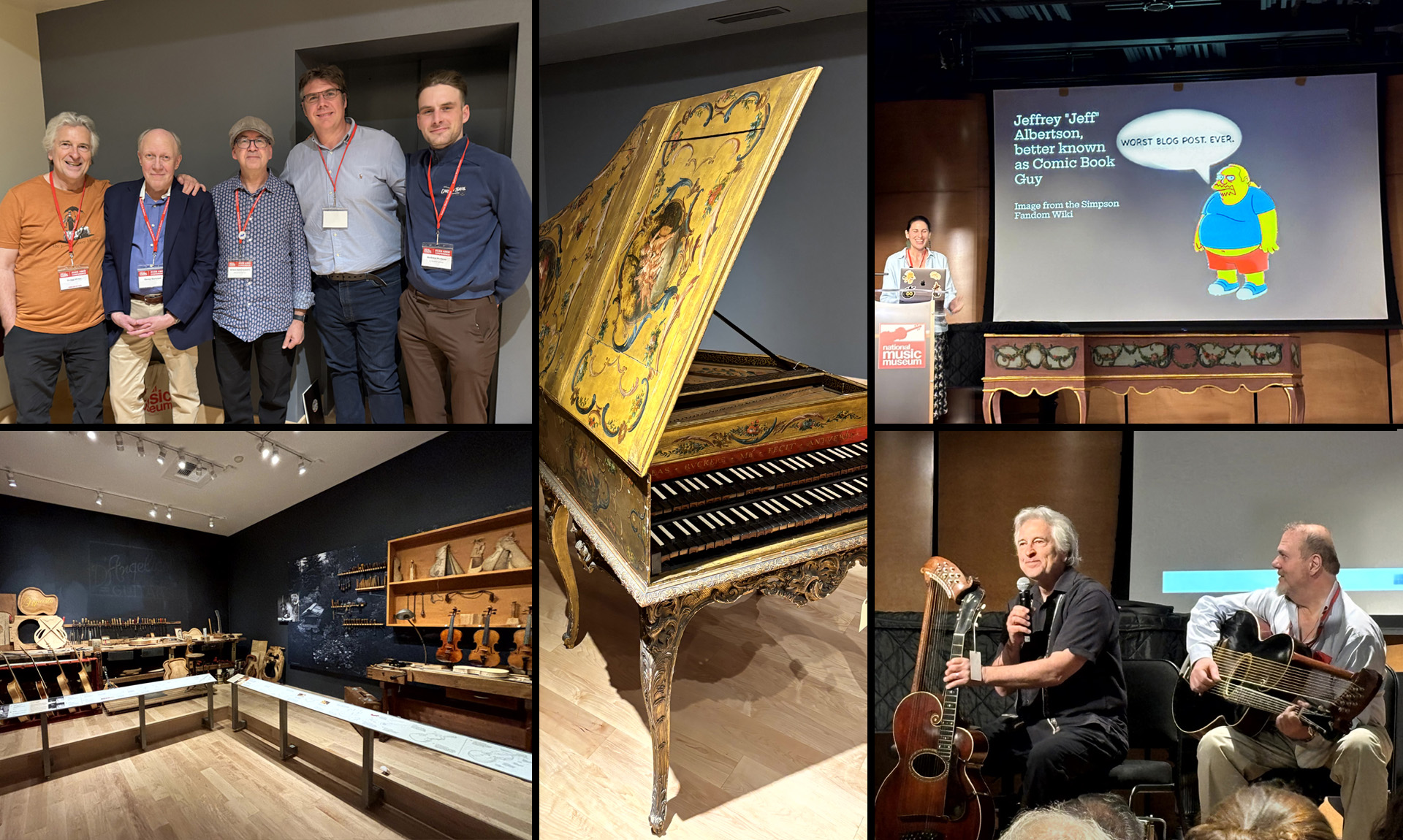
Above and below, the workshop of D’Angelico is again “recreated,” with instruments of his and protege D’Aquisto.
I was glad to see the rare early Gibsons (Orville and the later Manuf. Co.) given the center of the American guitar room.
The modern gamelan set with complimenting shadow puppets was a wonderful separate display room.
A number of us commented on the unique and imaginative gourd fiddle.
A nice way to honor their late director Dr. Peggy Banks while putting her vast CD collection to good use. I went home with several myself.
On now to papers (I took in as many as I good, tried to capture most apologies to those not included). I order of appearance throughout the three days:
Devanney Haruta (Brown U) would later win for best student paper for her new look at “Performance, Preservation, and Instrumental Ethics in Musical Instrument Museums.” She addressed questions about my OWN collection, so food for thought!
Another old friend, instrument restorer Emanuele Marconi is now director at the Berlin museum. He discussed museum practice of producing “facsimiles” of rare instruments, including those of collector César Snoeck (shown).
Patrick Dittamo (Chicago PhD student) continues his historical-to-modern crumhorn investigations.
OK, this was a challenge. It was also a surprise. To me.
Note to AMIS presenters: Ad libbing a paper will not be tolerated. Unless you have no choice.
If you remember my AMIS post last year, I did my paper on Gibson strings, concluding with the reveal that No One on Planet Earth Has Ever Heard a Gibson Harp Guitar Strung as Intended. Which is…gut. Strike that. Heavy gut. Oh, and I’m not talking just about the early scroll, glued-bridge Gibsons, I’m talking about the two that Matthew Hill and I are holding above – mid/late ‘teens “jazz-bridge style” Gibsons!
Well, Matthew was so blown away by my talk last year (their Gretsch Museum’s Gibson had old light steel strings on it), that he “vowed” to be the first to string one “authentically.”
Yeah, right. Good luck with that and keep me posted!
So, there I was, having just made my decision to go to South Dakota, when I get a cryptic note from Matthew. He’s doing it. He’s gonna string his in “gut” and compare it – live on stage – to NMM’s Gibson, strung (as we find all of them) with old light steel strings.
Oh, and I’m on the program.
It’s not like I wasn’t prepared. I’m joking. I was in NMM’s offices, seeing (and failing in any way to tune) each of the instruments in question an hour before our talk downstairs. “What Hath Matthew Wrought?” was the (Biblical level) question I was about to see – and hear – answered. Did I mention the “live audience”? Of “learned scholars?” Who were musicians and had “ears”?
As you can see from the image above, we were indeed (live) onstage. And we did present something (my mind wiped it from my memory as a defense mechanism). And we did actually pull something off. What that was will be explained later (very encouraging, but incomplete results due to a conflagration of unrelated issues…).
Suffice it to say that I hope to continue the (controlled) experiment on my own back here at home and hope to provide further, even more interesting, results. Stay tuned!
We’re now into concurrent sessions…upstairs, Fayrouz Osman gave an elaborate study of accordion practice in France. Below is a sample chart (so, no napping).
Followed by leading “Saxologist” (admittedly, he made up the term, so he’s the only one) Jake Goldwasser, examining one of the NMM’s Cecil Leeson instruments.
Before dinner, we were treated to a concert on four of the museum’s very special archtop guitars: 1988 D’Aquisto Avant Garde Prototype #1, 1970 D’Aquisto Excel made for Joe Pass, 1947 D’Angelico New Yorker, and Carl Kress’ 1933 Gibson L-5.
Demonstrating them was local guitarist Tim Snow. I quite liked his music, very reminiscent of our own harp guitar friend Dan Schwartz, who Tim used to play with in Minnesota. Unfortunately, while a fine fingerstyle guitar player/composer, his was the absolutely wrong style to demo these specific instruments. Still, a generous offering.
One never does this with a museum instrument, but Andrew Mullane was granted special permission to examine and hold Carl Kress’ personal Gibson. He was thrilled beyond words. I continue to urge my plucked string friends to consider joining (or just attending) AMIS, and our young guitar-playing/restoring/teaching friend from the Harp Guitar Gatherings had an incredible experience in so many unexpected ways.
After a communal dinner, many of us walked down to the main drag to elbow college kids out of the way to relax (mingle, converse, drink.
Up at the crack of dawn (or as early as we could crawl out of our beds), we got right back into it. Another talk on private collectors-to-museum collections, given by Sebastian Kirsch (new director at Vienna). An insider’s peek into the important and rarely-told history of this rarified world.
I’m going to splurge and give our next presenter three slides, as she profiled the stories of three “Regional Instrument Collectors and their Worlds.” This time, all private collections, as seen through the eyes of Lisa Beebe after interviewing various collectors (of all types of instruments) across the country. She chose William White and his Michigan Tuba Museum for her first victim.
Her next subject was Jim Bollman, whose first words to me upon visiting his unprecedented banjo collection a couple years ago were “So, what’s your exit strategy?” Lisa discussed Jim’s single-minded passion, successes and challenges.
Speaking of challenges, she ended with the Miner Museum. This appropriate slide (yes, she ended with a shot of the Simpson figures in my front office) accompanied my comments about why I personally shy away from the “collector” moniker. But Lisa, a true Star Trek nerd, nailed me. Her phone number is now blocked.
Chet Stussy (now completing his last year at UC Santa Barbera) did still another paper on a private collector’s holdings now in a museum (SB’s) – composer Henry Eichheim made fie Asian trips in the early 1900s to document music and instruments he might depict in his own musical works. After asking about the collection monograph that he mentioned in his talk, Chet very kindly gave me his last copy (below). Chet’s starting a year internship at the Met in the fall, so I expect to see him up here soon!
Gaia Saetermoe-Howard (on stage and onscreen in Tamil Nadu, India) gave a fascinating talk (and quick demo) of the pulang and kol, local reed instruments she learned to play by ear during her studies there (she’s a Baroque oboist in Boston).
Gijs Clement spoke about his internship at the NMM, restoring the soundboard of their important tangentenflügel. Whilst inside the rare keyboard, he was able to access the details to build a reproduction. Nice multi-tasking!
Friday evening’s pre-dinner concert on museum instruments (1785 French harpsichord by Jacques Germain and 1683 violincello by Francesco Ruggeri, Cremona) was a delightful German and French program by Elisabeth Wright, Jaap…

 点赞
点赞 收藏
收藏 点踩
点踩 分享
分享