Architectural determinism: how web2 primitives encode centralization

Note: This is a long form essay synthesizing my research and observations on web architecture and decentralization. I'm writing this primarily to organize my own thinking, but I'm sharing it publicly because I believe these ideas matter. I'm not claiming novel invention as most of these primitives have existed for years already. Also, I'm certainly not claiming to have all the answers. If you spot errors, faulty reasoning or have alternative perspectives, I genuinely want to hear them. This is exploratory work and not gospel, the conclusion contains a recap of the claims of this essay. Consider it an invitation to discussion.
Disclaimers: 80% my thoughts & ideas, 20% formatting & structure using gemini-2.5-pro. Title image by nano-banana.
I believe that the architecture of the modern web not only makes meaningful decentralization difficult but that it also structurally precludes it. As a consequence, seemingly "decentralized" systems built on top of modern web architecture inevitably collapse toward centralized intermediaries. I'm proposing an alternative set of primitives, or ways to think about the problem, that when properly composed, could make decentralization the path of least resistance rather than maximal pain.
Centralization gradient
Systems built on the modern web stack exhibit a consistent pattern: regardless of initial design intent, they converge toward centralized architectures over time, this almost feels like an architectural inevitability.
Every major protocol built on web foundations has followed this trajectory:
Email was designed federated but now it's a Gmail/Outlook duopoly (>80% of users)
Web hosting was designed distributed but today it's an AWS/GCP/Azure oligopoly (>60% of infrastructure)
DNS was designed distributed but Cloudflare resolves >20% of web traffic
etc...
I believe that these outcomes are not coincidental but that the architecture of these systems contain structural properties that make centralization energetically favorable.
Architectural centralization
A system is architecturally centralized if:
Functioning requires third-party infrastructure that could observe, modify, or deny service
Optimal performance or reliability creates pressure toward shared infrastructure
Correctness relies on trusting entities outside the end-to-end path
P2P (peer to peer) operation requires significantly more complexity than client-server
A system may be logically decentralized (example: federation) while remaining architecturally centralized if these properties hold.
Current modern web primitives
Location based addressing (DNS/IP)
The primary way of accessing the web today is by using what's called location based addressing. You click a link and you get a result: resources/things are identified by network location ( domain.com/resource )
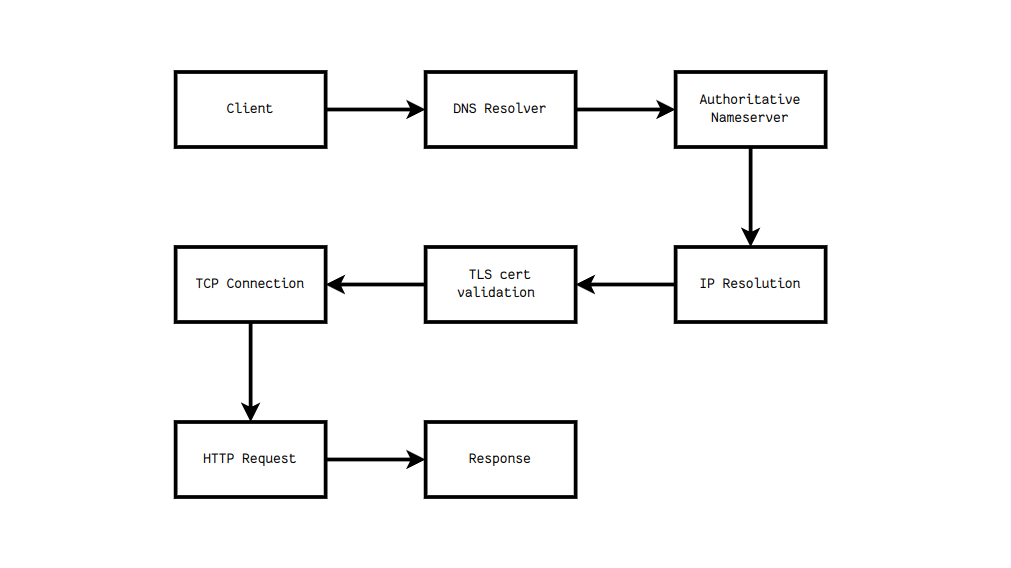
The request flow goes something like this (very roughly):
In this flow, there are 4+ mandatory intermediaries (DNS, CA, ISP, origin server) and more than 3 trust assumptions along the way (DNS hierarchy, CA system, server identity).
The consequences of this primitive:
You cannot verify the content, a same URL can return different content. So no caching guarantees, no integrity verification, no offline operation. Additional layers can be used for mitigation (SRI, signatures, etc) but these are optional and never used in practice
The server sending the response needs to be always on, if the origin is offline, the resource is unavailable. This means, 24/7 infrastructure costs, DDoS vulnerability, geographic latency, the mitigation of which is usually involving a CDN intermediary (read: more centralization)
The performance is degraded by physical distance to the origin (geographic coupling). Users farther away have worse experience, so distributing the infrastructure becomes a way to make the experience better (thus, economies of scale favor large provider)
Domain owners can change content, revoke access, track usage (censorship vector, surveillance vector)
These consequences combined posit that in location addressed systems, optimal resource availability requires resource replication across multiple locations. Replicating infrastructure exhibits economies of scale. Therefore, providers with larger infrastructure networks have structural cost advantages, creating convergent pressure toward consolidation.
Stateless Request/Response (HTTP)
Using HTTP, each request is independent, there is no session state in the protocol.
A HTTP exchange goes something like this (way simplified):
Request: Method + Headers + Body Response: Status + Headers + Body
(so no persistent connection, no identity, no state)
The consequences of this primitive:
Since applications need state and HTTP provides none, implementations usually leverage cookies, tokens, server-side sessions, resulting in applications usually implementing state management differently. This is a direct centralization vector because the session state is stored server-side, and thus the user bound to specific server pool.
There is no identity layer in the protocol, so implementations leverage simple credentials, oauth flows, session tokens, which again, every application implements however they want. The usual mantra is "don't roll your own auth", so what devs do is they externalize it to identity providers. Another centralization vector.
All requests are observable by network path, observers including ISPs, DNS resolvers, potential MITM... Of course a mitigation here is TLS encryption but as we'll see later, current ways of doing it aren't any better and introduce trust assumptions too.
So all that combined, it's safe to say that in stateless protocols, applications requiring state must implement state management at the application layer. Application-layer state management cannot provide end-to-end guarantees without trusted intermediaries. Therefore, stateless protocols force trust delegation to intermediaries.
In fact, the state must be stored somewhere, the options being: (1) client-side (tamperable), (2) server-side (requires trusting server), (3) distributed consensus (requires coordination protocol). Options (2) and (3) both require trusting entities beyond end points.
Interpreted execution (JavaScript)
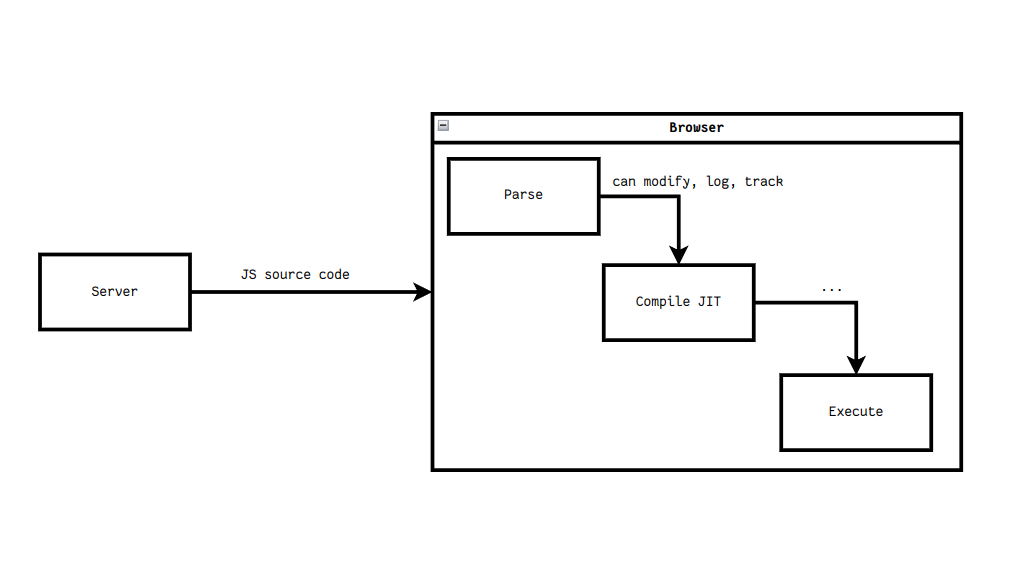
Execution code is delivered as simple text and interpreted by browsers at runtime.
How JavaScript ends in your browser:
The consequence of this primitive are:
Code execution is non-deterministic and hinges on browser version, JIT optimization, API availability, extensions etc
Users cannot verify what code will execute because the source can be obfuscated, minified, or even completely different per request (note: even with SRI, you can't verify execution, only source)
Browser vendor (third party) controls the runtime so they can deprecate APIs, add tracking, modify behavior (manifest V2 example), and there is absolutely no recourse
Tabs share browser context, bringing with it cross-site tracking, fingerprinting etc...
Put together, in interpreted execution models, code verification is impossible without trusting the interpreter. The interpreter is provided by a third party (browser vendor). Therefore, code execution requires trusting a third party.
Certificate authority trust model (TLS/PKI)
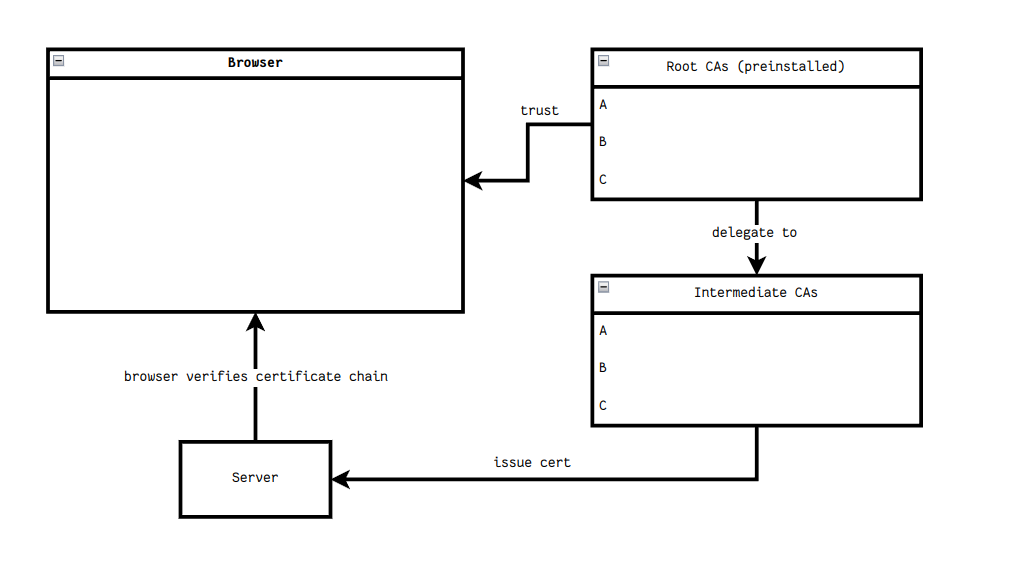
This is the big one, trust is delegated to certificate authorities.
How it works:
The consequence of this primitive are:
All CAs must be trusted equally, meaning any CA can issue cert for any domain. Certificate transparency might mitigate this but doesn't solve it once and for all. There is a certain trust transitivity involved.
CAs are subject to national jurisdiction, governments can compel CA to issue malicious certs. We've seen this happen.
Certs rotate, there is no no identity persistence and it isn't possible to verify "same entity as last time". The result of this is usually that the identity is conflated with the domain name (controlled by the registrar) and not the cryptographic key ensuring th…

 点赞
点赞 收藏
收藏 点踩
点踩 分享
分享