Essay | Is It Time to ‘Liquidate’ the Study of Sociology?

Why are some people richer than others? What drives societal ills or ignites a social movement? Why aren’t people having more kids?
These are some of the most important questions facing the country today. The answers shape our lives, polarize our politics and supercharge our culture wars.
Sociology, the discipline tasked with pursuing the answers, would seem well poised to take these issues on. For decades, its analyses informed policy on issues ranging from criminal justice to immigration to urban development. It introduced groundbreaking concepts like “white-collar crime,” “gentrification,” “unintended consequences” and “cultural capital.” At various points, sociologists proposed and critiqued affirmative action, inspired and lambasted welfare reform, diagnosed and dismissed the breakdown of the nuclear family.
Yet today, sociologists are embroiled in an ideological and existential battle of their own—one that is increasingly public and at least in part of their own making. The study of people, in other words, has a people problem.
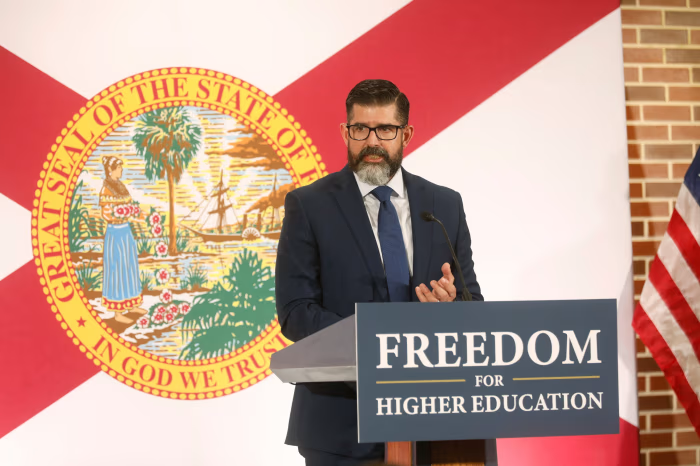
In 2023, Florida’s then-commissioner of education Manny Diaz, Jr., homed in on sociology as culture war enemy No. 1. It had been “hijacked by left-wing activists,” he said, leading the state to remove introduction to sociology from its general education curriculum at all public colleges and universities across the state.
The American Sociological Association promptly denounced the move as a blatant mischaracterization of the field and an effort to needlessly politicize a bastion of social science. Yet that same year, the ASA’s president described sociology to its members as “a form of liberatory praxis” that is “currently undergoing a renaissance as antiracist, decolonial, feminist, queer and transnational theorizing lead us to more inclusive insights.”
Meanwhile, one contingent, Sociologists for Palestine, is boycotting the ASA’s annual conference (theme: “Disrupting the Status Quo”) next month. The reason? The ASA refused to authorize a vote on their own proposed boycott—of Israeli academic institutions. This has drawn a counterpetition and a backlash so fierce, the Chronicle of Higher Education called it a “War for Sociology.”
Already, ASA membership is in steep decline, with membership at 9,400 down from 14,900 at its peak in 1972.
Now, sociology, long derided by many academics in humanities and the “harder” social sciences for its perceived squishiness, is being criticized from within.
An increasingly vocal group of sociologists say the discipline’s cratering reputation is especially vivid when compared with economics, psychology and political science, all of which can seem more serious and pragmatic—gateways to law school or business school or an advanced degree in healthcare. Whereas those disciplines often use cutting-edge methodologies, sociology seems dusty and theory-laden. Even sociologists acknowledge that students are often drawn to the major because they’re afraid of math or are sold on sociology as a means to activism.
Starting in 2013, the number of students majoring in sociology dropped from 31,000 to 21,000 in 2024. One ZipRecruiter poll found sociology among college grads’ most regretted majors.
It’s tempting to write all this off as another sorry example of academia gone off the rails. But the implications of sociology’s implosion extend well beyond the confines of higher education, driving everything from what kids learn in secondary school, to how workplaces and cultural institutions function (or become dysfunctional), to which ideas inform legislation.
Sociology is in many ways the mother of all social sciences, she who hath birthed dozens of disciplines ranging from criminology to postcolonial studies to ethnic studies.
Unlike psychology, which operates on an individual level, sociology considers human phenomena in the aggregate and often over the long run. By examining trends in educational attainment, labor force shifts and the effects of social media and AI, it can offer a grand-scale picture of societal health.
With roots dating to 19th century European theorists like Max Weber and Émile Durkheim, sociology coalesced professionally in America during the Progressive Era. Many consider W.E.B. Du Bois the father of American sociology. Though trained as a historian, Du Bois, later a founder of the NAACP, used sociological methods to document the impact of slavery and Jim Crow on Black Americans.
Du Bois’s dual role as both a social scientist and an activist also inspired some of the fiercest debates over sociologists’ role. In 1896, Du Bois defined sociology as “the discovery of truth” and warned that if scholars “dally with the truth to humor the whims of the day” they “hurt the cause of scientific truth the world over.” Traditionally, sociologists interpreted his words as drawing a hard line between studying the truth and acting on it. But sociologists in the scholar-activist mold note that Du Bois also believed in using sociological truth in the pursuit of activism, promising in 1906 to “never cease to protest and assail the ears of America.”
Sociology is fundamentally shaped by who is doing the work, many sociologists argue. Didn’t early sociologists claim to prove white peoples’ supremacy over other races based on supposed empirical evidence? Later research by conservative and neocon sociologists informed policies like broken-window policing, racial profiling, welfare reform and colorblindness. For many contemporary sociologists, steeped in postmodern theory, the insistence that a single truth exists is a fallacy and objectivity itself, a tool of oppression.
Social phenomena are always shaped by power politics and competing interests, according to Lisa Hajjar, who studies law and conflict with a focus on Israel/Palestine and chairs the department of sociology at UC Santa Barbara, one of the biggest sociology departments in the country. “What I always tell students is that when it comes to the complex world that people live in and make and change, there is no single Archimedean point of truth,” she says. “There are just better and worse ways of presenting information and making arguments.”
According to an increasingly dominant contingent of sociologists, sociologists also need to engage with the public more forcefully.
“As bodies, we need to speak to the public when we need to interrupt public harm or advocate for the public good,” Saida Grundy, a professor of sociology and African-American and Black diasporic studies at Boston University. She compares the ASA to the American Heart Association, which uses its research and authority to advance messages intended to improve public health, providing guidelines and issuing warnings. Shouldn’t the ASA and its individual members similarly deploy their research to inveigh against injustice and advance social change?
In her view, sociology has an obligation to engage with the world. Sociologists who study immigration, for example, should speak out against ICE.
“I believe in sociology as a weapon,” Grundy says.
Other sociologists say the impulse toward activism is compromising not only the aim and use of sociological research, but the quality of the research itself. In lieu of engaging in objective analysis, the discipline is shaping, even bending, the truth.
Critics of the activist-scholar model frequently cite Christian Smith’s 2014 book, “The Sacred Project of American Sociology,” as persuasively diagnosing a discipline increasingly corrupted by what amounts to a quasi-religious activist impulse.
“Sociology’s sacred project champions emancipation, autonomy, equality, justice, inclusion, diversity, open-mindedness, progress, tolerance, and cosmopolitanism,” Smith wrote. “In the end that sacred project actually tends to produce sectarian narrowness, exclusion, uniformity, silencing, self-censorship, lack of debate, the negative sanctioning of nonconformists, and the debilitation of rigorous thought.”
Smith quit the ASA arou…

 点赞
点赞 收藏
收藏 点踩
点踩 分享
分享