What lurks beneath the volcanoes of Jupiter's moon Io? NASA's Juno probe just took a peek

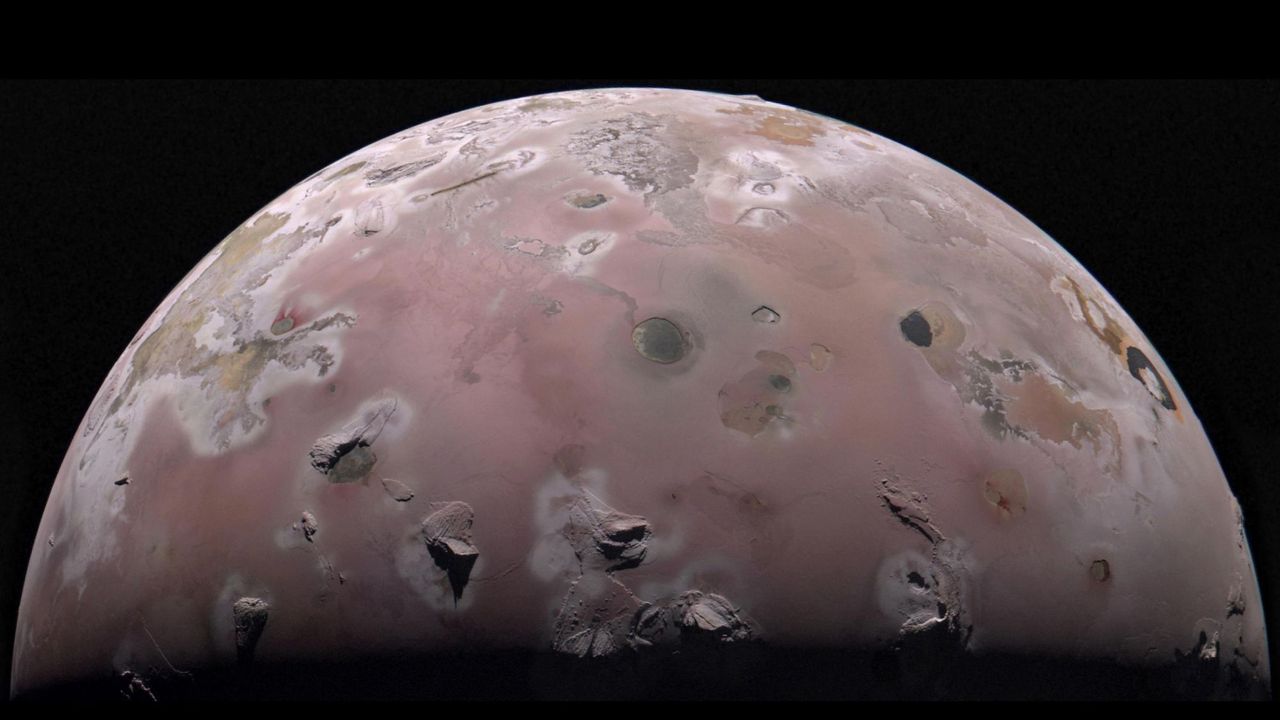
Scientists have measured temperatures beneath the surface of Jupiter's volcanic moon Io, offering the first-ever glimpse of the hidden heat driving the most volcanically active world in the solar system.
During close flybys of Io in late 2023 and early 2024, NASA's Juno spacecraft turned its Microwave Radiometer (MWR) instrument toward the moon, probing roughly six to 20 feet (two to six meters) beneath its surface. Originally designed to peer through Jupiter's thick clouds, the instrument instead revealed a powerful new way to study how heat moves through planetary crusts, according to a statement from the space agency.
"The surprising discovery that we could see below a rocky moon's surface has important implications for studying Earth's volcanoes," Scott Bolton, coauthor of the study and Juno's principal investigator, said in the statement. "Juno has taught us that if we look with an MWR-type instrument near a volcano on Earth, we might see a similar signature in the subsurface temperature gradient, providing new information on how terrestrial volcanoes work."
Until now, researchers had relied almost entirely on infrared observations, which detect only the temperature of Io's surface. By probing several feet underground, Juno has revealed how heat moves through the moon's crust for the first time.
The measurements showed temperatures rising by more than 40 degrees Fahrenheit (22 degrees Celsius) just a few feet below the surface — far more than sunlight alone could explain. Juno's subsurface heat map also revealed localized regions of elevated heat, with temperatures measuring between 18 and 36 degrees F (10 to 20 degrees C) warmer than the surrounding terrain, according to the statement.
Juno's observations uncovered another surprise, too. Despite being known for its towering mountains and active volcanoes, much of Io's surface appears remarkably smooth and composed of unusually low-density material. Researchers think the moon is blanketed by porous layers…

 点赞
点赞 收藏
收藏 点踩
点踩 分享
分享