Introducing Lightcone Commons

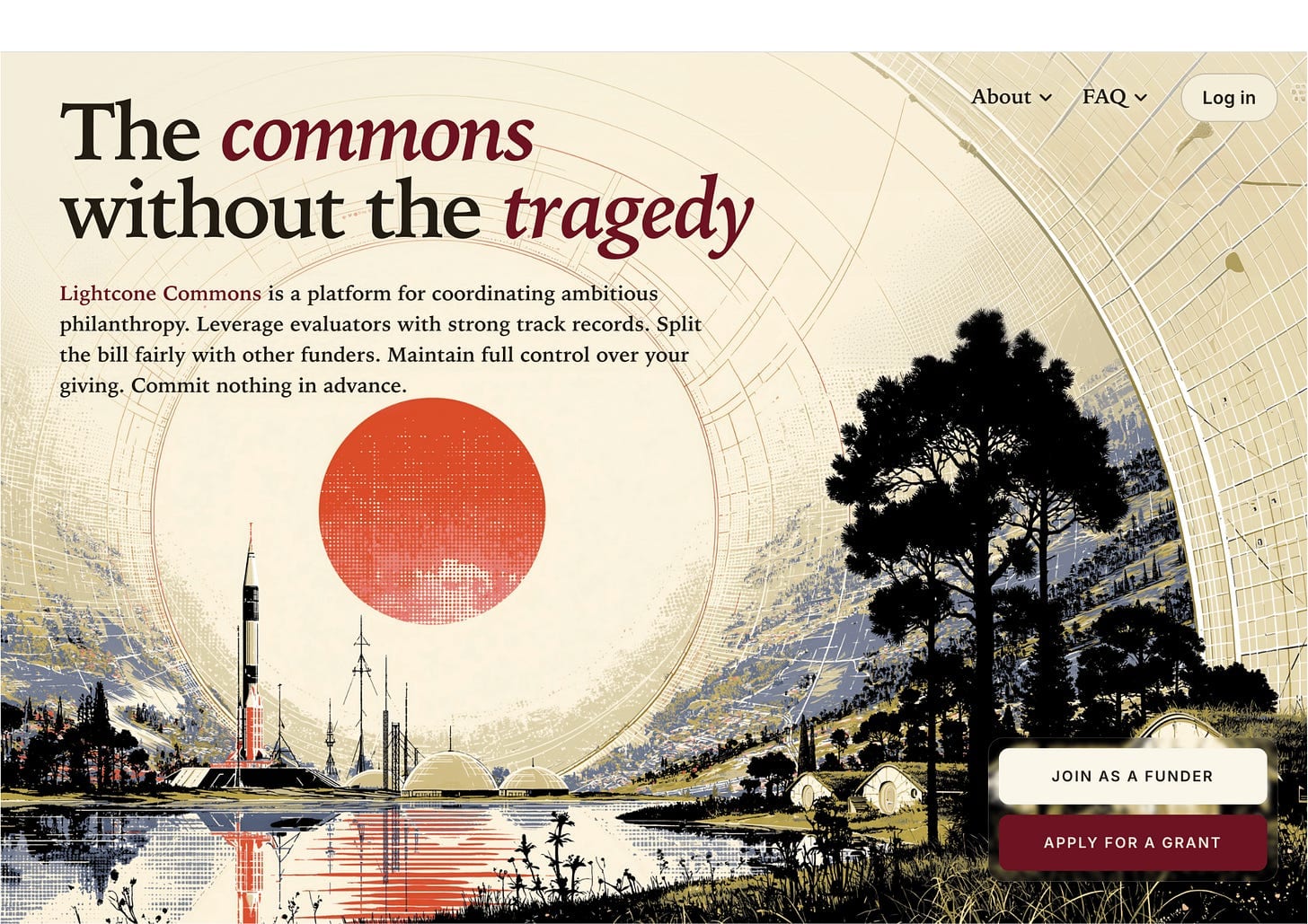
Oliver Habryka is proud to introduce Lightcone Commons, a new funding platform for coordinating large-scale ambitious philanthropy. Now with Opus 5.
I believe Lightcone Commons is a strong implementation of an urgently needed and excellent idea: A coordinated one-stop shop and neutral platform for charitable funders to coordinate their giving. This complements the existing Survival and Flourishing Fund, which I have now been a part of four times, and which this post will also discuss.
I will be participating in the first round as one of the evaluators. They anticipate the first round will involve ~$20 million in grants.
Any nonprofit, for-profit or individual is welcome to apply.
The only restriction on participation is trust that necessary confidentiality will be upheld. Funders can choose whose evaluations to follow or fund organizations directly in any combination, and can bring their own evaluators into the process with them to complement those recruited by the core process. Anyone giving away $100k+ this year is welcome to participate as a funder.
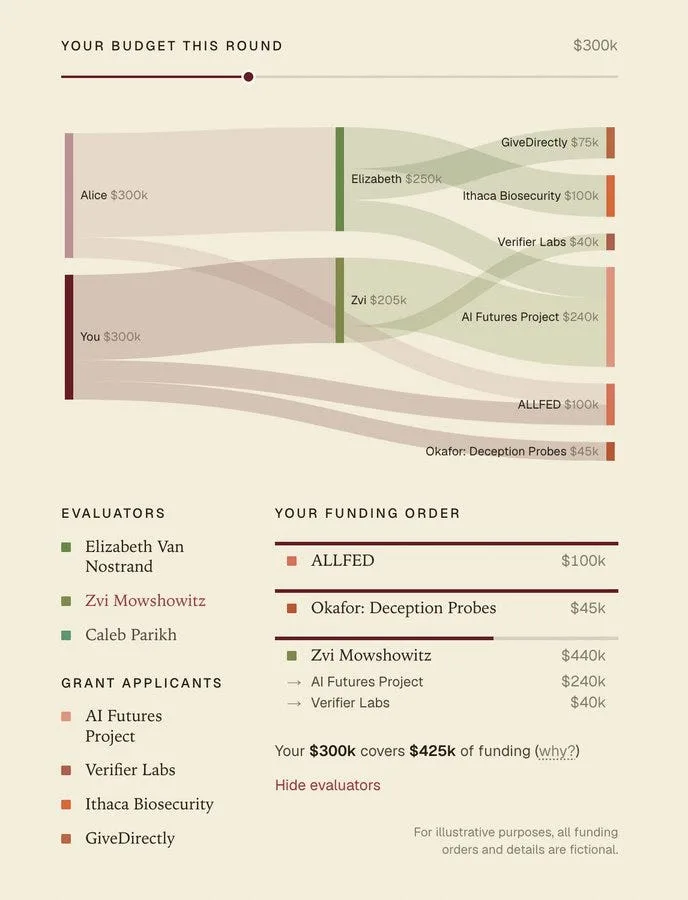
Lightcone Commons uses the S-Process, which was introduced and refined for Jaan Tallinn’s Survival and Flourishing Fund, together with SFC, Andrew Critch, and others. Funders with overlapping preferences split funding.The announcement post explain how it works. Everyone gives a curve defines how much they value marginal funds given to each organization, and then everyone takes turns giving to their highest value remaining funding opportunity. As Oliver says it is not perfect, but it is good enough that you can play honestly and things will go well. There are ways to somewhat game the system, but not without it being obvious you are doing so, which defeats the purpose.
Evaluators get a 2% fee of money that goes through them, and the flatform takes 3%, in exchange for handling everything including the logistics.You can apply for funding here. You only have to answer four questions, and can live edit your responses, how much more you share is up to you:
What are you working on?
What would you do with funding?
Who is involved?
Logistical details about your project.
Applications for the first round close August 23, 2026 and recommendations will be made by roughly October 23, 2026, plus some projects will get faster funding if needed. The second round is anticipated to resolve in January 2027.
I especially want to encourage funders to participate. I think this is pretty great.
Again, more details are in the full announcement post.
Why Now: The Funders Are Coming
Quite a lot of new money is going to enter the philanthropic realm soon, including from those who can sell in the Anthropic and OpenAI IPOs.
A lot of those people are going to want to fund important things that I and many of you care about, including but not limited to mitigating risks around AI.
By default this will go badly, as Oliver explains:
Oliver Habryka: Finding high-quality philanthropic opportunities is difficult. Potential grantees are incentivized to pitch themselves aggressively, often making evaluation adversarial. Many of the most effective grants are small. Information about grantees is scattered across the internet, and it is often very hard to tell how much room for funding an organization has.
Successfully giving away many millions of dollars without falling prey to grifters, confidence games, or plain bureaucratic conformity, is a great challenge that the vast majority of philanthropists fail.
When faced with these problems, many funders ask family members or other trusted long-time friends to manage their giving. But misalignment between a philanthropist and their foundation is common, and philanthropic foundations rarely manage to attract world-class evaluator talent.Oliver Habryka: Most philanthropists fail to give away their money. Building your own foundation takes years. Grifters and bureaucratic momentum introduce huge inefficiencies. The world’s best people don’t want to evaluate grants for you in-particular. lightconecommons.com tries to fix this.
I’ve helped distribute over $150M in grants through my work on the Survival and Flourishing Fund, the Long Term Future Fund, the AI Risk Mitigation Fund, and Lightspeed Grants. Lightcone Commons is built from the lessons I learned doing that work.
On top of that, the new funders will mostly be very busy people whose expertise is in very different problem areas. And those people, if they are wise, will be very worried that the moment they start looking to give their money away, this will destroy their epistemic environment and ability to have normal friendships and conversations.
That’s the main reason for this post: To lay out that this new thing exists, that it is exciting, and that you should consider participating.
The Default Outcome Is Not Good
The default is that they end up with the default in such situations, which is:
Allocating a lot of money directly to legible, safe choices.
Allocating a lot of money to regranting organizations that are highly bureaucratized and conservative, are worried about negative selection, and that make correlated mistakes.
Having their decisions captured by those with different interests.
Falling prey to predators in the ecosystem, of various types.
Missing weird opportunities and small opportunities.
Often not giving a lot of the money away for a long time.
Fail to coordinate well with other funders, leading to a lot of deadweight loss.
A general version of the S-Process, and a one-stop shop that solves all the logistical barriers and makes execution easy, can mitigate these problems.
It also offers us the opportunity to improve upon the existing S-Process, as instantiated in the Survival and Flourishing Fund (SFF).
My hope is that, if this process proves successful, not only can it serve as a way to greatly accelerate and improve allocation choices by a lot of the new funders and a few known existing ones, it can perhaps ‘escape containment,’ and be used by more mainstream funders, potentially including their foundations. I think that would be very good, even if they use their own evaluators and mostly fund cause areas I do not feel are so important.
My worry is that this could damage my own epistemic environment and those of other evaluators. This has importantly not happened with my participation in SFF, so I have become less worried, but I will very much be on the lookout.
SFF does an unusually job of having everyone coordinate around not gaming the system, and shutting out those who attempt to do so, which we will need to carry over into Lightcone Commons.
Report From SFF 2026
Back in 2021, I reported on my first round of participating in the Survival and Flourishing Fund.
Since then, the core process has stayed the same, except for introduction of a preliminary application evaluation round.
Even with everything that has changed, the first sections of my old post still seems highly relevant, before it gets into specifics.
After my other rounds, I wrote The Big Nonprofits Post in 2024, and then The Big Nonprofits Post 2025 a year later. I plan to issue a third edition soon for 2026. These posts focus on offering guides on where to consider donating money.
SFF in 2026 had better tools, including AI tools, which helps a lot. We also had more funds available, and much better funding opportunities. I would have been happy to see my choices funded for vastly more money than the round is going to have in it.
That’s the good news.
The most important bad news is that alongside that, we have a huge torrent of applications, without an accompanying increase in ability to invest time, or adjustments in how the process works, and the process is under a lot of strain. Things continue to move relatively slowly, whereas life is coming at us increasingly fast.Zack has his own post criticizing the process. I think his specific criticisms were valid, and there are many things that can improve.…

 点赞
点赞 收藏
收藏 点踩
点踩 分享
分享