Trump is stocking the government with his personal lawyers

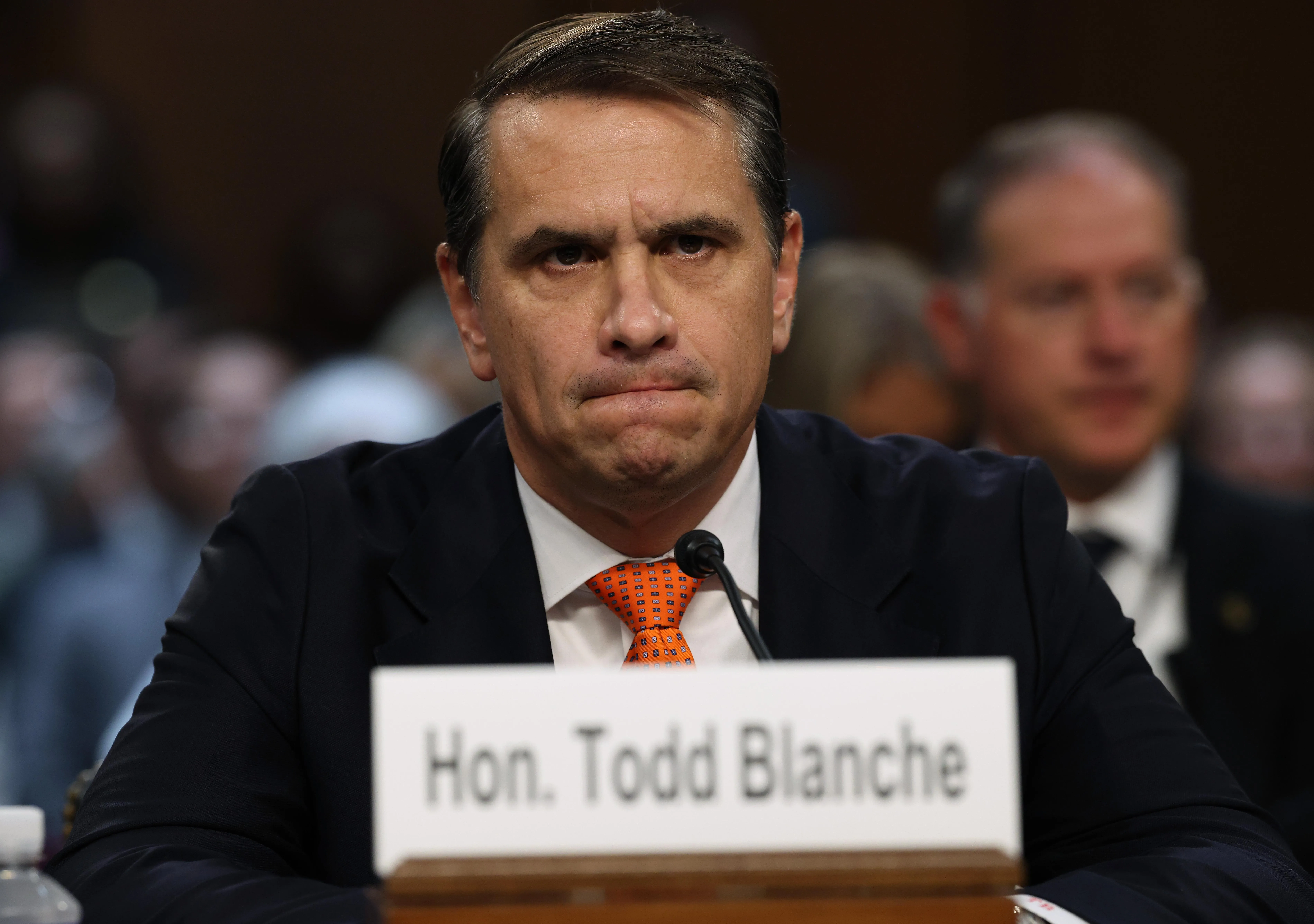
Acting Attorney General Todd Blanche appears at his confirmation hearing in front of the Senate Judiciary Committee on Capitol Hill July 15, 2026 in Washington, DC. | Win McNamee/Getty Images
There was an unintentionally revealing moment in acting Attorney General Todd Blanche’s confirmation hearing last week. After Sen. John Kennedy (R-LA) asked Blanche whether he and President Donald Trump are friends, the leader of the United States Department of Justice replied, “ I’m his lawyer,” before correcting himself and saying he “was his lawyer.”
Blanche previously defended Trump in three criminal cases brought while the president was out of office, but he is emphatically not supposed to be Trump’s lawyer right now. As acting attorney general — Blanche currently leads the DOJ because the attorney general’s job is vacant and Blanche is the Senate-confirmed deputy attorney general (DAG) — Blanche’s client is the United States, not the person who happens to occupy the White House.
But it’s easy to see why he misspoke: Blanche has largely acted as Trump’s hammer since he was confirmed as the DOJ’s No. 2 official, overseeing numerous prosecutions of Trump’s perceived enemies. Now Trump wants to promote him to the DOJ’s top job — a sign of Trump’s confidence in his former criminal defense lawyer turned personal enforcer.
It’s unusual for a president to put his own defense lawyer in such a powerful position — indeed, it’s unusual for a president to have a criminal defense lawyer at all. But Trump has a long string of attorneys who’ve defended him and his companies against an equally long string of criminal allegations ranging from tax fraud, to falsifying business records, to illegally taking classified documents, to charges arising from his failed attempt to steal the 2020 presidential election.
And he’s put at least five of those criminal defense lawyers in top federal jobs.
Trump’s decision to turn much of his criminal legal team into powerful government officials matters for two big reasons. The first is that two members of that team, Blanche and Solicitor General John Sauer, are leaders within the Justice Department. Next to the military, there is no more fearsome government institution than the DOJ, which has the power to arrest people and try them for federal crimes.
The DOJ is supposed to exercise this authority with restraint — and often with restraints imposed by the Constitution itself — but Blanche has used the Justice Department’s power against Trump’s political enemies who appear to have committed no crime and removed constraints on Trump and his Justice Department, all while Sauer has worked consistently to convince the Supreme Court to remove other constraints on Trump.
Meanwhile, three of Trump’s former criminal lawyers, Emil Bove, Justin Smith, and Matthew Schwartz, now have lifetime appointments as US Court of Appeals judges, placing them one rung on the judicial ladder down from the Supreme Court. The judiciary, of course, is the branch of government that is supposed to prevent the president from breaking the law, so every Trump loyalist appointed to this branch weakens the remaining legal constraints on Trump and his administration.
Trump, of course, isn’t the only president to place close confidants in the Justice Department or the federal bench. President John F. Kennedy famously named his brother attorney general. President Lyndon B. Johnson appointed Abe Fortas, who represented him in a 1948 election dispute, to the Supreme Court in 1965.
But Trump’s decision to place someone willing to pursue his personal vendettas in charge of the Justice Department is, at the very least, a break with post-Watergate norms established to prevent the DOJ from becoming a political weapon. And Fortas, who resigned in disgrace after fewer than four years on the bench, is more of a cautionary tale than a model of good governance.
Although the current Supreme Court is dominated by conservative Republicans, some of these justices do break with Trump on questions that divide the Republican Party — such as whether Trump should unilaterally impose high tariffs on many nations. But if Trump gets to turn his personal cronies into justices, that could change quickly. A judiciary controlled by MAGA loyalists means that all remaining checks on Trump’s authority could end. Many of his former-lawyers-turned-appointees are already working to make an unchecked Trump administration a reality.
How are Trump’s former personal lawyers already reshaping American legal norms?
Smith, who worked on the Trump v. United States immunity case, was confirmed last month. And Schwartz, who worked on the false documents case that led to Trump’s conviction, joined the bench last week. So there’s not much to say about these two men’s record in federal office — yet.
But Blanche, Bove, and Sauer have all displayed ruthless cunning in their efforts to advance Trump and his causes.
Blanche has been DAG since March 2025, a role that oversees the federal government’s criminal prosecutions and its 93 regional US attorneys’ offices. He’s led the entire Justice Department since April, after former Attorney General Pam Bondi — another of Trump’s former personal lawyers — left office.
So Blanche oversaw several dubious federal prosecutions targeting people Trump perceives as enemies, including criminal proceedings targeting former FBI Director James Comey and current New York Attorney General Letitia James. There’s also evidence that Blanche has played an unusually direct role in the Justice Department’s decision to bring meritless charges against prominent Democrats.
In May 2025, for example, Newark Mayor Ras Baraka, a Democrat, showed up at an ICE detention facility in his New Jersey city and asked to tour it. He was briefly let inside the gate, where he was confronted by about a dozen law enforcement officers and asked to leave, which he did.
But then one of these officers received a phone call. A video, later submitted to a federal court, shows the officer turning to his colleagues after the call and announcing, “We are arresting the mayor right now, per the deputy attorney general of the United States.” That deputy attorney general, of course, was Blanche. (In a September court filing, DOJ confirmed that officers arrested Baraka “ after consulting with the Deputy Attorney General.”)
Yet, despite Blanche’s apparent decision to personally order Baraka’s arrest, the DAG forgot to check whether Baraka had actually done something that could support criminal charges. The mayor was only charged with misdemeanor trespassing, and those charges were dismissed two weeks later. At the court hearing formally dropping these charges, a federal magistrate judge admonished prosecutors for “using the immense power of the government to pursue weak cases or to make examples without sufficient cause.”
Blanche also unsuccessfully attempted to establish Trump’s $1.776 billion “anti-weaponization fund,” which would have been used to distribute money to Trump’s allies — including, potentially, Trump supporters who participated in the January 6 attack on the US Capitol. Although the fund appears dead after it received bipartisan pushback in Congress, a DOJ press release announcing the fund said it was “established” by the attorney general, a role performed by Blanche, and that the fund would be administered by five people chosen by Blanche.
Before Trump took office, Bove was Blanche’s law partner. Shortly before Bove joined the bench, he briefly served as principal associate deputy attorney general — essentially the DAG’s top deputy, which meant that Bove was Blanche’s right-hand man. In that role, he was often described as Trump’s “ enforcer.”
Bove spent only about half a year as Blanche’s lieutenant, but he managed to spark a mini-revolt in one of the Justice Department’s most prestigious offices during his short tenure. After Bove ordered the DOJ to dismiss corruption charges against then-New…

 点赞
点赞 收藏
收藏 点踩
点踩 分享
分享