The breakthrough changing how Americans donate organs


Instead of death being declared because the brain has stopped functioning, in DCD, death is declared after circulation ceases and the heart stops beating. | Miguel Porlan for Vox
This story was originally published in The Highlight. To get access to member-exclusive stories like this every month, become a Vox Member today.
Emily Hoffman was walking home from lunch in the Pittsburgh neighborhood of Squirrel Hill in February 2023, when a driver turning left struck her on the crosswalk.
Hoffman was 34. By the time paramedics arrived on the scene, she had gone into a traumatic cardiac arrest. They strapped her onto a machine that delivered automated chest compressions and rushed her to UPMC Presbyterian, a major trauma hospital in Pittsburgh.
Over the next several days, doctors performed multiple surgeries, kept Hoffman on a ventilator, and waited until she was stable enough for an MRI. The scans showed multiple strokes and severe traumatic brain injury. She was alive, but her family understood that she was not going to make a meaningful recovery to a life she would have wanted.
The next Thursday, a week after the crash, Emily’s parents and her sister Beth Hoffman met with the care team and decided to remove ventilator support to allow her to die naturally. Organ donation came up only afterward. Emily was already a registered donor, and Beth knew it was what her sister wanted.
For most of the short history of organ transplantation, Emily would not have been the usual kind of organ donor.
Almost all transplanted organs once came from patients who died in one specific and rare way called brain death, in which the brain has irreversibly stopped functioning, even as machines keep the heart beating and the organs supplied with oxygen. Brain death is extraordinarily rare, but it happens often enough to create a workable — though far from sufficient — supply of life-saving organs.
But Emily was not one of the brain-death donors. Even after the strokes and brain injury, she still had some reflexes. She was dying, but not brain dead.
Her donation followed a different path, one that has transformed American transplantation in the last decade. It is called donation after circulatory death, or DCD. Instead of death being declared because the brain has stopped functioning, in DCD, death is declared after circulation ceases and the heart stops beating. Many more people die this way than by brain death.
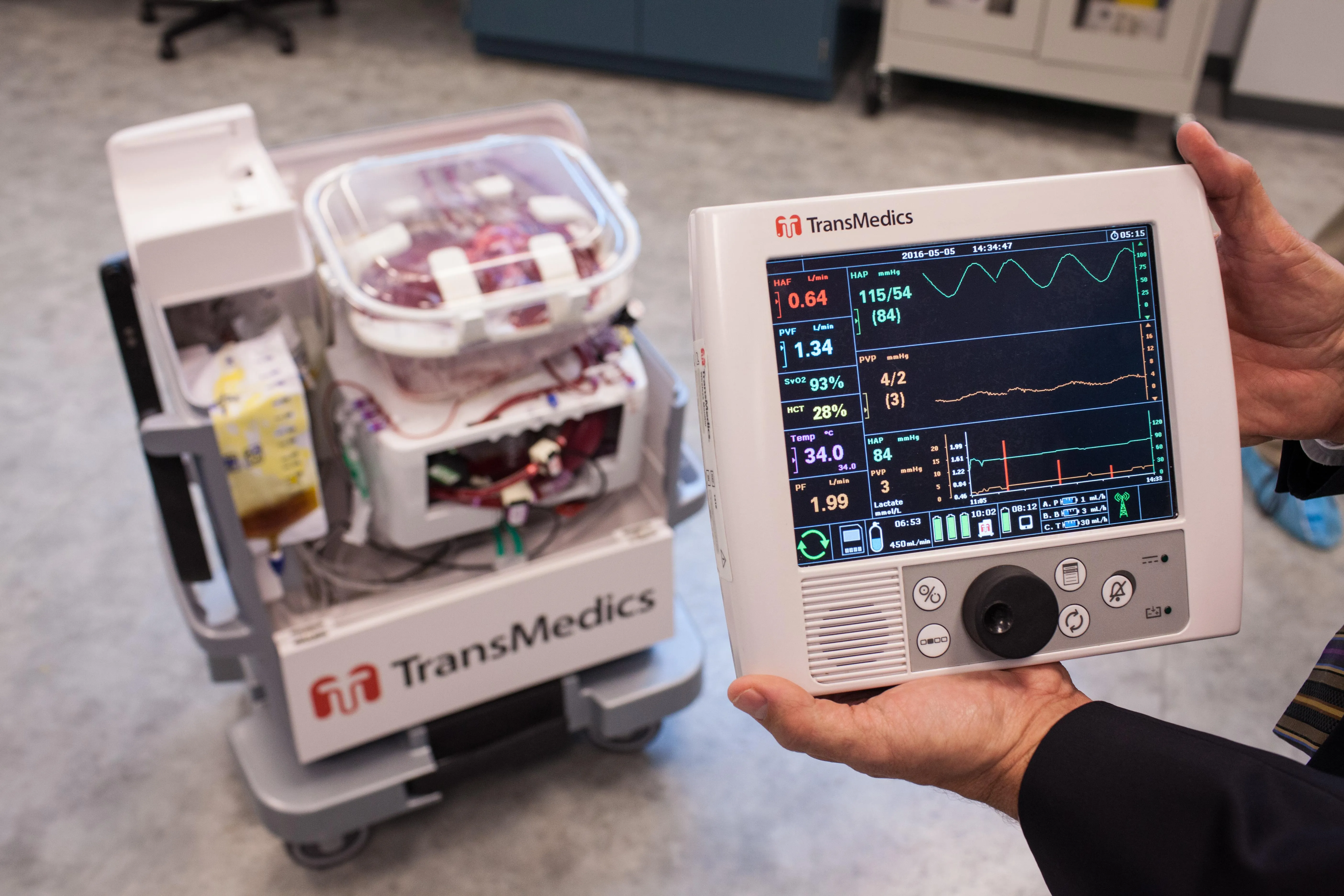
Death by circulatory criteria has been legally recognized since the 1980s, but for decades, doctors rarely recovered organs this way, because, once blood stops moving through the body, organs begin to deteriorate within minutes. In recent years, however, new machines and surgical techniques have helped change that, giving doctors the ability to preserve organs outside the body, making DCD far more viable.↗ Explore the interactive version of this chart.
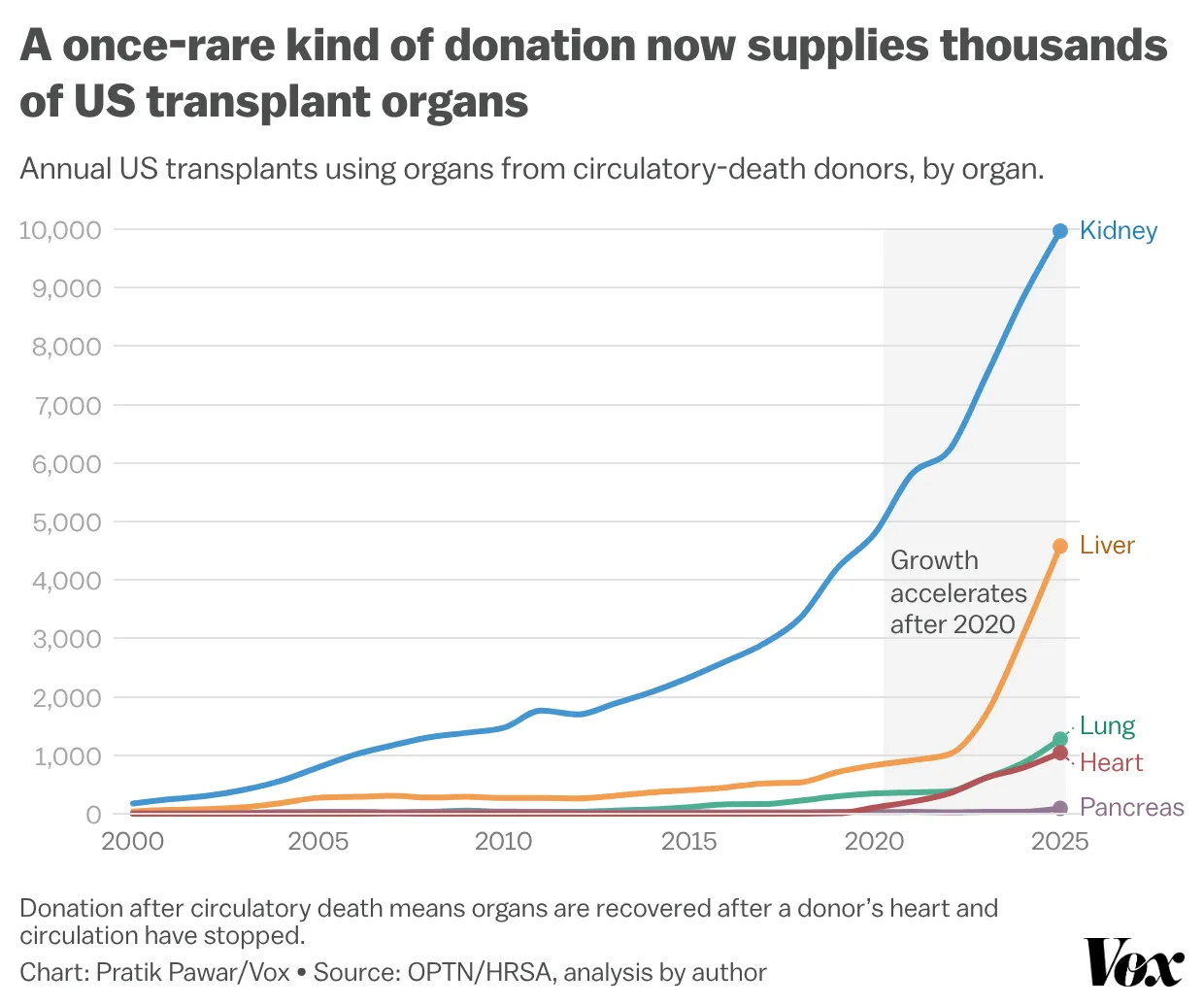
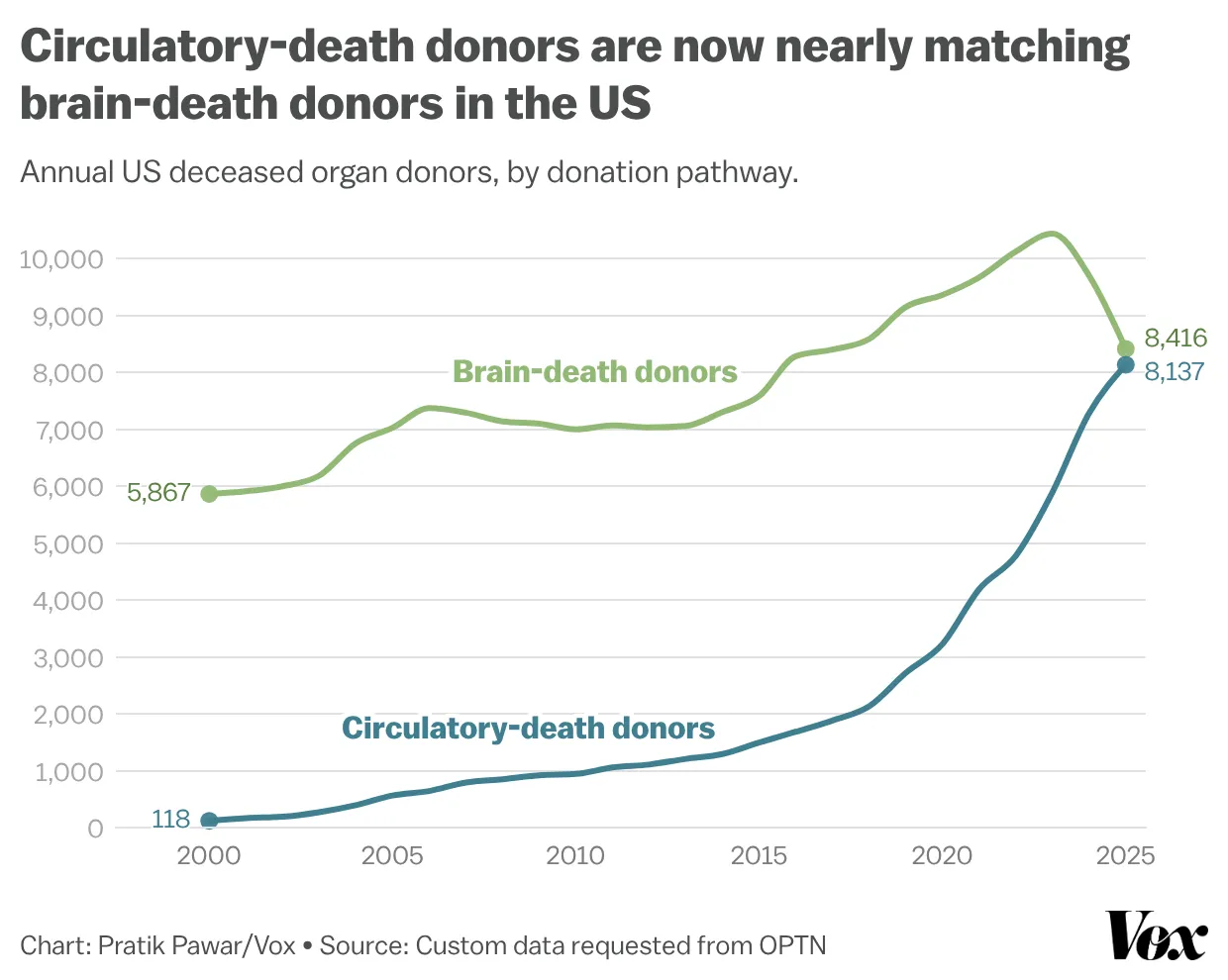
Hoffman’s donation is hardly an outlier anymore. In the last decade, DCD has gone from a rare practice to something that now accounts for nearly half of all organ donors who have died in the United States. In 2000, DCD donors supplied just 219 organs (kidneys, livers, lungs, hearts, and pancreas combined) to the transplantation system in the US. In 2025, DCD brought in close to 17,000 organs. (Most transplanted organs, about 85 percent, come from dead donors, though some organs, most often kidneys, can also come from living donors.)
That growth has saved lives, but it has also pushed transplant medicine into an unusually sensitive moment: the time after a family has decided to let their loved one die but before death has actually occurred.
In brain-death donation, a patient has already been declared dead before the possibility of donation is raised with the family. Because most brain-dead donors are on ventilators, with machines supplying oxygenated blood to their organs, transplant teams can take their time with the donation process.
DCD doesn’t offer that same cushion. Because organs deteriorate so quickly after circulation ceases, the work of donation — the testing, matching, surgical teams flying in — has to be set in motion once the family has decided to withdraw life support but before the patient has died.
This is where the tension in DCD begins. The process pushes transplantation into the narrow interval between that decision to let someone die and the moment death occurs. It creates a situation with almost no parallel in medicine: one set of hands caring for the dying, even as another prepares to recover and transplant their organs.
The medical system tries to manage that complexity with a strict procedural sequence. First, hospital doctors and family conclude that no treatment will bring the patient back to a life they would have wanted. Only then, and only from a separate team, does the word donation come up. The firewall is in place so that the need for organs never shapes the decision to let someone die.
“Ethically, you want to make sure that those two are uncoupled,” said Wade Smith, director of the Neurovascular Service at the University of California San Francisco.
But as DCD has scaled up, more weight is put on that narrow interval. What was once a rare event is now routine in hospitals across the country, carried out by teams with different levels of experience and overseen through rules that can vary from one place to another. At the same time, the organizations that handle organ donations are under new federal pressure to acquire and distribute more organs from eligible donors.
DCD has saved thousands of lives by making donations possible from patients who once wouldn’t have been donors. Hoffman’s donation improved several lives at once: Her kidneys went to two men, her liver to a third recipient, and her corneas helped give sight to a nine-month-old baby.
But its growth has also made the fragile period before death more consequential: how families are told, which steps can be taken while the patient is still alive, how consistently hospitals and organ donation teams follow safeguards, and who has the authority to stop the process if something feels wrong.
When DCD was still rare, these questions stayed at the edges of transplantation. Now, they are moving towards its center, as a lifesaving practice becomes a routine part of how Americans die and donate.
Key takeaways
In the past decade, there’s been a boom in the number of organs available for transplantation in the US.
Much of that growth has come from a little-known donation pathway called donation after circulatory death, or DCD.
DCD allows patients who are dying but not brain-dead to donate organs after their life support is withdrawn and their circulation stops.
That boom has raised questions about medicine’s ability to manage the boundary between life and death.
The breakthrough
Modern transplantation is a relatively young field, only about 70 years old. And from the beginning, transplantation has depended on the novel medical achievement of keeping organs functional after a person had been declared dead.
The mechanical ventilator, developed in the 1950s, made that possible. It could keep a body breathing, and its heart beating, even after the brain had stopped for good. That created, for the first time, a situation where patients were deceased by every older measure, even as their organs were still functional.
Surgeons were initially wary of recovering organs, largely because the legal lines between life and death had never been clearly drawn. Then, in 1968, a Harvard committee proposed a definition of brain death. By 1981, a model law gave states the language to recognize two ways of legal death. Your heart and lungs could stop for good (circulatory death) or your entire brain could (brain death). Today, every state recognizes some version of that framework.
With those lines in place, transplant teams could work with more confidence, and brain death turned out to be close to ideal for them. Because a ventil…

 点赞
点赞 收藏
收藏 点踩
点踩 分享
分享