Tech Names Find Investors Much Harder to Please


The earnings season is confirming worries that the technology rally had gone too far, with investors now harder to please and reluctant to buy into rising profit estimates.
The technology sector has stalled after powering the stock rally in the first half of this year. Chipmakers have been hit particularly hard by profit taking, with the MSCI World Semiconductor index down 6% in July. A reprieve for software names hasn’t canceled that out, with the sector up a modest 1%.
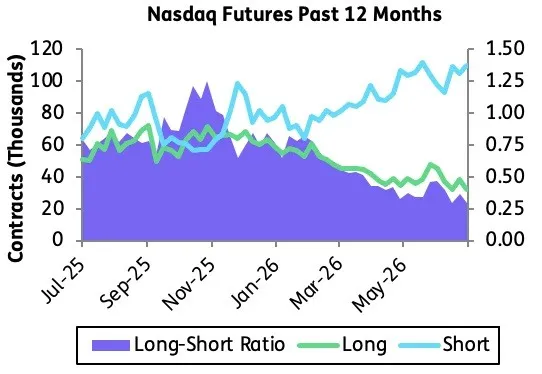
“Traders are bailing on tech,” wrote EPFR Global analysts including Winston Chua. As evidence of this, they cite the long-short ratio on Nasdaq 100 futures, which plunged to a 17-year low on July 14, down 63% in a year.
Beneath the index level meanwhile, the market’s varying treatment of areas within the tech universe becomes evident. For hardware makers, strong results have failed to boost stocks, with the good news about the benefits from AI well priced for now. But for software, meeting consensus estimates has often been good enough, given heightened investor worries that the sector is at risk from sophisticated AI tools.
STMicroelectronics NV was the latest chipmaker to be punished severely, after its outlook came in below sell-side estimates. Its stock fell 18% on Thursday. Close peer Texas Instruments Inc. dropped 3% in the US, despite an upbeat forecast. Along with other examples in Europe and Asia, these reactions showed investors paring their positions in a crowded sector and cashing in year-to-date gains.
“Capital has rotated aggressively out of AI-related stocks, reflecting growing concerns about infrastructure overcapacity, uncertainty around the return on the massive investments made, stretched valuations, and potential demand moderation,” said Algebris Investments senior equity analyst Simone Ragazzi. “The delayed OpenAI IPO and intensifying competition from Chinese models have added to this wall of worry.”
Still, Ragazzi notes fundamentals continue to look strong. Analysts are increasing estimates for capital expenditure by the so-called hyperscalers, a key metric for the sustainability of the AI trade.
Given the high market expectations, sell-side consensus has been somewhat “irrelevant” this reporting quarter, said Ken Hui, a director at Bakewell Alpha Fund. That’s led his team to reduce positions or even exit stocks such as Taiwan Semiconductor Manufacturing Co., BE Semiconductor Industries NV and STMicro before their earnings, despite long-term positive views on the names. “We may add back if the stock prices correct to more attractive levels,” he said.
On the software side, though, sentiment could hardly be more different. After the group was bombarded with profit warnings, including recently from the likes of IBM Corp. and Accenture Plc, any software company able to meet estimates this quarter will likely be rewarded by investors.
That has played out in Europe for Dassault Systemes SE, which rose on Thursday despite an in-line set of results. SAP SE also climbed in US trading after cloud revenue met estimates.
Investors have turned highly selective within tech and some mild rotation has begun. The sharp underperformance from hyperscaler and Magnificent Seven stocks has started to raise eyebrows, especially given most companies in the group continue to generate very strong earnings at the same time as cranking up their capex programs.
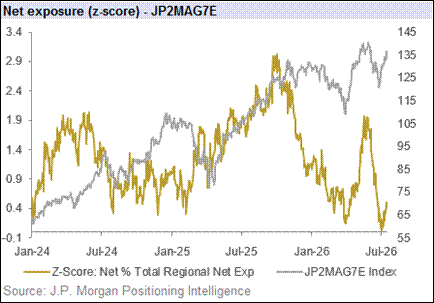
JPMorgan Chase & Co. derivatives strategists including Adam Halmi said the long/short ratio on the cohort is at the 25th percentile since January 2018, meaning hedge funds are as underweight this group as they’ve been in years. The net exposure z-score has collapsed toward zero, while gross exposure has been cut aggressively.
“Positioning is the real story going into earnings,” Halmi said. They recommend buying a call spread on the the Magnficent Seven basket. “You don’t need to pick the single best earnings print — you need the group to broadly not disappoint, which is a lower bar given how washed-out positioning is.”