Half of Students Now Get A’s, But Actual Achievement Is Declining


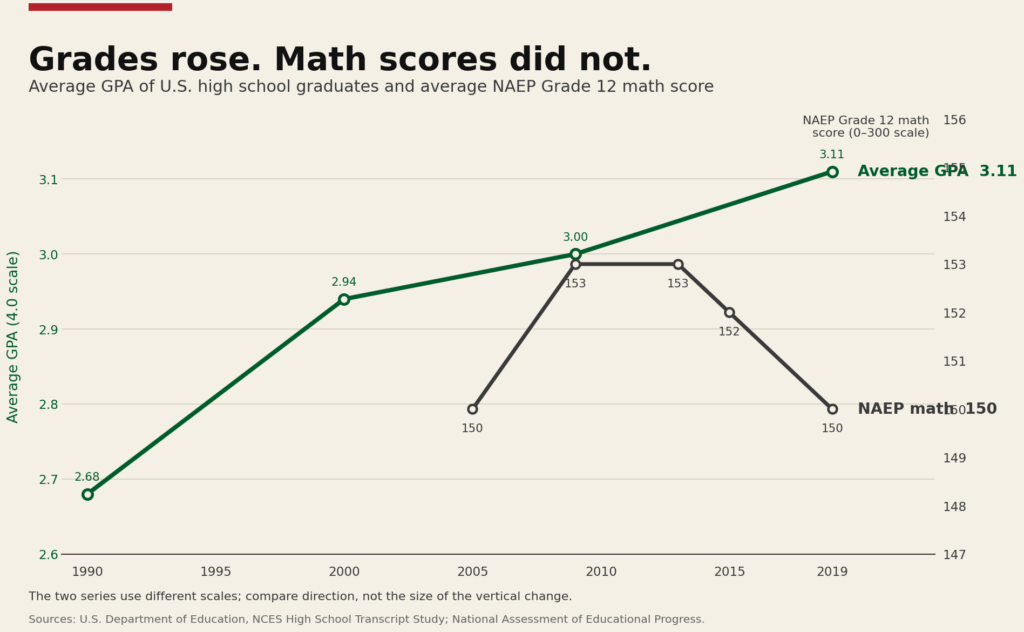
As recently as 1995, a child’s straight-A report card meant something specific. Still relatively rare, the feat indicated a child had worked hard and was learning and retaining information at the expected grade level. Parents would congratulate their little scholars over dinner, take them out for ice cream, and quietly calculate the damage of a college tuition bill.
If your child comes home with a straight-A report card in 2026, there may still be cause to celebrate. But grades have changed in ways a discerning parent should understand before they load up the car for a run to Baskin-Robbins.
When Every Child Is Above AverageHalf of all seniors graduate now with grades in the A range (up from 39 percent in 1990), making it by far the most commonly awarded grade. But state-administered proficiency test and SAT and ACT scores decline year after year.
Once upon a time, grades were at least a nominally objective measure of academic merit, in the sense that they equated roughly to a percentage: an A meant a student got 90–100 percent of the work correct, a B meant they got 80–89 percent correct, and mastering less than half meant a failing grade. And more importantly, there were far fewer incentives for a teacher to misrepresent them.
In the twenty-first century, grades are inflated as standard practice. Grades evolved from relatively standardized metrics of knowledge into heavily inflated, subjective signals between adults and institutions. This shift — driven by consumer-model schooling and faculty incentives — actually harms students.
For years, the headlines have been full of reports of students getting good grades but failing miserably at actual academics. Grade inflation may be even more common in wealthier schools, driven partly by demanding parents.
In 2025, a student in Connecticut graduated from high school with a 4.0 GPA, then turned around and sued her district because she couldn’t read. Later that same year, the story broke that UC San Diego, one of…

 点赞
点赞 收藏
收藏 点踩
点踩 分享
分享