Upward Mobility Is a Better Measure of Justice Than Income Equality


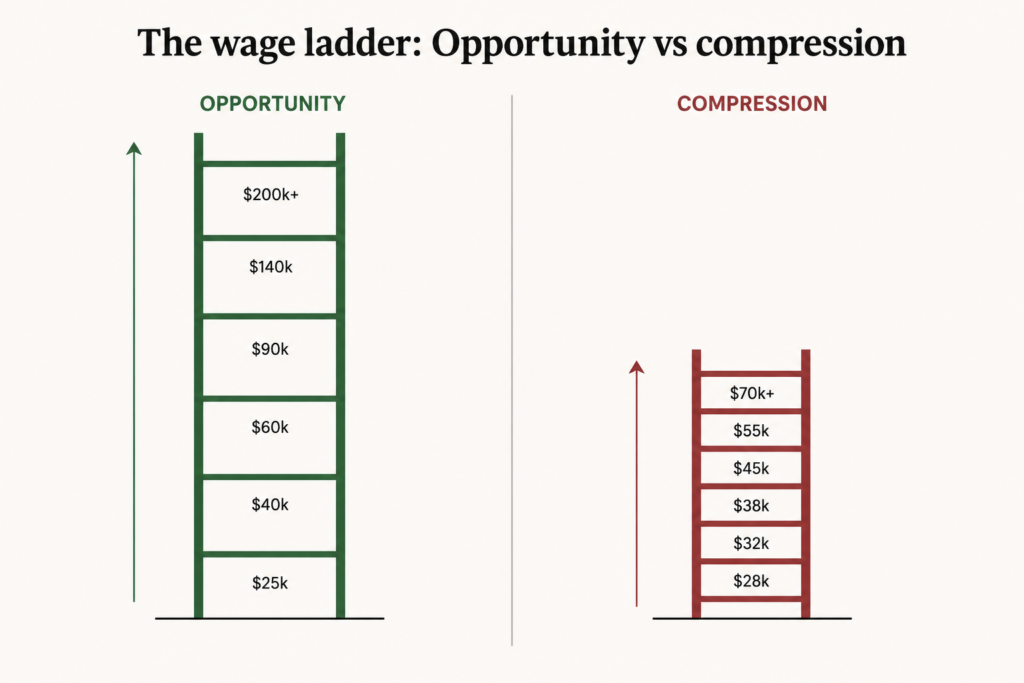
A free society should be judged less by who becomes wealthy than by how easily people can improve their circumstances under impartial rules. Who gets wealthy matters less than how.
Income inequality is dominating a national news landscape primed for questions of affordability, contrasted with ever-growing private fortunes on the other. Socialists in the New York Mayor’s treat wealth concentration as one of America’s defining political problems. Debate erupted over Elon Musk’s growing fortune, accompanied by familiar declarations that America should never permit its first trillionaire. A $30 million wedding and a sweeping “ housing affordability law.”
As another national campaign season begins, including some unapologetically redistributionist platforms, Americans should expect to hear still more about “income inequality.” Candidates will promise to narrow it, activists will measure it, and commentators will treat it as a proxy for economic justice.
But income inequality, while politically useful, is a poor measure of economic health. By itself, it tells us surprisingly little about whether an economy is flourishing or failing. More often than not, it distracts from the question that actually matters.
The Real Metric is Mobility
A free society does not merely permit unequal outcomes; it guarantees them. That is not principally because people differ in intelligence, industriousness, or luck, though they do. More fundamentally, they differ in what they want.
Some willingly exchange higher salaries for flexibility, especially balancing with care tasks. Others endure longer hours, greater stress, or years of additional education in pursuit of higher earnings. Some choose to relocate or remain in expensive metropolitan areas because the labor market rewards them accordingly. Others leave those same cities for lower costs of living, accepting slower wage growth in return for larger homes, shorter commutes, or proximity to family. Increasingly, adherents of the FIRE…

 点赞
点赞 收藏
收藏 点踩
点踩 分享
分享